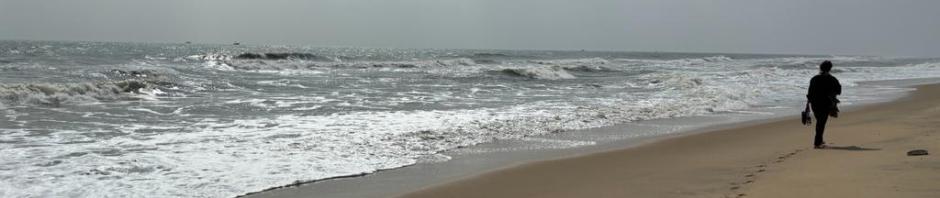

My 60th birthday, walking the beaches of Tamil Nadu, India.
When I lived in LA in the early 2000’s, I interviewed a 100 year old woman for an oral history project. she was going to turn 101 the following month. Julie was raised in Chicago. She had survived polio (with no ill effects) and Spanish Flu. She recalled the doctor coming to her house in a horse and cart. She had seen electricity replace gas lamps, had seen cars open up the world to allow people to visit places they had formerly only dreamed about but also to spend longer away from home. She had outlived all of her children. She was one of the most naturally content people I had ever met. She had not really questioned why things had happened, she stayed positive, alert, curious about the world around her. I liked her tremendously.
I turned 60 years old last week, and thought to put together some reflections on my own passage through time. In contrast to Julie, up until my mid 20s, the most exciting development that had living room life impact was the advent of the personal computer. But before the advent of the internet, it was little more than a glorified typewriter that you could play Pong on. Then came the big shift. My husband and I were one of the first people in our circle to get dialup. I recall a friend leaning over my shoulder as the AOL rainbow circle revolved in that interminable way and the system screeched like a dentist’s drill as it struggled to connect. She winced. It’ll never catch on, she said.
I lived almost half my life without the internet. I hadn’t thought much about what this implied until 2012 when Jyoti, a young Indian journalist, messaged me after I posted a Facebook album titled LIFE BEFORE THE INTERNET. It consisted of several scruffy old photos of me and some friends larking around the beaches and mountains of Southern Crete in 1980, when I was all of 17.
Jyoti’s message was this. What was it like?
No ‘vintage’ filter, just what photos used to look like!
I didn’t get what she meant at first. She explained that she had never known what life was like before the internet. It was a total mystery to her. She couldn’t even imagine it. I suddenly felt, not old exactly – more like the narrator in H.G. Wells’ The Time Machine, meeting the Eloi for the first time. What was it like? I didn’t know what to say. I mean it was just life, right? We didn’t have anything to compare it to. I told her that we didn’t even have mobile phones. She found that hard to fathom. How did find your way around? I told her about the paper maps that we got from tourist information office; the kind you hold down with stones to read in strong winds and repair with strips of Sellotape. We had travelled over 200,000 kilometres this way. Jyoti sounded skeptical. As I listened to myself try to explain, even I was beginning to find it all rather unlikely. We used payphones to call home once a month or so. We sent and received mail occasionally through the Poste Restante. We had traveled for a year like this. Greece, Cyprus, Israel, Egypt, Turkey. Hadn’t my parents worried about me? Erm, maybe. I’m not sure. If they did, they never said so.
What did you do? Hmmm. What did we do? She meant instead of hanging out on social media. I had to think hard about this one.
I chortled at having ever denied being a hippy to my nephews and nieces; tattered baggy pants and patched jeans, dusty and dreamy-eyed, long unkempt hair, I don’t think we even owned a mirror – smiles that threatened to crack our faces in two, minds so wide open that the hinges threatened to fall off, high on the freedom of waking up and deciding, yeah we’ll go to Egypt today, or Turkey, or….. We were insanely fit in that youthful cocky way, even smoking the local filter-less cigarettes (the ironically named Santé, with a Marilyn Monroe lookalike on the box) and drinking more than our share of retsina (that back in Maidenhead, England, tasted like washing up water but on the Cretan beaches like liquid pine forests), swimming in the Aegean, soft and warm as a baby’s bath, listening to music (lots of Leonard Cohen – whole albums, never tracks) piercing our ears with a needle and thread, using the local moonshine for courage and antiseptic, liberating beeswax candles from cave churches (leaving behind some drachmas, we weren’t thieves) because we had no electricity in the donkey shed we lived in while we ran the village restaurant from dawn to dusk, no experience required. Three months of this. Crazy. Wonderful. Life. Before setting off for Israel to work for three months sorting carnations on a Mushav north of Tel Aviv, to raise the funds for the next phase of our year-long voyage – Egypt.
We talked. We listened to a lot of music. We smoked pot, we drank, we laughed, we planned our next adventure, and we talked. A lot. About life, about our dreams, trying out our naively formed ideas of the world on each other like playing dress up. Idealists all.
Why do you ask?
I can’t imagine what you’re telling me, Rebecca. I feel like a slave to my phone. I wish I could have experienced that life before.
That life before….I had never been a big one for nostalgia, but as I struggled to express what that life before was like, my appreciation for that life found new depths. That my rather chaotic, career-less path, devoid of children or salary packages, would be of any interest to a young, professional modern woman like Jyoti, was more than surprising. But the more I thought about it the more I have come to understand that my generation; we’re are the lucky ones.

The author age 17, second from the right, on a beach in Southern Crete with my then boyfriend with whom I travelled over 200,000 kms in one magical year from June 1981 to June 1982.
For the most part, we’ve avoided the negative cognitive effects of long-term exposure to digital spaces that have impaired attention capacities on a global level. We can still read a book, write a letter by hand. We know our times table. We can do long division and multiplication without a calculator, listen to a whole music album, get from A to B without Google. We can roast potatoes on an open fire that we can build. We have a nose for bullshit. We know what good music sounds like. We can ask someone out to their face, or at least we could if we wanted to.
The next conversation along these lines was with my niece, Lucy. It started just as mysteriously.
How did you do it Aunty Bek?
Do what?
Date without the internet?
Hmmm. I had to think hard about this. How did we do it? My teenage mates and I. Looking back on it all seemed so incredibly unlikely and intrepid. If I was Scott of the Antarctic for travelling abroad without Google, I was Amelia Earhart for dating without Snapchat. My niece had her eye on someone. They were friends on Facebook. They had chatted several times, but he never took the initiative to ask her out. Eventually, he ghosted her. And that was that. In contrast, when a boy asked you out in the 70s, you almost always said, ‘yes’, even if you weren’t that into him. Who knows when you’d get another chance? And at least it would be good practice.
We had very limited choice, for one. The pool was small. You dated boys from school. That was it. Or someone you met at the Friday night disco. Our expectations were different. There was no option to swipe a screen to find a ‘better’ one. You took what you got; acne, bad breath and all.
You called them from the only phone available, a rotary landline in the kitchen or the hallway. You had to assume that anyone within earshot was listening your conversation. There was no such thing as privacy. You kept things brief. More than five minutes and you’d be accused of ‘holding up the line’ for some nebulous ’emergency’. When technology developed to the stage of answering machines (though still not able to take a message if the line was busy) none of us tended to leave messages on them because your boyfriend’s mum or dad would be the one playing them. You made arrangements to meet again when you saw them, and if on the phone only on the call itself. We were like spies conducting ourselves like characters from a John Le Carré novel.
What if they didn’t turn up, or were late? You couldn’t text them.
Not turning up wasn’t an option. What else were you going to do? Everyone showed up. Late or not. And you waited, because, well, what else….? Go home and watch the telly? Even if you didn’t really fancy them, you went. If you wanted to break up with them, you did it face to face. It was awkward and messy and sometimes embarrassing. We covered our tracks, developed elaborate stories to explain ourselves. But in spite of the odds being against us, my girlfriends and I, we made it happen. At the same time, sexual expectations were very different to what is expected of young girls today. There was none of this ‘putting out’ pressure. If you let a guy undo your bra strap after the fourth date it felt like sky-diving. For him too, I imagine. The effort itself was somehow part of it. I don’t remember ever not having a boyfriend up until I got married.
My pretty, charming, kind, funny niece couldn’t find a boyfriend among the dozens she was connected to in the digital space. Social media had somehow made dating harder, not easier. As I told her all of this, I realized something else about the analogue generation. We can have the difficult conversation in real time. Even the worst of us are mostly better at it.
Maybe every generation at some point things their generation had it better. I regret not asking Julie what she thought of the new communication technologies and if she thought they had made the world a better place. It seems such an obvious question now. But something did seem to happen, in between the dawn of the internet when it was still open and exciting, full of hidden knowledge like the Akashic records, when you’d stumble upon personal blogs and magical art – and the point when it became, in the words of tech investor, Roger McNamee, ‘full of garbage’. A ‘Digital Detroit’ where you can find all sorts of compelling things but where you can equally get mugged.
Something weird happened between the marvel of being able to write a letter to someone thousands of miles away that they could receive and reply to in minutes, and the bullish narcissism of social media platforms, always thumping for our attention like entitled toddlers. We’re told that data is the new oil, and perhaps it is. But what these platforms are really after is our attention. Because attention means engagement and its out engagement that provides the data. All those thousands of little personal choices, every casual click, feeding the ravenous algorithms like bottomless bellied bureaucrats. ADHD is a perfectly logical consequence of the auctioning of our attention into smaller and smaller bits, so that we gradually lose sight of the big pictures. Less a mental disorder than a social one. The subsequent erosion of our abilities (fragile as they may have already been) to focus, concentrate, and retain is inevitable. I was struck recently by an article which said that one-quarter of all songs played on Spotify are skipped within the first five seconds of listening and almost half aren’t listened to all the way to the end.
“Few people have the imagination for reality.”
Johann Wolfgang von Goethe
Mix this divided attention with an imperative that rewards image over substance, and you end up with a world that feels increasingly partitioned and simulated. More than just shallow. Artificial. Pixilated. We are deep in the simulation now, beset by hyperreality, a term coined by Jean Baudrillard, that (perhaps counterintuitively) and which refers to the the inability to distinguish reality from a simulation, especially in technologically advanced societies. Everything is a model, a sign, a reference to something, but the object of that model, sign or reference is further and further away. Base reality is a kind of ancient history.
Real life seems madly unpopular these days, maybe because no one is having much real fun any more. It’s so easy to lie about it now; to create a narrative that goes – in broad strokes – look at me, isn’t it awesome? Or, look at me, isn’t it terrible? To toggle endlessly between bragging or grievance. When I was a teenager, you couldn’t get that kind of attention, no one was interested. It would have been considered utterly weird to put yourself on display like that. It’s a lot harder to create a life worth telling true. And yeah, it can seem boring when everyone else looks like they go skydiving once a week or are always turning up in some new version of paradise. But boy, it’s better than the simulation no matter how succulent the fake meat is in the Matrix.
And those people – I know quite a few of the them. They’re just people, with the same fears and challenges as the rest of us. Perhaps they just hide it better. Some are actually quite seriously lost, and in danger of believing their own hype. Others know full well the measure of their reality and simply choose to share the good times, not the bad. And fair enough. But it skews our perception of each other. A few years ago, I bumped into an acquaintance in a pub. She asked how I was, and before I could answer, replied. “Well, I see you must be well from your Facebook posts.” My father had just died the week before.
We have long been in danger of identifying with the simulation. But we are now being actively encouraged to do so, perhaps so that we will soon all be content to remain isolated on our couches in a state of perpetual virtual reality.
When I was a teenager, we didn’t have time to curate our lives, we were too busy living it. The camera was always pointed away from us. No one had ever heard of the word ‘selfie’. They would have thought you meant, you know, erm, pleasuring yourself. Sure we were full of ourselves and know-it-alls, but you couldn’t get away with self-aggrandizing or self-pity for too long. You’d be called an idiot or be taken out for a glass of cider and assured that it would be okay, which it probably would be.
I feel grateful to be 60, for many reasons. One of these reasons is to possess the memory — both cognitive and cellular — of a truly offline life. And it seems to me that although I will likely not be around to see it, humanity will at some point in the future need such before-time skills once again. Because one fine day, the kids will rise up against the Big Tech overlords, break free from their digital chains, and demand to know what was it like? for themselves.


 subincontinentia