The end of the inner selfie

Can you take the risk, even for just a second, that you are not what you think you are?’ Swami Atmananda

desertEvery one of us is a Great Magician. We conjure up illusions every moment of every day and hypnotize ourselves into believing they are real. The most brilliant of these conjuring tricks is the fancy that this unwieldy and capricious amalgam of skin and bones, loves and hates, persuasions and complexes, abilities and quirks that is sandwiched between history and imagination, has an independent substantive reality.

The illusion becomes even more of a show-stopper when we elevate this hodge podge, this tamasha, to Celebrity Status. Say hello to the Inner Selfie.

We have come to regard the universe as little more than our personal Paparazzi, with lenses zooming in and out in relation to our activities on the World Stage. Every ‘click’ is another reassurance that we are somehow solid, permanent and important. It is our misery that deserves the most attention. It is our happiness that is the most desirable. But how is this possible on a planet of almost seven billion people?

Our whole life is filtered through our relationship with this imagined interest in our personal welfare, continually reinforcing our sense of separation and distinction. Most of our relations with others work to validate the boundaries that we are forever re-drawing and thus enhancing our sense of identity. When calamity strikes, it is a personal affront. When things go well, it is a personal reward. In this illusion what counts is what separates us from others, what makes us ‘special’. But actually we distinguish ourselves only in order to conform. We are led to believe that what makes us unique is whether like bananas instead of apples, blue instead of red, whether we prefer warm or cold climates, whether we do or do not believe in astrology, and endlessly on and on.

We become obsessed with trivia, with the small print on the packaging of our personalities. And with this obsession we buy into the biggest conformity of all—that this role we are playing is who we truly are. It is a performance worthy of an Oscar. On the contrary, radical difference—the kind of difference that questions this state of affairs —is frowned upon. Radical difference threatens to disturb the collective hypnosis that informs the socially-sanctioned theatrics. Every now and then someone will go off script. The Matrix might tremble for a moment, but more often than not, the errant performer will be reabsorbed into the drama after finding themselves temporarily shunned by the majority. They may even manage to convince themselves that their snatch of insight into a world beyond the sawdust and floodlights was the illusion, not the play itself. For some this experience is so isolating and alienating that they are careful to never venture there again.

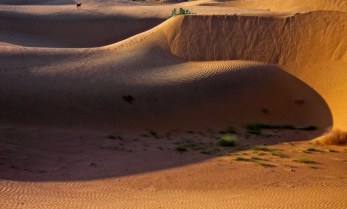
The desert gets our attention on the hushed velvet stalls beyond the drama, and hints at a life outside the theatre itself. In the desert we can turn our vision inward. Reshape our identity like the wind reshapes the sand dunes. Stretched out beneath the firmament ringing with infinity, we get to reconsider, our limited and finite identity. It is not easy to manage a night in the desert. Deserts abide on the edge of civilization, and to enter them requires an intention. More often than not it involves long train rides followed by long drives in off-road vehicles. Deserts are not a side trip.

Such was my first visit to the Thar Desert in far Eastern Rajasthan, an hour’s drive from the gold-baked brick city of Jaisalmer; it’s very sound evoking images of silver bell anklets jingling under the moon and old turbaned men singing poems to the wind. I had just come from the set of Viceroys, a period film about the partition of India and Pakistan in 1947. I was an extra. One of about fifty fished by casting agents out of cafes and beaches from Rishikesh to Goa. Most of us were no-make up tee-shirted traveler types, who became miraculously transformed into British Raj ladies of leisure by the costume and make up department. We emerged wearing clothes that require an assistant to get into, fractal hair dos, foundation applied with a trowel, and lipstick that could hold its own through a clash of civilizations.

The hours were brutal: we began at four in the afternoon and went straight through to four in the morning, two days straight. By midnight the first evening, the glamour had worn down to the husk, and we were rubbing blisters from impossible shoes, giving impromptu massages, and generally getting grumpy. One 20 something Israeli complained to me afterwards that she had repeatedly asked for a coffee to no effect. Everyone had promised to get it for her, but no one had come through. She seemed to have missed the fact that there wasn’t anyone on the set, except for the stars themselves, who had access to coffee.
“I felt like a nobody.” she pined.
“Darling,” I was tempted to respond. “You are a nobody.”
We turn somersaults to get the camera’s attention, and high five one another when we do. We abhor obscurity, being overlooked, being insignificant. Being a nobody.

The blissful wails of Qawwali singer Nusrat Fateh Ali Khan provide the perfect soundtrack as our driver, Fatan, battles the auto rickshaw down a dirt track, careening full throttle towards the setting sun as if he intends to meet his Maker in its corona. Without suspension every bump bashes our heads against the roof Auto rickshaws are not off-road vehicles, but in India anything can be made ‘fit for purpose’. Today this battered little two-stroke three-wheeler, mmmming and zuzzing like an over-sized honeybee, is playing the role of a mighty all-terrain SUV, carrying myself, Sharif and Hazan into the Thar desert of Rajsathan. We set up camp and I step away from the fire to be alone. We are only twenty kilometres from Pakistani territory. Camel drivers from both countries used to regularly cross the border and drink chai together. But these days the border is under much tighter control and such mingling is no longer possible. The night lovingly undresses the Milky Way and drapes it across the firmament. I had forgotten this kind of silence.

Even with Fatan and Hazan chatting around the campfire and a couple of dogs barking in the distance, the silence is numinous—almost like another kind of sound. Sharif hands me a plate of food and sits down next to me. The lights from our mobile phones as we try to see to eat begins to attract grasshoppers. One hops right onto my mouth, and (thankfully) promptly out again. Interpreting my quietude as boredom, Sharif talks non-stop, about nothing and anything, his train ticket back to Jaipur, his plans for a garden, his partiality for Milky Way chocolate. His talk is like a shield, held up to the silence. But he is feeling the strain. As if he too can sense his inner ‘selfie’ begin to ripple and distort.

In the desert we are all extras. The stage lights dim a little to make way for the real A list: Venus, Jupiter, and tonight a Grand Appearance by the Incomparable Constellation of Scorpio. Even they are awed by this silence. Perhaps that is why people like to go to the desert in large groups. The presence of other people validates our inner selfie. In places such as these, where human insignificance is prominent, it is dangerous to be alone. The environment is unforgiving, but it does not just threaten our physical reality, it threatens to smash down the fortress of our inner reality also. It is no coincidence that Jesus chose the supreme aloneness of the desert for his final surrender to Divine Will. The Desert Fathers knew this.

The desert does not care about our story. A thousand stories like yours and mine are scattered with the bones of the dead—sandblasted into submission. The desert will peel your story away from you, scene by scene, unraveling your narrative to leave you dangling by a thread—if you’re lucky.

When we are hypnotized by our stories, the silence of the desert is a chasm that begs to be filled. But when the trance begins to wear off, this same silence is a clarion call. It is a call to escape the role we have conjured out of the flotsam of perception. To escape the confines of the stage that has limited our actions to a handful of worn out scenes repeated over and over. To discard the script that keeps our imagination trapped inside a few predictable lines. It is only when we step out of the glittering limelight and dip a toe into the void beyond the stage, that we begin to know the noble quality of this freedom.

It is an exquisite irony that the praise and adulation of the whole world cannot begin to compare with the honour of being a nobody.

Posted in epoche | Tagged , , , , , , , , , , , , , , , , , , , , , , , , , , , , | 1 Comment

First world problems#1

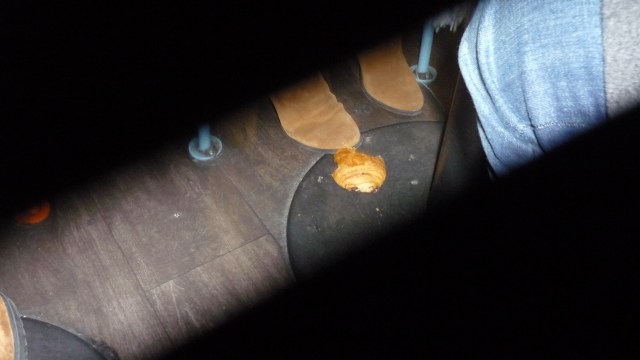
I dropped my pain au chocolat on the floor of a Paris train station. Proof of the Buddha’s first noble truth. Life is suffering.

pain du chocolat

Posted in epoche | Leave a comment

Why there is no French flag on my Facebook profile

 I was as shocked and outraged as every other thinking, feeling individual about the November 13 Paris massacre. I love Paris. It is an extraordinary city. I have friends and memories there. It is a city more familiar to me than most. But still, I couldn’t quite bring myself to put that French flag over my Facebook profile picture. Why? Not because my heart did not go out to the victims and their families, but because my heart did not go anywhere especially French; it went out to the people who suffered, and since compassion is a borderless state, it could not help but extend to the whole world, to our entire humanity. Today it might be Paris, but tomorrow it will be another place. And usually, it is ‘another place’ – one that people like myself are less familiar with—a place where I haven’t munched on croissants in picturesque street cafes, or taken daft selfies on bridges oozing with romance, or spent hours soaking up the auras of artistic masterpieces.

It has been a bloody month, and it is not over yet. Just one day before the Paris attacks, 43 people were killed and 259 injured in a suicide bombing linked to Daesh in Beirut. (And I am aware that ISIS has threatened to ‘cut out the tongues’ of anyone using this term). The terrorist organization, Boko Haram (who are reported to have murdered more people than Daesh) are suspected in the November 17th killing of 30 and injuring of 80 in Nigeria; yesterday, 27 people were killed in an Islamist terrorist attack in Mali (although this by an Al-Qaeda affiliate led by a one-eyed Algerian). I don’t buy the criticism that it’s the media’s fault if these stories are not getting their due. The media is a business like any other. It reports what its consumers want to hear. And all the above stories were reported on, including the April attack at a university in Kenya by Al Shabaab, Al Qaeda’s affiliate in Somalia, where 147 people died. As journalist Lindsey Hilsum writes, ‘I don’t think that the lives lost in Paris are more valuable than those lost in Beirut. I do think that the atrocities have different meanings…’ Interestingly, in the wake of the Paris attacks, far more people are now re-tweeting and sharing the reports of other terrorist attacks around the world.

I am not one of these people who finds it outrageous that the attacks in Paris got more media attention in the West than the one in Kenya. It is understandable. It is the ‘croissant in the cafe’ effect. Even for those who haven’t been there, Paris is more familiar to us, and humans everywhere (not just First Worlders) understandably connect more closely to what they find more familiar. But the rise of terrorism calls for people like me to do exactly what Daesh are incapable of doing—that is, to think beyond the familiar. Flags are important as the proud symbols of a nation. But this is a global problem.

I applaud the hacktivist group Anonymous taking on Daesh’s social media outreach (even if this results in some ‘collateral damage’ in their targeting of Twitter accounts). On Wednesday, they announced, “They picked a fight with Anonymous when they attacked Paris, and now they should expect us,” suggesting that in carrying out the attacks in Paris, Daesh had crossed a line. Good on them. But didn’t Daesh cross the line when they started beheading children?

The Paris attacks were terrible. And meanwhile, in Daesh-controlled territory, individual executions are carried out daily and mass executions on a weekly basis according to social media reports coming out of the region.

Flags are nice—bright colourful flap-in-the-breeze things that can help people feel a warm kinship with their fellow nationals. And solidarity is a beautiful thing. I was as touched as the next person when the British football fans sang (or rather hummed) La Marseillaise at Wembley Stadium before a match between England and France (for those unfamiliar with the historical enmity between the two countries, the significance of this event might pass them by). But now is the time to extend such feelings of kinship to embody a global front where “Je suis la monde!” is our battle cry. Only then do we stand a chance against the forces of ignorance that have gripped the hearts of the followers of terrorist groups like Daesh and crushed them into nihilistic isolation. If there was a Facebook image for that – I’d post it.


Posted in epoche | Tagged , , , , , , , , , , , , , , , , , , , , , , , | Leave a comment

Fleeting

fleeting

Posted in epoche | Leave a comment

Journey of a neopilgrim – Kedarnath (part 3 of 4)

Anything you are attached to, give that. Go to the places that scare you.’
Machik Lapdrön

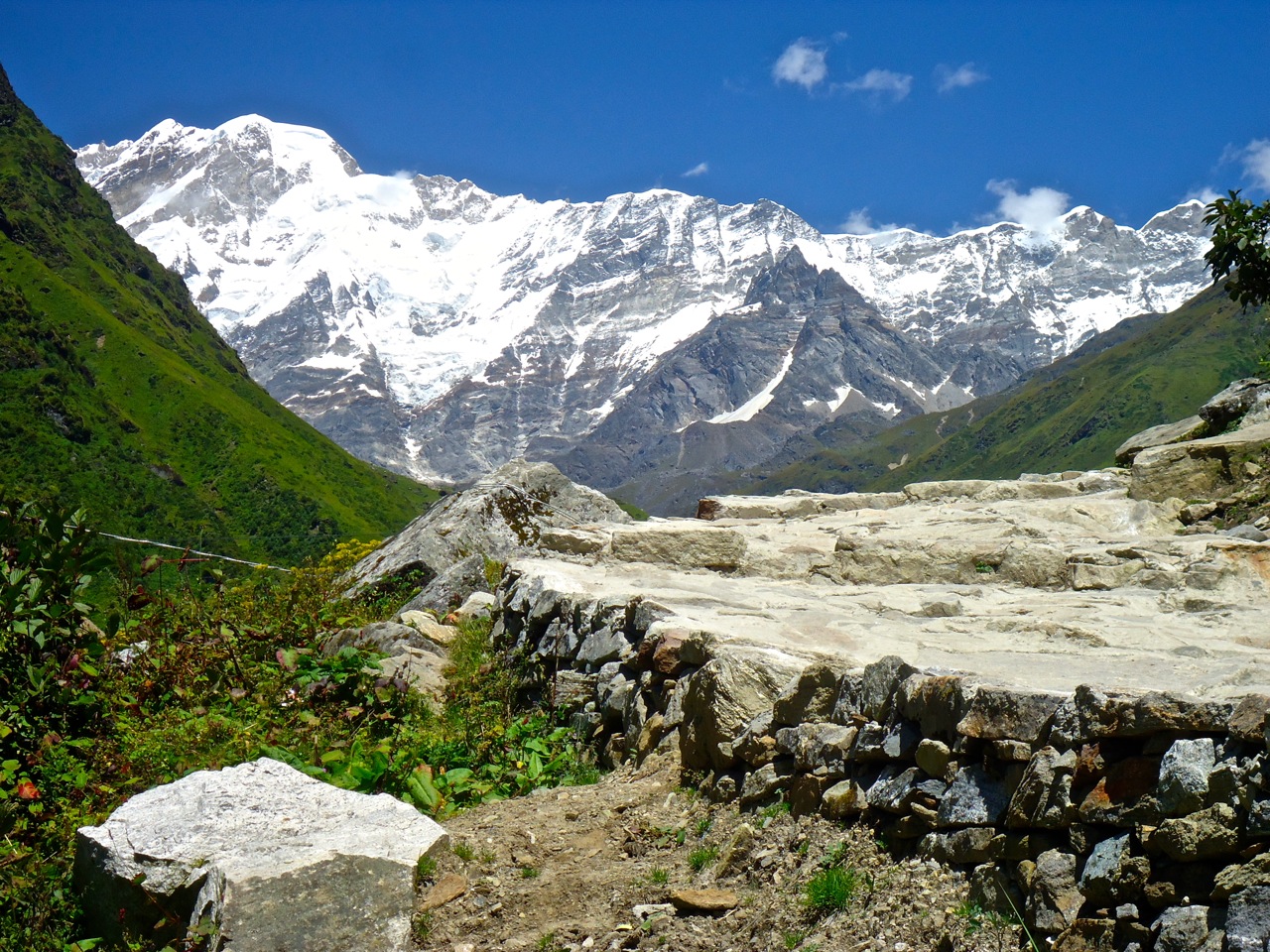
DSC09945 In the high plateau under the gaze of snow-capped mountains Puttiah ambles away in the direction of the temple. I wonder where he plans to sleep. He had mentioned walking down to Gaurikund the same day, but it would be impossible for him to reach before sunset. It is only four o’clock, but already the light is dimming. In these mountain communities the sun sets early and rises late. I figure he is sensible DSC09949enough to look after himself. Myself on the other hand, perhaps less so. I had found one guesthouse online with a Tripadvisor review from 2012. From the devastation around me, it is safe to say that the guesthouse no longer exists. There is no question of going to the temple now. I am too wiped out, physically and mentally. Plus, I have absolutely no concept of what a visit to the temple entails. The temple is the sine qua non of this journey, but it is also the biggest unknown. If I can’t be prepared for the unknown, I at least want to be fresh for it.

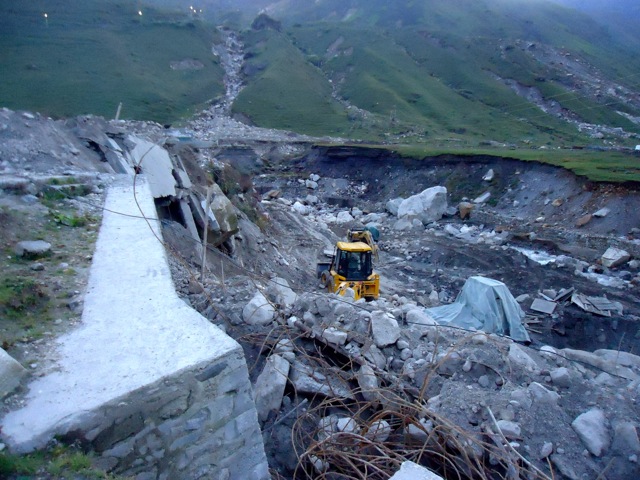
Even in the creeping dusk, the primordial memory of the forces that have reshaped the environment and personal destinies of this place are vivid. Hardly a building is left standing. The rest are savagely buckled and distorted in a deranged graveyard of stone and concrete corpses. A few guesthouses are under construction but not yet operational. Again not a woman in sight. It is a town of men and mules. I return to the tent village, the best option for a bed for the night, my thoughts still fussing around the question of the temple. What am I doing here? I’m not a Hindu. I don’t know the rituals. How am I going to manage? What if I inadvertently offend someone by doing the wrong thing? They’re going to think I’m crazy. I AM crazy! What am I DOING here?

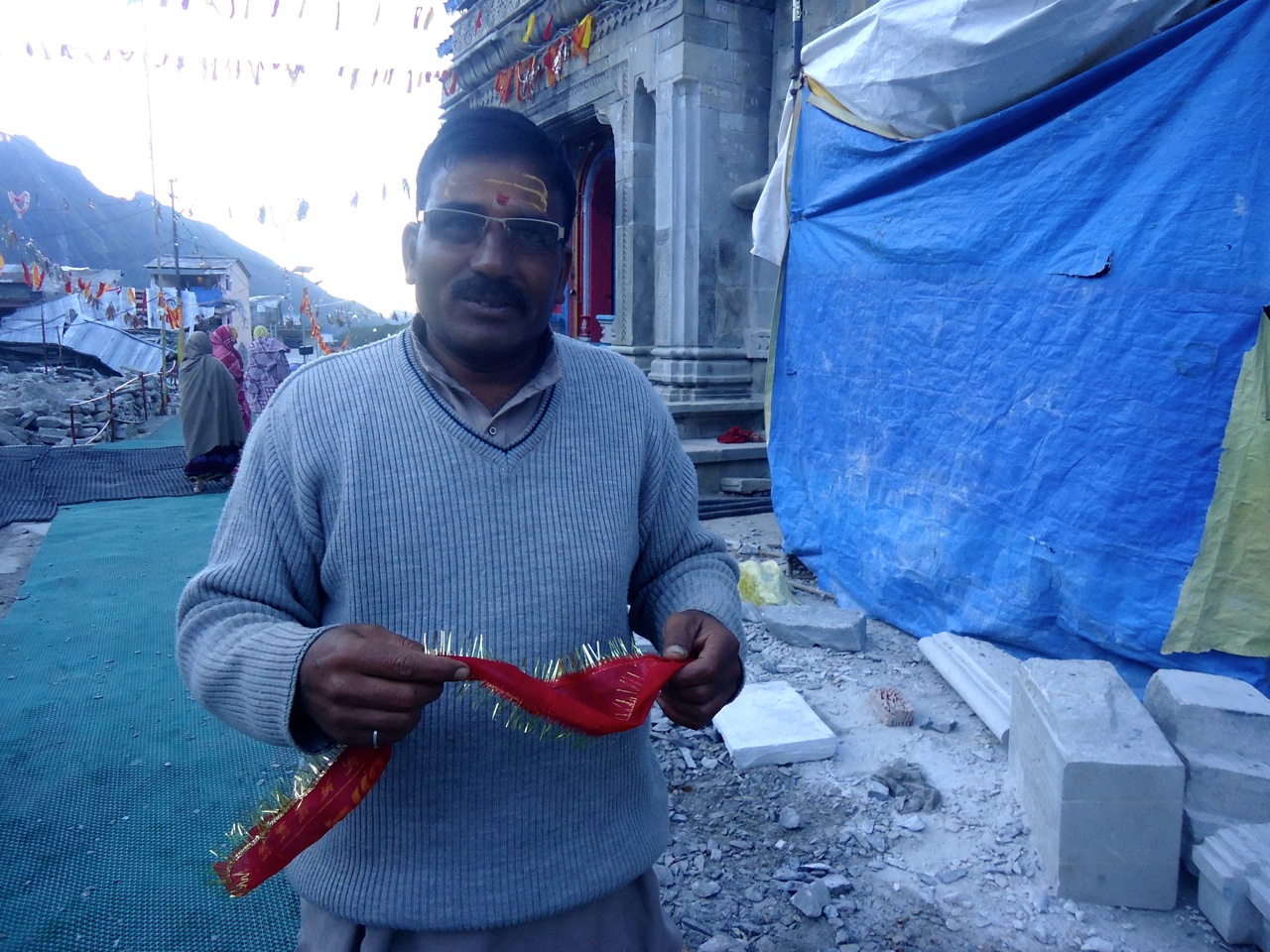
DSC09966As if reading my thoughts a man materializes by my side and presses a business card into my hand.
“I am a priest at the mandir,” he explains, ‘mandir’ being Hindi for temple. “Come morning time. Six-thirty. Puja. Explain everything.”
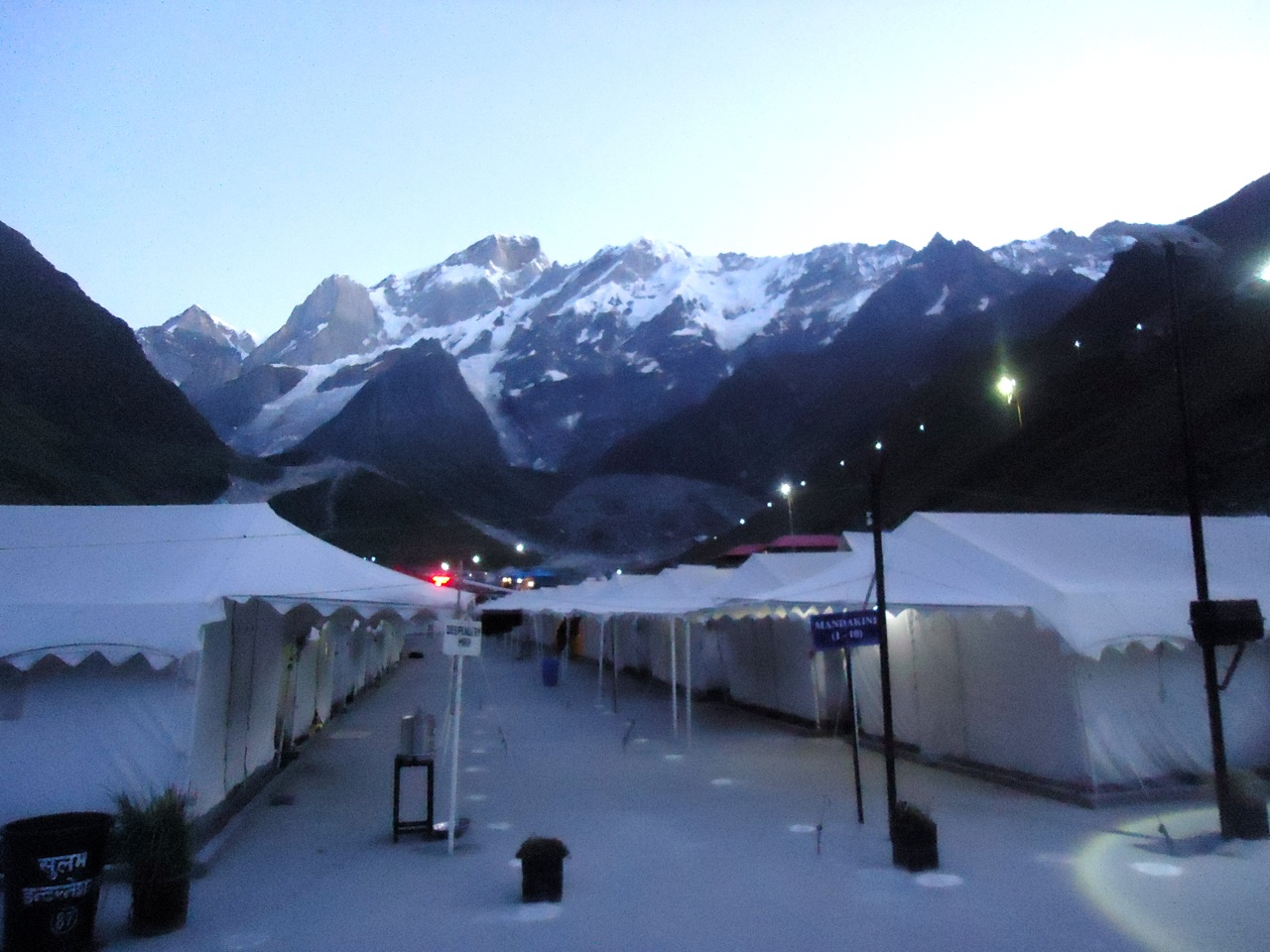
The card reads PUROHIT KISHAN AWASTHI. Purohit means ‘family priest’. I am too tired to be impressed by this synchronicity, which is anyway becoming less unusual. I step into a camp courtyard DSC09943that fronts a row of institutional-style buildings and approach a man behind a desk who looks the most probable ‘in-charge’. He is all bundled up in coat and hat, while the sweat from the climb is still drying on the back of my neck. He is surprised to see me but hides it well and confirms that tents are available for one hundred rupees. I present him with my biometric card, which he studies for a very long time. Finally, he looks at me.
“Single person?”
I nod.
He opens a ledger and I gird myself for the next installment. If the previous two form-filling sessions at Guarikund and Sonprayag had seemed excessive, the next one outdoes them in every possible way. It is also clearly the most exciting thing going on in Kedarnath that evening, since by the end of the process there is a full house. The office manager studiously notes my particulars, while five jacketed men stare at my passport details as if they are a constitutional amendment. In my light-headed state, I worry that I might get the giggles.

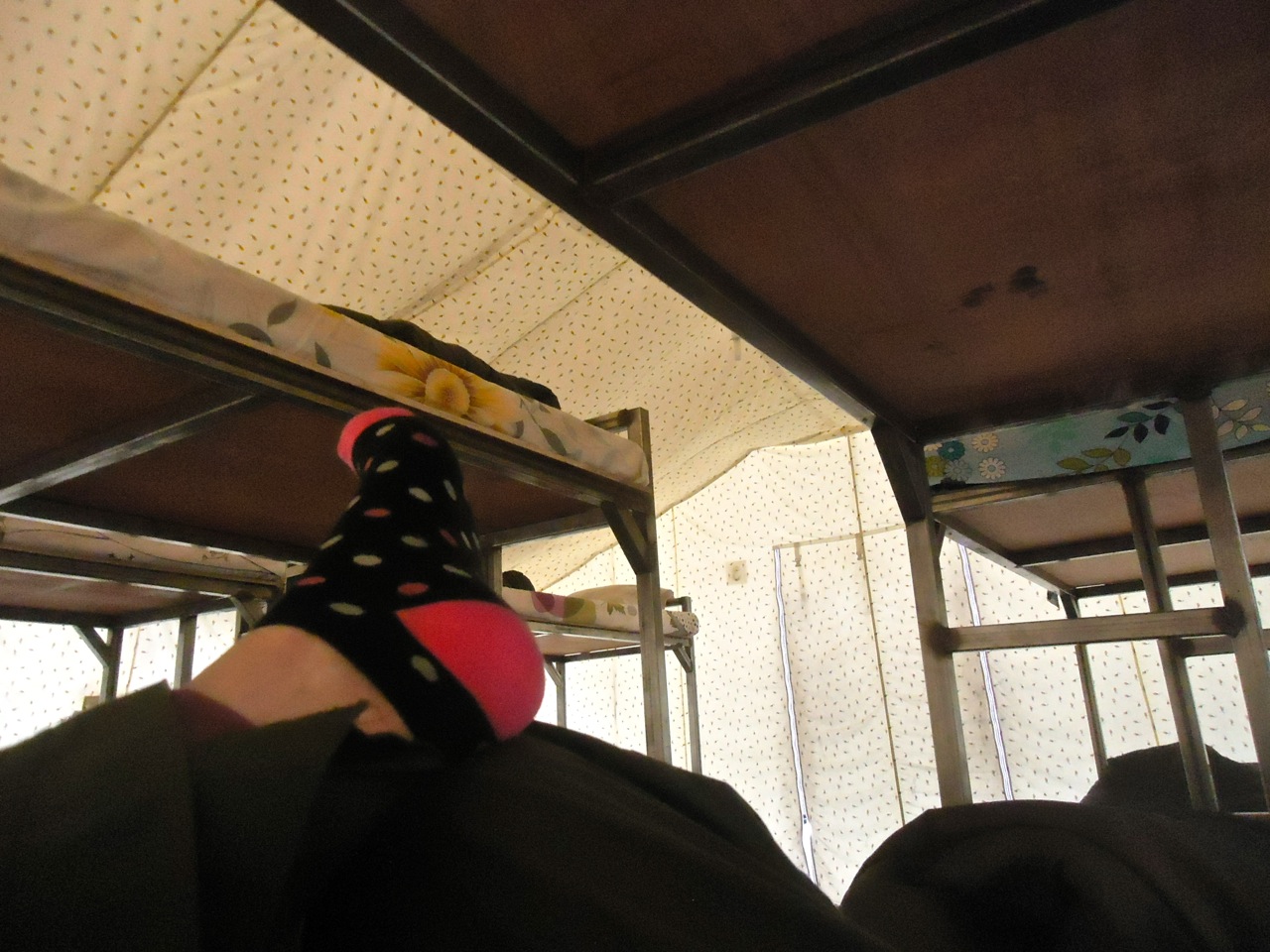
Finally, the ledger is closed, and I am directed to Tent Number 3. It is immaculate with five bunk beds stocked with brand new mattresses and pillows and quality army issue sleeping bags. I ask if I can have the tent to myself. My guide gives me that “it’s highly irregular, madam” look, but since only about five tents out of sixty are occupied, he can find no reason to refuse. He shows me a plug where I can charge my phone and directs my attention to the light switch. He switches it on and off in case I am unclear on the concept. It is often the case that foreigners are treated like children in India, and assisted in the most routine of tasks. Perhaps Indians notice how much less observant and coordinated we are. With such a low level of motor skill ability and alertness, we don’t seem entirely capable of looking after ourselves.

DSC09935With only a zip between me and the outside, I consider if it’s safer to take a top bunk. I don’t really think anyone will harm me or steal from me in such a holy place, still I have become habituated to security drills. But all such calculations collapse along with my body onto a bottom bunk. I wake up in the dark an hour later. It is getting chilly, and I pull the sleeping bag around me. It smells of petrol. I wobble out in search of food. A simple buffet dinner of daal, sabji and chapatti is available for the yatris for sixty rupees (less than a dollar). In the cafeteria, an Indian news channel is looping a CCTV captured scene of eight youths beating an old man to death in Ahmedabad. Twelve shawled men are watching wordlessly. In my newly sensitized state I find it even more horrifying. I can’t watch it. I clean my teeth at the outside sink and use the portable toilets that claim to be some special eco brand produced for high altitude climes. The temperature is dropping fast and I can’t bring myself to take a shower. Plus the dexterity required for all the undressing and re-dressing in the confines of a shower stall with no hooks are beyond my present capabilities. I return to my bunk and lie for a while in exhausted joy. The joy wells up from somewhere deep in my stomach. It feels dependent only on itself and is intensely soothing. I have no way to contact the outside world. My phone has no signal and there is no internet, but rarely have I felt more connected. The atmospheric conditions at 3500 metres is an effective somnolent and I surrender to a dreamless sleep. At five I am wide awake, gasping at the fantastic purple predawn light stroking the Chaukhamba massif into view, ascending over 7,000 metres into thin air. I take my 40 rupee breakfast of chole bhatura (spiced chickpeas and fried bread), and head out.

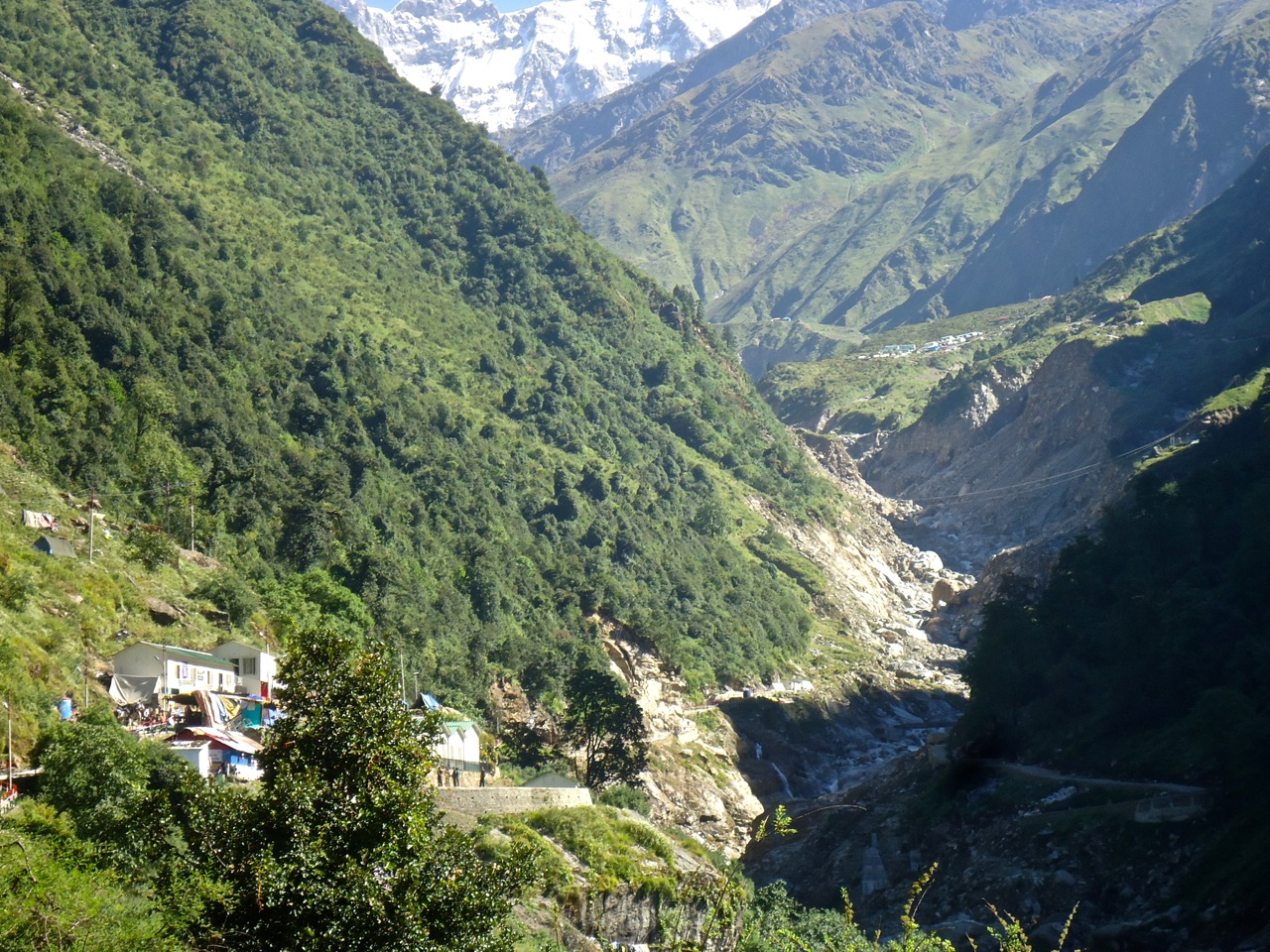
DSC09948The town looks like a war zone. Concrete, iron girders, and slabs of cement are smashed together at violent angles, as if the forces that put them there are still operating. Only the newly paved red-brick road is intact. This road, the continuation of the 16 km stretch from Gaurikund, is an insistent exclamation of endurance. The fact that it leads directly and only to the temple door, speaks volumes about this land’s priorities. I take photos, even though I can’t always untangle what I’m looking at. Scientists at the Wadia Institute of Himalayan Geology that runs two automatic weather stations around the Chorabari glacier near Kedarnath have described the Uttarakhand catastrophe as “one of the most extreme events of the century”. Eyewitness accounts describe a tsunami-like “wall of water” over three storeys high that engulfed everything in its path, collapsing buildings like sandcastles. Experts are still debating what actually happened. Monsoon had come early with especially heavy rains, over 375% more than normal for that time of year. In just 24 hours, Kedarnath received a staggering 120 mm of rainfall. The deluge caused the glacial lake of Chorabari Tal (aka Gandhi Sarovar) a couple of kilometres higher up to burst its banks (others contend that the body of water that overflowed was a temporary lake). The sound of the lake bursting its banks was so loud, reported one resident, it was as if the mountains were falling apart.

DSC09958Whatever the cause, around 8 pm on June 16th 2013, ten million litres of water was dumped on the town in under ten minutes. By the morning, the flash floods had been compounded by the run off from rapidly melting glacial ice, swelling the rivers and vastly increasing the force of their momentum. In the following days, the Indian Space Research Organization estimated a mind-boggling 745 landslides along the DSC09959river valleys in the area, with the debris of dams and bridges adding to the destruction. There was a lot of finger pointing in the weeks afterwards, in particular about the rampant construction of hotels and guesthouses along the riverbanks (none of which remained standing). But nobody expected this to happen. It was utterly beyond human imagining; redolent of Lord Shiva’s Tandava—his cosmic dance of creation and destruction.

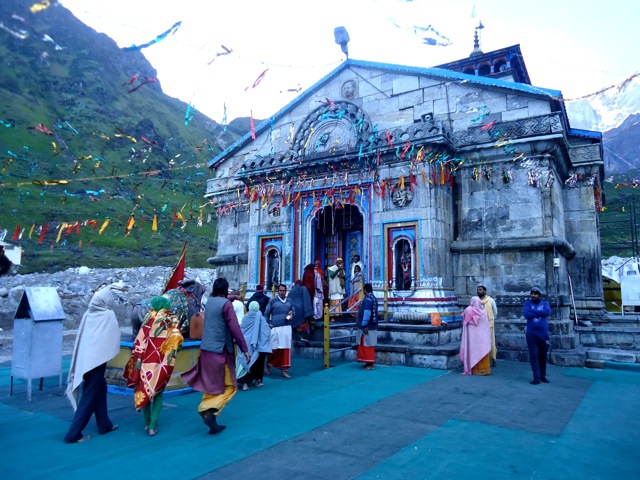
DSC09953My ‘family priest’ greets me in the temple grounds. I am relieved to see him and he looks just as happy to see me. There is only a handful of pilgrims milling around. Puja business is slow. I had imagined being joined by others, but this is a puja for one. The temple is a grey stone edifice reminiscent of a church with a pear-shaped steeple. The building dates back to the 8th century, but the site as a place of worship has a far more ancient thumbprint, going back a few millennia. The approach is flanked by stalls selling intriguing items for the puja offerings; artificial and real flowers, piles of ghee, exotic-looking gourds, bags of seeds and rice, and white pellets for Prasad.

I remove my shoes and Purohit ji directs me up the steps, past a statue of Shiva and Parvarti’s gatekeeper, the bull Nandi, carved out of rock. I had read a story that during the floods of 2013, a large boulder had tumbled down the mountain and lodged behind the temple, protecting it from the force of the floodwaters. I ask Purohit ji if it’s true. He nods in recognition and takes me to the back of the temple, where a thirty-foot boulder is sitting DSC09954daubed in orange paint. With his spartan English he begins to sketch the story. On the morning of June 16th, 2500 people ran for their lives and sought refuge at the temple. Purohit ji and his family among them. He watched the massive boulder tumble down the mountain towards him on what looked like a direct collision course. But six feet from the temple wall, the boulder came to a rest. Its presence diverted the floodwaters into two separate channels that flowed either side, keeping the temple and its huddle of refugees from harm. The boulder is now worshiped as a divine object. Purohit ji referred to it as ‘Bholenath’ one of the 108 names of Shiva, in his manifestation as the unquestioning deliverer of whatever his disciples desire. There is something wonderfully Indian about this; among a million negatives to shower hope and praise on a singular positive thing. But many were not so fortunate.
“Government number very low,” he says, referring to the official death toll that had hovered around the 5,000 mark before the reports had fallen into an uncomfortable silence.
“How many?” I ask.
He doesn’t hesitate.
“Twenty thousand.”
Purohit ji regards the boulder for a moment, his right hand pressed against his heart. He turns to me.
“We go inside now.”

Posted in epoche, Rose Apple Island | Tagged , , , , , , , , , , , , , , , , , , , , , , | Leave a comment

Journey of a neopilgrim— Kedarnath (Part 2 of 3)

September 10th, 2015

Pilgrims recognize one another by a capacity for wonder, and a gut-level discomfort with bigotry.‘ From Pilgrim’s India

The sun has not yet risen but my mood is already quickening. I dress fast, having prepared my pack the night before and am out on the Gaurikund street by 5:30. It is ‘street’, singular. Well, really more of a lane, too narrow for anything more than a scooter. I find an DSC09875open chai shop and sip piping hot sticky sweet tea under a greasy 60 watt bulb while half a dozen mule herders conduct their morning meeting. They seem to sense I am not planning to hire them since only one makes any attempt to engage me. I move on to where the dozen or so grocery shops (all stocking the same items: soda, bottled water, cigarettes, crisps, biscuits and washing powder) ends, and am thwarted again by the police.
“Seven starting,” says the jawan, pointing to his watch.
He invites me to wait with him. I politely decline and return to the guesthouse where Palao’s uncle makes aloo paranthas to die for.

I step out again an hour later, and this time the jawan ushers me along. The morning temperature is perfect for hiking. My pack rests gently against my back. My body feels rested and my limbs supple. I try to pace myself as my excitement overtakes. The road is broad, the cement inlaid with flat rocks that provide a good gripping surface. The incline is undemanding. I pass a milestone that puts Kedarnath at 16 km ahead. I wonder if that is the old distance before the re-routing of the road after the floods.

At first I meet no one except for a handful of mule herders—all in their twenties and thirties. They greet me with “Jai bholey!” the mantra of this yatra. Bholenath is another name for Lord Shiva. Bholey means “simplicity” or “innocence”. So “Jai bholey” means something like “Praise to Simplicity” or “Praise to Innocence”. I love saying this. For me, it is a reminder to return to basics. To what we are underneath all these labels we’ve imposed on ourselves and on others.
“Jai bholey!” I return.
“Dollar! Dollar!” one of them jokes and rubs his fingers together in the international ‘money’ mudra.
His antics jar with the gracious atmosphere.
After half an hour, I spot the little Tamil man. He acknowledges my presence in that stripped-down Indian way, with an almost imperceptible nod.

He disappears around a series of bends, but twenty minutes later I catch up with him at a chai shack and he gestures that he is going to buy me chai. I try to insist but it’s no use. There is something super focused about him. It is difficult to describe DSC00014the impact this small gesture has on me. In India, where so many have so little, foreigners are often viewed as targets —“a wallet on legs” was how one American friend described it. Westerners are all de facto ambassadors of India’s mesmeric and often schizophrenic relationship with modernity, informed by a potent mix of envy and suspicion. Foreign women are dual targets, for both money and sex. I don’t mean just the literal act of sex. Despite the much publicized reports of rape in India, most ‘actual sex’ remains in the category of wishful thinking. I’m referring more to a set of behaviors that can best be described as sexual teasing—‘eve-teasing’ as they call it in India. This is not the same as flirting. What would be called ‘flirting’ in the West is very rare in India, just as what is called ‘eve-teasing’ in India is rare in the West. I’ve only experienced something close to ‘flirting’ from Indians who have spent time abroad. Flirting is one-on-one, whereas sexual teasing is almost always carried out in packs, where individual sexual anxieties can be temporarily tranquilized by the group ego. Even if some women find it annoying, flirting is more sophisticated, playful and respectful than the crude objectifying and vaguely threatening way in which many Indian youths engage women. Foreign women are often assumed to have loose morals, as if they’re ready to strip off and get down to it right there in the street. But you can sense that the bravado in these man-children masks a deep-seated fear, deprivation of physical intimacy, a general state of confusion about the true meaning of power, and an inability to manage their own sexual energies. I often see Indian men treating foreign women like they’re poking a stick at a caged lion; with a clumsy combination of cocky posturing and pant-shitting terror.
In India I am constantly treated as a source of something because I hail from ‘Desire Factory Central’ aka ‘The West’. But the more time I spend in India, the less certain I am that everyone knows what exactly it is that they want from me. It’s a bit like Marlon Brando’s famous retort “What you got?” when his character, Johnny, is asked, “What are you rebelling against?” The programming works to assume that I have something desirable. When a beggar asks me for money, the motive is very clear. But it is not always about money. Sometimes it’s a photo, or just a brief exchange. It is often very cordial, but there is always a subtle imbalance that is no one’s fault but which prevents most encounters from reaching any real level of sincerity. At times, being on the receiving end of this continuous grasping can feel uncomfortable, but it must not begin to compare to what women of colour experience, and what Indian women endure on a daily basis.

Even my so-called ‘progressive’ male Indian friends seem oddly blinkered to this reality, and respond to such observations with a kind of patronizing dismissal. One of them I used to meet regularly in Delhi could not seem to get his head around why, when we were planning to go somewhere together, I insisted on meeting in a café or other venueDSC09873. He seemed to think I was just being difficult that I didn’t want to wait for him on the street, to be bombarded by overt projections and repressed fantasies of hordes of sex-starved men. He had no idea what I was talking about because when he stood on a street corner in Delhi, he experienced an entirely different set of behaviours. I would put good money down that if they were asked to endure such treatment even for a minute, many of my male friends would need to restrain themselves from punching someone in the face. It is not even about understanding. I have come to the conclusion that understanding is over-rated. Indeed, true understanding may be an impossible aim. But it is necessary that we a least try to understand. I can share my experience of men while happily admitting that I have only a vague idea of the inside scoop of the average male. Teach me, I say. Illuminate me! I am Jane Goodall with bells on! I am befuddled by so many otherwise intelligent men who find it hard to admit that they are equally unenlightened about the view from behind a woman’s eyelashes. Collective embarrassment, perhaps?
But the Tamil man didn’t want anything from me. He just wanted to buy me a chai. And this from someone who appeared to have so little. He was walking barefoot and had no luggage at all. Not even a blanket. Tradition states that more spiritual merit is gained when pilgrims on yatra walk without shoes, so his being barefoot was probably more out of choice than necessity. But his appearance and demeanor were of a man of very humble means. The chai was relatively expensive—fifteen rupees compared to ten in the lowlands. He spoke no English or Hindi and I spoke no Tamil. Our communion was reduced to a few simple gestures and a temporary higher purpose.

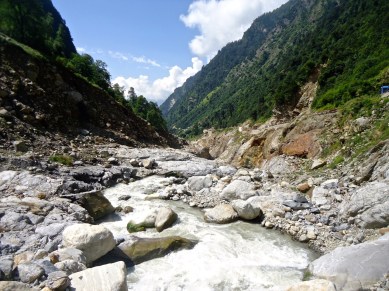
My surroundings are exhilarating. The way is occasionally interrupted by waterfalls, that slip horizontally across the trail, before continuing to plunge into the Mandakini river. It is impossible to cross them without getting soggy feet and I’m glad for the extra socks I packed. DSC09868After two or three hours I begin to be passed by other pilgrims riding mules. The ones who look more middle class engage me as a Western tourist. I return with “Jai bholey!”  hands together at my heart. Most return in kind. They holler at me from their saddles. What country am I from? What is my name? Am I a single person? Sometimes the order is different, but I am only ever asked these three questions. Except once when a woman leans down dangerously low from her mule to shout in my ear, “What is your purpose in India?!”
I am beginning to feel good about my “fitness level” when a lady in a sari and sandals overtakes me. I notice she is knitting. Here am I all earnest and decked out with backpack, bandaids and special sweat-absorbing vest, and this woman is meandering up the mountain making a sweater! We chat for a bit in my terrible Hindi. She establishes that I am a “single person”, meaning not just that I am unhitched but traveling solo. Indian women seem intrigued by this state of affairs. They eye me as if considering their odds. The men usher them on quickly, as if eager to put distance between them and one who seems to be managing quite alright on her own.
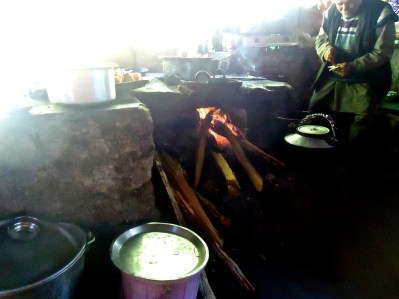
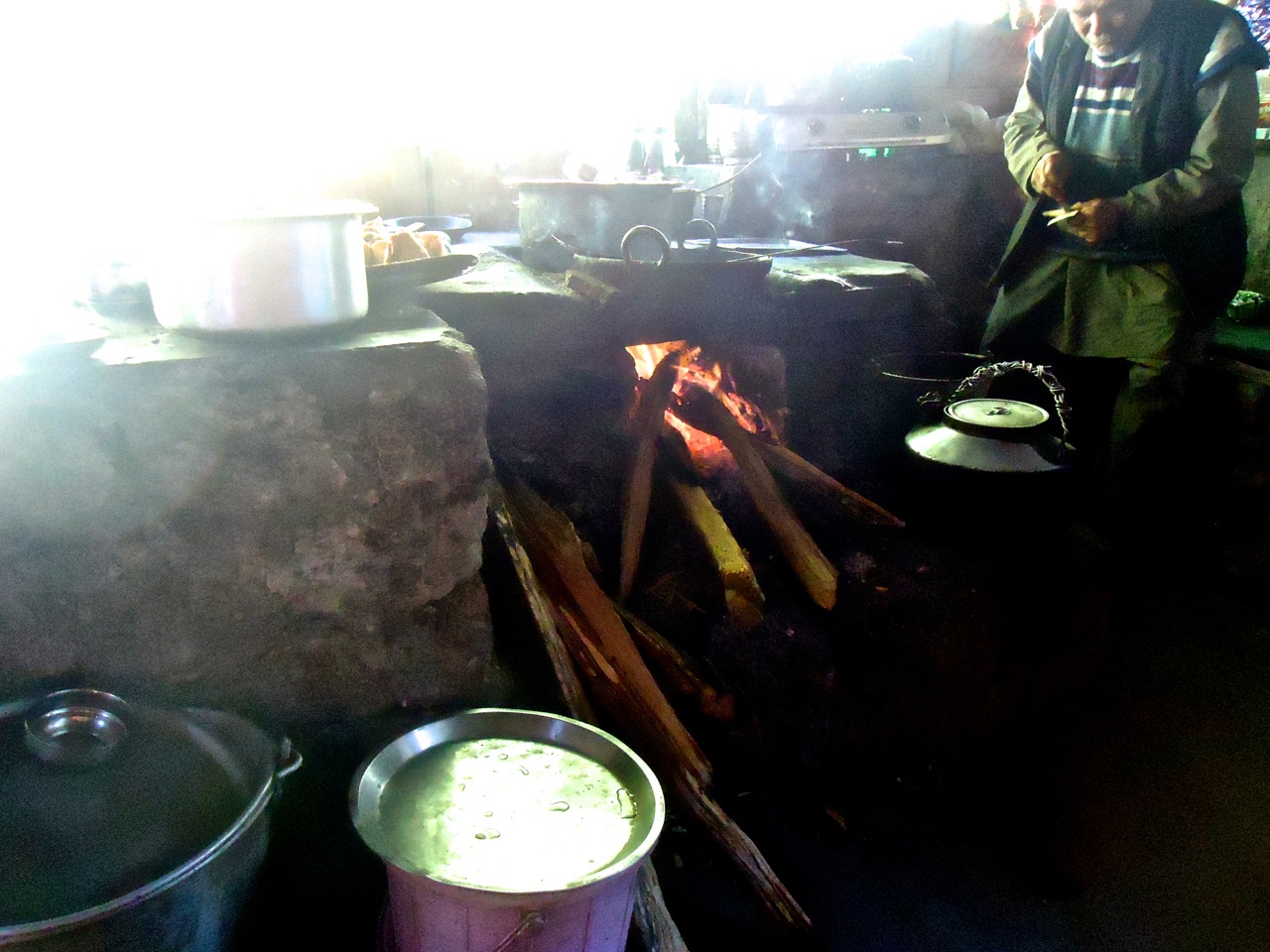
DSC09870The heat is still manageable and my body is responding to the mountain like a long lost friend. It has been a very, very long time since I have hiked alone in the wilderness. When I lived in California, walks like this were regular therapy. Arguments, anxieties, indecisions, would all get worked out of my system, and I’d return with renewed perspective and vitality. But in a country of one billion people you have to work harder to find solitude. It is also not especially sensible for a woman to walk alone, and company, although pleasant, changes the experience completely. I press on for the next three hours, occasionally digging into my stash of walnuts, figs and amaranth cookies when my energy begins to sag. I come across a shack where a stubbly-faced elderly man is frying samosas in a giant wok-like pan on top of a wood oven. They border on the divine.

About a kilometre further up, a bridge spans the river and on the other side the road begins to steepen. I begin to feel the weight of my pack, but I plod on. Palao had said the trek could easily be done in five or six hours, and according to this estimate I am only two hours away. Two hours later, I am feeling the strain. Fatigue sets in suddenly; loads up my thighs with sandbags and compresses my lungs in a vice. On this side of the river, the sun is blazing, and I am soon drenched in sweat. I am no longer marveling at the scenery and swinging along like a happy idiot. I am nose to stone, fixated only on the next three feet in front of me. I stop to make use of one of the numerous portable toilets that are kept immaculately clean. I’m impressed by the facilities prepared for the yatris that even includes a staffed medical dispensary. I buy a bottle of water at a roadside stall, and start to doze off on a bench. After ten minutes, I have trouble getting upright again. Six hours in and I am still five kilometres from my destination, according to the mule herders, who breeze up and down the mountain in flip flops. I plonk myself down on a bench under one of the numerous sun shelters that line the route. Next to me a middle-aged gentleman in a white vest and matching moustache is chatting to a young man whose job is to sweep away the mule droppings. I am very grateful for the presence of these sweepers. In the few places where the droppings have been allowed to accumulate, the acridity is overpowering.
The man is asking the sweeper how much he makes a month.
“Ten thousand rupees,” is the reply.
The man nods as if making internal calculations, and I sense a professional interest. He looks tired and I offer him some water. We talk a little. He tells me that he is a retired IAS officer from Bangalore (Agricultural Section). He is a very fit 65, his biceps would be the envy of a man of any age, but like me he is struggling. We are being challenged physically in different ways; me with the altitude, him with the gradient. Somehow we both know that we will make the next leg of the journey together.

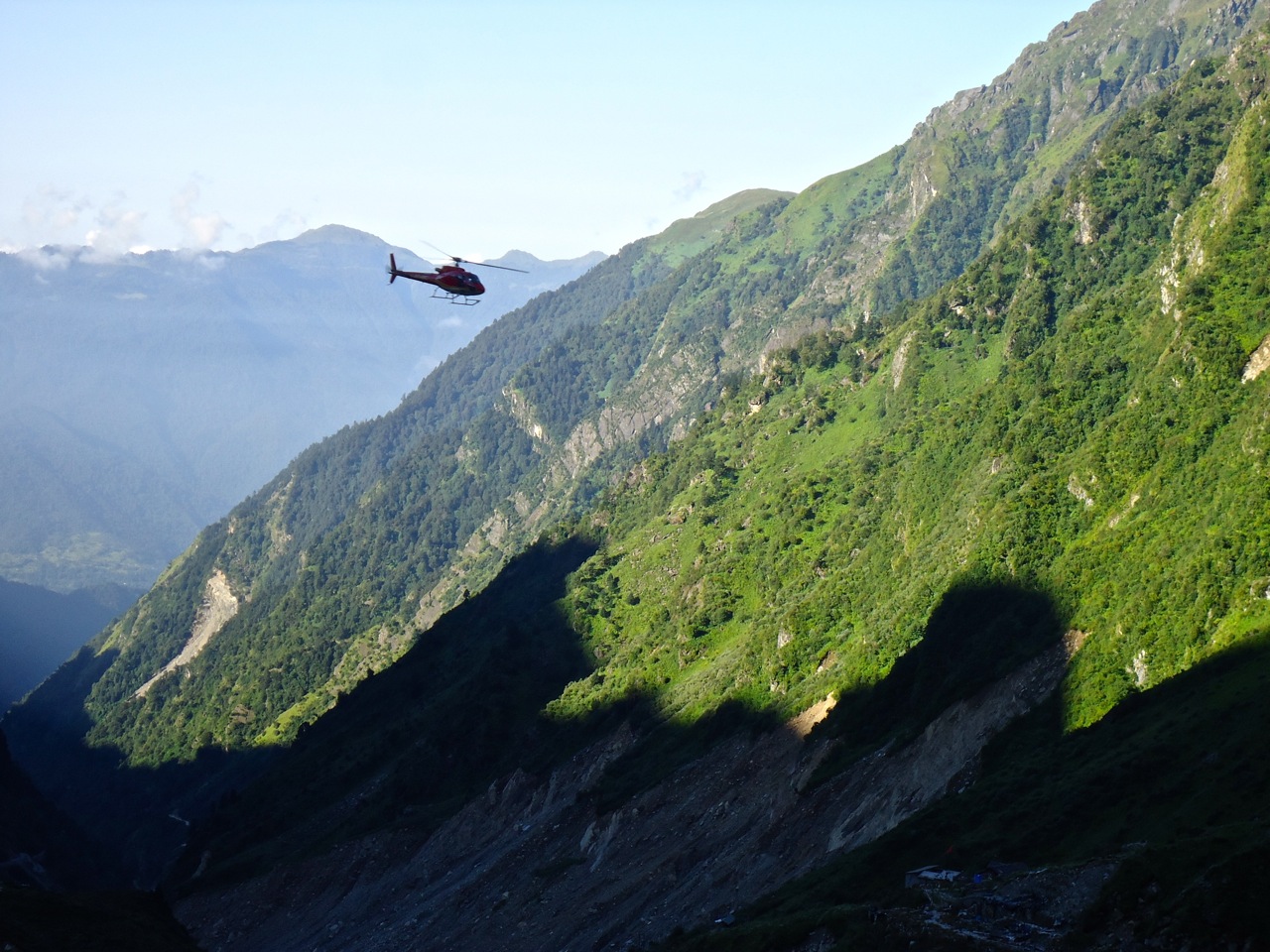
Almost nobody is walking to Kedarnath. I count eight in entirety. But those that are do so with quiet purpose. I’ve seen Indian families hiking up Triund near Dharamsala. Most look as if they can’t wait to get back. But on yatra no one squabbling over the snack ration, taking selfies or moaning about their blisters. On yatra, Indians will endure almost supernatural hardship, extend themselves physically and psychologically in every way, just to make it happen. Today, however, the vast majority are making the journey on mules that are goaded with sticks and beaten when they falter. Those who can afford it whizz above us in a government-run helicopter that makes about DSC09979one trip every hour. The private helicopter companies have been temporarily shut down, for reasons I can’t readily ascertain. A man on his way down stops us to ask how much further it is to Gaurikund.
“My helicopter did not provide me with a return ticket!” he complains.
He is out of shape and wheezing heavily, with impatience as much as fatigue. My fellow pilgrim and I can’t give him a straight answer, since we ourselves are unsure. The man tuts and stomps away.
“I don’t have time for this conversation!” he blusters. “My car is waiting for me in Sonprayag.”
It is an odd encounter and we gaze after him quizzically.
“Chalo,” says my companion after a few seconds. Let’s go.
We speak very little. He doesn’t ask me any of the “three questions”. I never tell him where I am from, or whether or why I am a single person. He doesn’t even ask my name.

At times I am a few minutes ahead. At others he is. If he falls behind, I wait for him, and he does the same. It is not up for discussion. It is the natural thing to do. After another hour, we are only making it about 500 metres, about every other bend, before we have to rest. At first, I look for rocks that offer conducive-looking contours. Soon, I am taking respite on any rock that is vaguely arse-shaped. We greet the occasional shelters and benches like they’re desert oases, and rest for longer and longer periods of time. Then one of us decides it is time to move and rouses the other with an encouraging, “Chalo!”

During one rest, I casually ask if his family are happy he is going on yatra. I am not expecting his response.
“Not at all,” he replies. “My wife did not want me to go. My children think it’s a waste of time. They are both university professors. They have no value for such things.”
He is a a true gentleman with a strong sense of duty. He must have wanted this very badly to forge ahead without the moral support of his family. He tells me that after retirement, he had planned to devote some time to spiritual philosophy. He has a strong desire to study Buddhism. But retirement has not provided the time or space he had hoped for. It has been filled to the brim with domestic duties and family pressures. His days are spent baby-sitting grandchildren and mediating family squabbles.

As we’re talking, who comes to join us but the little Tamil man who had bought me chai that morning. He has already been up to Kedarnath, performed puja at the temple, and is on his way back down. He looks proud and happy. There is a blaze of fire-coloured paste between his eyes. I wish I had half his energy. He shows us photos on his digital camera and poses earnestly while I take one of him. He is on his way to Badrinath, another of the Chota Char Dham pilgrimage sites. He has no plans to sleep. The contrast between him and the man we’d met earlier could not have been starker. The other man could afford to travel to this holy place by helicopter and private car, and yet he seemed to have taken nothing away with him, except a temper. The man from Tamilnadu was traveling by the slimmest means possible, yet his contentment was radiant. There are many ways to get to pilgrimage sites, but it seems that not all of them involve pilgrimage.

As we make our incremental headway, we meet more and more pilgrims on the descent—those who went up by mule or helicopter and are now walking down, having received DSC09916their blessings and said their prayers at the famed Kedarnath temple. For many as well as my companion, a pilgrimage such as this is a once in a lifetime opportunity, and the general mood is of serenity and completion. As tired as I am, I feel buoyed by this Caravan of Joy. I am still the subject of some curiosity, but there is another connection being forged now. In their eyes, there can be no other motive for me to be on this road than a spiritual one. And this makes all the difference. It is one of the rare times that it matters less that I am a foreigner or even a woman. Something else is being acknowledged. Something beyond the labels. Although Western travelers have made much of how the common greeting “namasté” supposes an acknowledgement to the divine unity within mundane plurality, the fact is nowadays the term is rarely imparted with this spirit. It has been devalued in the cultural marketplace into little more than a “Hey, how ya doing?” But here, walking the pathway between man and God, “namasté” regains its rightful etymology. It is delivered boldly, with meaning and depth.
In India, where every social interaction is characterized by difference, whether it be gender, caste, or the condition of ones shoes, it is immensely refreshing to find a situation where the focus is on “sameness”. In the exquisite book, Pilgrim’s India, Richard Lannoy comments on how pilgrimage temporarily allows for caste to be transcended since all are sinners. But the bond between sinners is not as strong as the bond between expressions of the divine.Those coming down the mountain have been to the source. There is still the scent of unity in their nostrils. It will fade soon enough. Even before they’ve reached the bottom, the distinctions will begin to re-concretize: woman/man, adult/child, this caste/that caste. But right now the distinctions are still in disarray. I can perceive my own private boundaries undergoing a slow unmistakable unification. It feels like space. And moves like freedom.

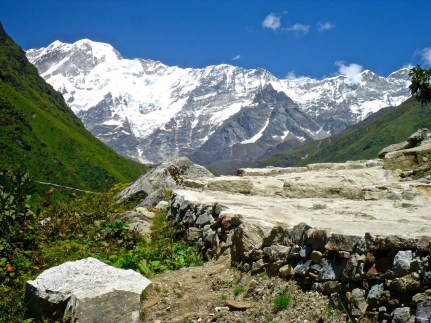
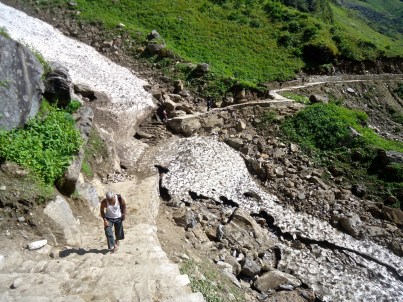
As we ascend, the scrub forests are replaced by alpine meadows in the middle altitudes, and further up by alpine grasslands. Kedarnath Wildlife Sanctuary is the largest protected area in the western Himalayas but I see no animals except the mules with the ever-present jingling of their harness bells. What is becoming increasingly evident is the environmental impact of the floods and slides of 2013, when the yatra route across the ravine was more or less annihilated. At times I can make out a short flight of steps here, a section of path there, and then—nothing. Just swathes of barren scree. I recall the news footage of people clinging desperately to rocks, to brush and to each other. Over 100,000 were evacuated from these valleys by the Indian military and paramilitary, but for thousands more there was no escape. My heart sinks into the thoughts of such despair, when around yet another bend, the glimpse of a snow-capped mountain makes a majestic promise of the journey’s end.
DSC09923After another hour, we pass the man and his son who had started with me at Sonprayag. They are on their way down. The man seems surprised to see me.
“You are very late,” he says, looking at his watch. It was two o’clock.
I’m startled by this statement. Late indeed! The affrontary!
“You still have five kilometres to go.”
“That can’t be,” I protest.
We’d been told the same thing over an hour before. The father continues his descent with a  ‘have it your way’ backhand wave of his stick. I feel annoyed by this encounter. My friend looks sapped of strength. We are stepping across a glacier but I hardly notice. All I can think about it sleep. We start taking shortcuts across the curves, which since they are steeper, often prove even more exhausting. We come across a bed of clover and without any announcement both flop to the ground. I wake up a few minutes later. My friend is lying beside me, snoring loudly. We have fallen asleep together, side by side. It is so intimate and innocent. And we still don’t know each other’s names. I can’t imagine any other situation where this might occur, except perhaps during a natural disaster.

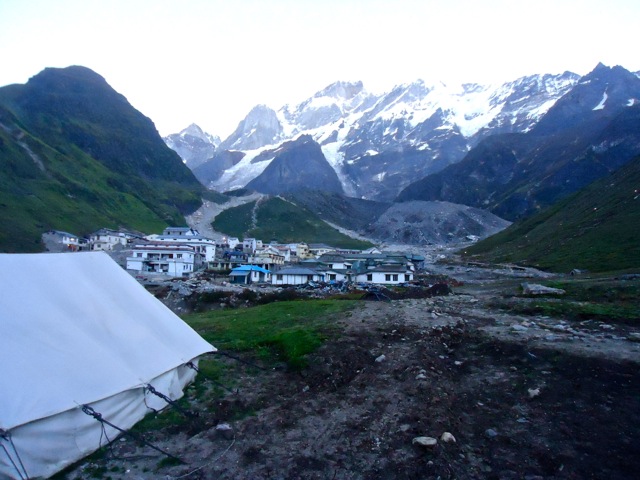
I wake him with a husky “Chalo!” He pulls himself to his feet, and sways a little unsteadily. When I put on my backpack I suspect some mischievous child has filled it with with rocks tentswhile I was sleeping. We stagger back on to the road. By this point, we’ve both lost any hope of actually arriving. I am feeling vulnerable, breathless and disappointed in myself. I am clearly less fit than I had thought. We pass orderly lines of large white tents, and I suddenly realize we are in Kedarnath. It has taken us nine hours. The place looks like a bombsite. Hardly a building is standing. I spot the temple in the distance on the far side of the town. I turn to my friend. It is time to part.
“What is your name?”
“Puttiah,” he replies. “And you?”
“Rebecca.”
I clasp his hands in mine.
“I could not have done this without you, Puttiah.”
I hadn’t meant to sound so dramatic. It wasn’t as if we’d just climbed the Eiger. But the exhaustion and lack of oxygen prove a heady cocktail. I can feel myself tearing up.
He raises my hands to his forehead.
“Same to me. I shall never forget you.

We go our separate ways. Unlikely to ever to meet again. But friends forever.
Posted in epoche, Moving on...., Rose Apple Island | Tagged , , , , , , , , , , , , , , , , , , | Leave a comment

Journey of a neopilgrim – Kedarnath (part 1 of 3)

There is no happiness for him who does not travel, Rohita! Thus we have heard, Living in the society of men, the best man becomes a sinner….Therefore, wander!

Indra (Protector of Travelers) to a young man named Rohita

September 9, 2015

DSC09671It’s 6:15 and the Uttarakhand mountains are busy steaming up slow-moving clouds into the early sky. Swathes of cloud are literally flowing from mountain tops like the steam from coffee mugs. It is condensation in progress. Far more engaging than the diagrams called How Precipitation Works I hazily recall from geography class. Arrows on paper are forgettable, but drag a schoolchild up a mountain and stand them in the rain and they’ll be sure to remember the lesson. Far below and to our right as we head north, the Ganges flows south, gleaming like a platinum chain necklace.

DSC09676I’m on my way to do yātrā—Sanskrit for ‘journey’ or ‘procession’. Tirtha-yātrā is a journey or pilgrimage to a holy site. I am heading to Kedarnath, the most remote of four sacred sites in a Himilayan pilgrimage circuit called Chota Char Dham (‘small circuit of the four abodes’ since there is another Char Dham that covers a greater geographical area). The other three sites in the Chota Char Dham circuit are Badrinath, Gangotri and Yamunotri, all in the Northern Garhwal region, around 50 kilometres as the crow flies from the Tibetan border. Badrinath is a seat of the god Vishnu, the Preserver. Gangotri and Yamunotri are both goddess sites. Kedarnath is a seat of Shiva, the destroyer, and was the epicenter of the floods and slides in June 2013 that become one of the worst natural disasters in the nation’s history. I had found myself just three days earlier, researching guesthouses and booking taxis, and inspecting backpacks and shawls in the shops in Rishikesh, with a gently focused compulsion. I didn’t tell many people I was going. This compulsion felt private in effect and universal in origin. But not social. Not social at all.

DSC09796I kept my intentions to myself, partly because I didn’t want to jinx it, and partly because I wasn’t sure I could satisfactorily explain my motives. For one thing, I am not a Hindu. I am drawn to do this, as I have found myself increasingly  ‘drawn’ to places rather than ‘planning’ the next trip. Plans, such as booking travel tickets and hotels and such are simply the technical responses to this draw. The question, ‘Where do you plan to go next?’ becomes a bit of a non sequitur. These days it feels more as if I am pulled somewhere like a swallow is pulled south in the winter ‘whose way and motion is a harmony and dance’ as Wordsworth said. Well, at least that’s the idea. The reality is often awkward, messy, sweaty, exhausting, frustrating, and occasionally intimidating. Still, I wouldn’t have it any other way.

DSC09696Arjun, my driver, stops for chai and we take the measure of each other. He is gentle and carefree and seems happy that I’m doing this. “You will see the power of Shiva,” he promises, reminding me of the famous temple at Kedarnath that some claim is 6,000 years old. Arjun’s mood, already maintaining a position well towards the upper end of the positivity scale, improves noticeably as we get deeper into the mountains and further from the hubs of commerce. A youth stands in the road and waves a blue flag at us. Arjun explains that he is letting Char Dham pilgrims know that there are free refreshments, all funded by individual donations. The CD player grinds out a percussion-heavy chorus that somehow reminds me of Welsh male choirs. It blends well with the scenery.
“This is Garhwali music,” Arjun says, proudly.
“Are you Garhwali?”
He glances at me in the rear view mirror and smiles.
“Yes. My family live in Rishikesh thirty years, but this is my home.”
He throws an arm out of the open window and gesticulates at everything between heaven and earth. When we stop for breakfast a couple of hours later, we sit next to the owner who is involved in heated debate with a young man.
DSC09725“I don’t understand what they say,” says Arjun ruefully. He looks embarrassed that he does not know the language of his heritage. “It’s not like Hindi at all.”
Many people here look Tibetan. This is Bhotiya country, the Transhimalayan people who reside in the upper Himalayan valleys between India and Tibet. Things are different here from the plains. I see local women hitch-hiking alone, something I’ve never seen anywhere else in India.
“This is an interesting part of Uttarakhand,” I comment.
“This is not Uttarakhand.”
Arjun is joking, but not quite.

We make good time (only once do the road conditions require me to get out and walk) and reach the town of Sonprayag in the Rudraprayag district by one o’clock. Here, we learn that we can’t travel the 5 km to Gaurikund by car, where I had planned to spend the night because the road is still under construction from the damage inflicted in 2013. We are surrounded by around 40 bored-looking semi-employed young men, mostly taxi drivers and mule herders neither of which I’m intending to recruit. I feel suddenly self-conscious, reluctant to exit the car. The Kedarnath yatra is open from mid-April or May through until Diwali (New Year) around October/November. Chota Char Dham used to receive 2.5 million pilgrims annually, but numbers dropped dramatically after 2013. The last spike in visitors was in June/July during Shravan, the holy month dedicated to Lord Shiva. From September 17 it will spike again with the start of Ganesh Chaturthi. But now is a definite lull. I am the only foreigner, and also the only woman that I can see. I often find myself wondering where the women are in India. They seem as elusive as Snow Leopards. As a Westerner, I represent the hope for some fast cash, a hope I dash almost instantly by announcing that I plan to walk the whole way rather than hire a mule. I am, thereafter, looked upon with a kind of sullen disinterest. Arjun is shuffling his feet, obviously itching to get back on the road.

I head towards the GMVN office. The acronym stands for Garhwal Mandal Vikas Nagam; a state government agency that oversees tourism activities in the Garhwwal region, which is largely related to pilgrimage. I feel a DSC09797bit relieved when a kindly gentleman is able to explain to me in passable English that I need to register as a yatri (pilgrim) and that the registration office opens at three.
“Single person?”
The question is many layered. “Yes, single person,” I reply.
I brace myself for a two hour chai session as he casually adds, “And you also get medical check.”
I wasn’t sure I’d heard him right.
“My what?”
“All pilgrims must take medical check.”
What could he mean? All kinds of unsavoury images spring to mind, mostly involving sharp shiny instruments. All further inquiries from the staff behind the registration windows are rebuffed. They won’t speak to me. It is not yet three o’clock. In a country where only 2% of things happen on time, that 2% can be surprisingly intransigent. I find a tiny chai stall and stuff myself and my backpack in a dark corner, scrawling notes in my journal while being silently assessed by the other customers. I write, Possibly in over my head at last.

I return to the GVMN offices promptly at three. A sign the size of the window boasts a new Android application for pilgrims offering ‘real time self-navigation’, and access to emergency services. The clerk throws me a suspicious look and grabs my passport.
“Single person?”
“Yes.”
This is obviously highly irregular.
DSC09826“Go police,” he barks.
I try not to sound unnerved.
“Police?”
He motions dismissively towards an office perpendicular to his. On the veranda, one policeman and a heavy set man in plain clothes are seated on plastic chairs.
“You need go registration,” says the heavy man before I can say anything.
“But they sent me here.”
I decide the best policy is to silently refuse to move while smiling innocently. My presence was bound to become irritating sooner or later and they’ll be happy to be rid of me. Perhaps suspecting my tactics, the plainclothes man enters the office and returns bearing a large musty register. After a few false starts, he begins—rather reluctantly—to jot down the relevant details from my US passport, during which he looks up to ask. “Single person?”
I nod to confirm.

DSC09828It proves an impressively incremental procedure, with an additional five minutes of rummaging through the office desk drawers to find a workable pen. Somehow between us, we complete the form, though I am unable to stop him writing ‘United Kingdom’ in the box asking ‘country of origin’. I return to the registration officer who equally reluctantly issues me with a pink receipt slip and shoos me into an adjoining office. I am relieved to discover that the medical check up consists of a blood pressure test and two questions. Am I a single person and do I take hypertension pills? No, did he think I needed to?
“Your fitness level very high,” he says, which I find encouraging.
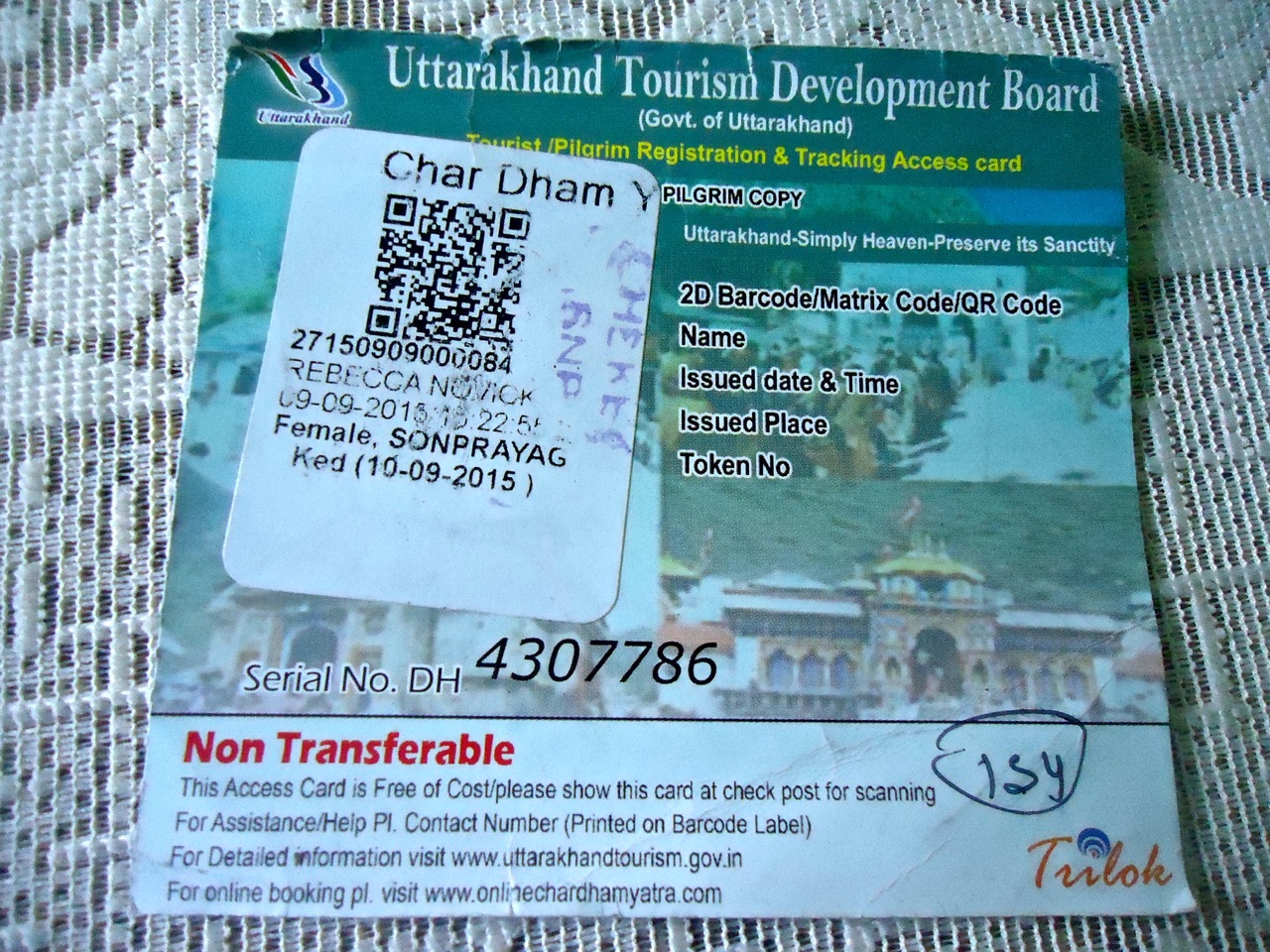
DSC00087I am presented with a “biometric” card, that officially establishes me as being in adequate physical condition for the journey ahead. On the back is a brief message in English, Hindi, Malayalam and Tamil from the Ministry of Health & Family Welfare about the merits of breast-feeding babies up to six months. I had my own bar code and a hand-written number. I am a card-carrying pilgrim. Number 154. No one has asked me for any money. But I am still unclear about the logistics. An internet search had generated conflicting results. The old road from Gaurikund to Kedarnath had been washed away in the floods and an entirely new route built in 2014. I’d been quoted anywhere between 16 and 22 kilometres.

This did not sound especially far, but the route spanned altitudes between 2000 and 3500 metres. I had traveled to high altitude regions before; Kashmir, Ladakh, Spiti, and Upper Kinnaur—and to some domains significantly higher than where I was headed. But I had not trekked in those places and I wondered how my middle-aged body would cope. Come to think of it, I had never trekked in my life. Before I left Rishikesh, a friend and experienced trekker had asked me if I had any trekking experience.
“I’ve gone on lots of long walks, does that count?”
She hadn’t said anything.
I finger the biometric card in my pocket, as if its existence alone could guarantee physical endurance. I strap on my backpack and merrily trot through the next police barrier heading for Gaurikund, 5 kms north. Sonaprayag is a one road town, so even with my poor sense of direction I was in no serious danger of getting lost. I wave cheerfully at three policemen stationed in a wooden hut the size of a garden shed. One of them waves back but then shouts something in Hindi. I decide to ignore it and keep walking. I hear more shouts and pick up the pace. I’m in no mood for a repeat performance of the two-hour interrogation by Delhi police two years earlier. I can’t let this whole crazy venture be scuttled by a petty bureaucratic technicality pounced upon by some bored jawan scanning for CIA plots in the bottom of his chai glass. A chilum-soaked saddhu with rasta hair and loincloth leans down from a rock temple.
“Kedarnath?”
“Yes! Om Namah Shivaya!”
“Om Namah Shivaya,” he says, his hand raised in a kind of salutation.
It’s like a gateway. A test. The saddhu has blessed me. I’m good to go!

But then the whistles start. By this time I have crossed an iron bridge and am picking my way through a construction site. A road worker lopes up alongside me and points urgently to our rear. I wave my hand in a ‘don’t worry I’ve got this under control’ way and pretend to be on the phone while my heart starts to race. The whistles begin to fade and I relax a little. But then they start up again and this time they sound fully insistent. Oh my god! Can they please stop blowing their whistles? I just want to go on pilgrimage! I keep going, banking on the jawans being too lazy to pursue me very far. But I am wrong.
DSC09833“You not hear whistle, madam?”
The policeman’s face is more perplexed than angry. I mumble something about having been absorbed in prayers, feeling uncomfortable lying, and even more so for lying about a religious practice.
I’m still walking but the return to the checkpoint is inevitable. The policeman slows down and I give up and turn to face him.
“Stamp! Stamp!”
With a flash of clarity simultaneous with a slight pang of shame I realize that all he wants is to stamp my registration card. We walk back together to the police post, where (to make me feel even worse) he buys me a chai and lets me take his photo. This false start is the first in many lessons from the yatra guru—the teachings received through the very act of pilgrimage itself. I didn’t need to elbow my way in and insist on a place in the queue. I was already there. The path was already open. I just had to walk it. The jawan was far more forgiving than he needed to be and I had been far more stubborn than I needed to be. Trust. Trust is the first lesson.

DSC09832The second is patience. It turns out that the police are not letting anyone through the checkpoint until 4 pm. It is now a quarter to four. I am the only one there. Couldn’t they bend the rules a bit? No. It is impossible. Quarter to four and no sooner. I sip my chai and consent to discuss the relative merits of Barack Obama and Narendra Modi with the cops and respond to the occasional inquiry about being a “single person”. By four o’clock, eight other people have gathered at the checkpoint. A middle-aged man and his son, a jolly group of four students from Delhi, and two single men; a tiny curly-haired barefoot fellow from Tamilnadu, and a thin laconic serious-faced youth. When we at last get the all clear to forge ahead, and begin to make our way north along the half-built road, I see the sense of keeping strictly to a common starting time. I was beginning to understand that everything going on around me was for the protection of the pilgrims. If everyone set out at the same time, then the police could keep track of who was on which leg of the journey. If one of us didn’t turn up at the next registration post, an alert would be raised and a search would ensue.

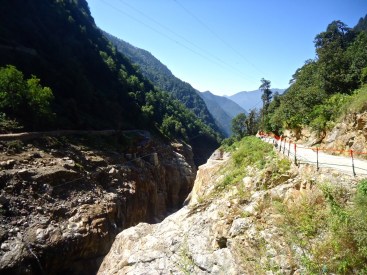
The silt and gravel road soon diverted to a wide path paved with flat rocks to prevent slippage and lined with a railing painted in the colours of the Indian flag. Only one DSC09835kilometer in, and the concrete huddle of Sonprayag slipped effortlessly behind me and soon disappeared behind a bend. As I head up a series of switchbacks, forested mountains encircle me like a mother’s arms. To my right, mountain slopes of pine, oak, birch and rhododendron, sliced by waterfalls the length of skyscrapers that plunge into the Mandakini river, barreling through the ravine with a pounding roar or low rushhhhh depending on the relative acoustics of my circuitous ascent. To my left, a lushly shifting rock collage of moss and lichen rummaged by fat-bottomed lizards is interspersed with waterfalls cooling the surrounding air like a natural AC, and glacial water springs where I pause to splash sweat from my neck and face. The number of pilgrimage sites in Uttarakhand is why it is known as ‘Dev Bhoomi’—‘God’s country’, but the landscape alone seems a suitable stomping ground for any passing divinity. An ebullient post on Tripadvisor asserts, in such surroundings ‘even an atheist would get involved with the feeling of spiritualism’.

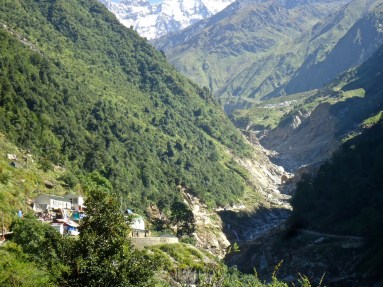
I pace my stride to try to keep in occasional sight of at least one of my fellow pilgrims. My sense of security stems from a trust that those of us who share this road also share some common values, but I am also breaking the golden rule of the solo female traveler by walking alone in the wilderness. The little Tamil man keeps looking back DSC09839in my direction, as if checking on me. I arrive in the mountain village of Gaurikund one and a half hours later. I actually walk through and out the other side before I realize there is no more to it. At 6,000 feet, the town provides a base camp for the Kedarnath yatra, and until the road is repaired, it can only be reached on foot or by horse. There are two streets. One winds down into a staircase to the riverbank. The other continues on and up 17 kilometres and another 6,000 feet into the Garhwal Himalayas. Gauri is another name for Parvarti, Shiva’s wife. It was here, legend goes, that she performed a series of ascetic practices to win his affections, while he remained unmoved, deep in meditative retreat and in mourning for his deceased wife, Sati. Even when the God of Love shot arrows at him, intended to make him fall for Parvarti, Shiva opens his Third Eye and incinerates him on the spot, returning to his meditation as if nothing had happened. But meantime, as Parvarti’s own spiritual practice deepened, she developed complete control over body and mind and came to realize her true self as the universal goddess, Mahadevi. Eventually, the fervor of her realizations generated an intense heat that threatened to set the whole region on fire and shook Shiva from his meditative state. When Shiva went to see what was going on he found Parvarti–no longer a love-sick maiden but a force of nature. It was through the intensity of her love for him that Shiva came to realize his own power. Shiva and Parvati are the most passionate couple in history. For one thousand years, they did nothing but have sex, and didn’t even speak to another soul. Their passion made the earth tremble and the gods blush.

DSC09865Gaurikund is also the place where Parvarti, while bathing in the hot springs, is said to have fashioned her beloved son, Ganesha, out of the soap suds from her body. Gaurikund’s hot springs were converted into a public bathing place, but were entirely destroyed, along with much of the town, in the natural disaster of 2013.

After one or two inquiries, I find the Tourist Rest House tucked away down a short flight of stone steps. I hadn’t booked a room, finding the online booking form confusing and deciding to trust the travel agent in Rishikesh who told me not to worry since it was low season. Fortunately, he was right and the place is only half full. Again I find myself the only woman, something I am going to have to get used to on this adventure. After another marathon form-filling session (into four separate ledgers), I am shown to my room by Palao, the earnest and diligent manager. It’s a bargain at 700 rupees; spacious with a large bathroom and plenty of hot water, and a double bed with spring mattress (Indian mattresses seem to have a personal grudge against human comfort). Palao’s uncle makes me yellow daal, chapati and aloo jeera. It tastes utterly amazing. I regret not having bought a map. There’s one hanging in the dining hall, but it’s faded and upside down. I twist my head around to try to figure it out and get suddenly dizzy. I check my phone. There is no reception. There is no wifi. The TV in my room has no signal. I can’t quite explain why this makes me feel so happy. But it does.

Palao hands me a chai on the balcony that affords a soothing wooded vista half way between the riverbed and the mountain rim. I pull a woolen shawl around my shoulders, welcoming the chillier air after the energy-sapping humidity of the plains.
“Nice view.”
He looks with me across the ravine.
“Before 2013, three large guesthouses were there.”
I scan the hillside but can find no evidence of any buildings having been there. Not a single cement block or piece of foundation.
“One guest house all 300 people die.”
The beauty all around me trembles a little as I take in this news. It will tremble some more in the days to come.

Posted in epoche, Moving on...., Rose Apple Island | Tagged , , , , , , , , , , , , , , , , , , , , , , , , , , , , , , , , , , , , , , , , | Leave a comment

Radical friendship and the end of the guru

DSCF0017For three days now I’ve been stalked by a saddhu. Wherever I stop to drink chai or pause to circumvent a cow, he’s there. Tiny and persistent, with standard issue trident, topknot, and road safety orange robes. Our exchange is always the same.
“I can be your guru. I can teach you many things,” he says.
“But I don’t really want a guru,” I reply.
I’m not sure he even hears me. His eyes are glassy. Even looking right at me, he doesn’t seem to see me. He is on the street, peddling liberation. Just like the postcard seller at the Laxman Jhula bridge, or the ear cleaner with his questionable guarantee of rejuvenated aural faculties.
“I can help you, teach you many things.”
“I’m fine,” I insist.
His stride is shorter than mine and I can speed up imperceptibly and slip into a café where I know he won’t follow. Westerners are batting off gurus in Rishikesh like wasps at a picnic. Every day saddhus attach themselves to foreigners (almost always women) usually on their way to yoga classes. They speak to them intently, with body language broadcasting neediness more than serenity. The women look unmoved, tolerating the intrusion like a local condition of weather or terrain, to be patiently endured. There is almost a hint of sympathy in their expressions; as if somehow they know that the end of the time of the Guru is nigh.

Guru. The word evokes such different reactions in us. From some it elicits devotion, for others suspicion, skepticism, even mockery. In the 2012 documentary, Kumaré, Indian-American filmmaker and lapsed Hindu, Vikram Gandhi, becomes a temporary guru, enticing Western students with a philosophy hobbled together from Vedic teachings and slogans from Nike and US Army recruitment ads (he even translates ‘Just do It’ and ‘Be All You Can Be’ into Sanskrit*). His stated intention for this rather elaborate project is to teach that gurus are unnecessary for inner development and happiness after personally becoming convinced that most gurus are self-deluded charlatans. His insistence upon spiritual self-reliance, however, only seems to endear him more to his students, and further convince them of his authenticity as a ‘real’ master. At times the film is painful to watch. While Vikram repeatedly maintains that he is a fake guru and that no one can lead his students to inner peace but themselves, their eyes grow wider with devotion. It is all strangely reminiscent of a certain scene in Monty Python’s ‘Life of Brian’.

Regardless of your opinion about the ethics of this social experiment, the film is a fascinating exposure of the power of spiritual projection. In fact, Vikram uses the metaphor of a mirror throughout, always claiming that what his followers are seeing in him is only a reflection of their own potential. And what is fascinating to watch is that although they are following someone who is merely acting a part, their lives actually start changing for the better. Even when Vikram reveals that he has made the whole thing up, the majority of his students accept it as another teaching with no hard feelings.

I watched Kumaré (at the time of writing it is still findable on Youtube) during a period of reflection on the guru/disciple relationship. I sense that the desperation of the Rishikesh saddhus is a sign of a new Zeitgeist. We’ve heard of post-feminism; post-modernism, post-capitalism, even post-idealism. I believe than in order to evolve and fully claim our spiritual heritage, we need to embrace post-gurusim.

DSCF0021For eighteen years until his death in 2009, I was the student of a Tibetan Buddhist teacher. His name was Geshe Tsultim Gyeltsen. More than any other branch of Buddhism, Tibetan Buddhism emphasizes the guru-disciple relationship in the context of “guru devotion”—an attitude to one’s spiritual teacher that is radically receptive (or submissive depending upon the disposition of the student). This involves complex meditations where the student mentally engages with the teacher as a template for enlightenment – the ‘mirror’ idea that Vikram toyed with in his experiment – along with receiving teachings on classical Buddhist texts appropriate to the lineage to which the teacher belongs. The essential idea is that the guru, if followed perfectly, will lead you to the realization of your inner guru. I consider myself incredibly fortunate to have had a teacher like Geshe Gyeltsen. I took the process so seriously, that I studied under him for seven years before I even accepted him as my guru. (When I asked him after this time if he would be my teacher, he just laughed). He always encouraged me to be more confident, and never seemed especially happy when I prostrated to him. He himself was intensely devoted to his own teachers, particularly to the Dalai Lama, but he always remained firm with me when I felt tempted to unquestionably surrender my own judgment to his.

On a number of occasions over the years, I had the opportunity to spend many precious hours with him going over the drafts of the books I had edited from his teachings. During these times, he would often ask me what I thought of a particular change here or there. I was so in awe of him, I found it hard to articulate any disagreement with his opinion. But during these sessions, I learned that voicing a different point of view is not a sign of disrespect, as long as that point of view is genuine and mindfully asserted. In fact, to comply with spiritual authority merely out of faith is an abdication of responsibility. Perhaps this is why Geshe la so often brought up the Buddha’s counsel to his disciples to never accept what he said merely on faith but to always test the value of his teachings the way a goldsmith would test for the quality of gold.
My teacher never claimed to be clairvoyant (although I have reason to believe he was) and he was humble about what he did not know. People would come to him for all kinds of reasons: from requests for prayers for dying loved ones and questions about their spiritual practice, to whether to ditch their boyfriend or buy a new sofa. Although he tolerated the trivia, Geshe la kept focused on his job description; to teach the path to enlightenment as it had been taught to him. The temple politics and jostling for position among his students was sometimes hard to stomach. Shortly after he passed away, I had a dream where he showed me up a long path to his temple. Inside, there were a number of rooms. In one room, some of my fellow students were arguing, in another, one was crying, and in the puja hall, another was being enthroned as the new guru.
“Where is your room, Geshe la?” I asked.
He pointed to a tiny windowless room in the basement that was little more than a cellar.

After the passing of my teacher in 2009, I imagined that sooner or later I would find a new one. I remained open to the possibility, attending Buddhist teachings here and there, observing the guru-disciple dynamic with a certain fresh distance. But I was not in a hurry to re-enter that relationship. At one teaching by a Tibetan lama who had become especially popular with Western women of a ‘certain age’, it was clear that I was fast becoming uninterested in formal Buddhism with its traditional teaching methodologies. Although I had no issue with what this guru was saying, I was less and less able to relate to the hierarchical architecture of instruction through which he was saying it and the strange atmosphere of pride and elitism around his students.

I then spent two years organizing international Buddhist conferences. At the first one there were over 900 delegates that included some of the the most prominent figures in the Buddhist world. This gave me the opportunity to study gurus up close and personal. Though many of them were sincere, I witnessed first hand a disheartening amount of posturing and spiritual competition. Some of the behaviour was so shocking that one of my volunteers felt like quitting. “I thought Buddhists were supposed to be nice!” she moaned. I’ll always remember the comment of a lovely gentleman who to me embodied the best of Buddhist wisdom and compassion. “No matter how big the stage, it is never big enough for more than one saint.”

After this experience, I began to study Buddhism from an academic perspective, through a Masters degree in Buddhist Studies from the University of Wales. Over the next three years, I became exposed to the sutras for the very first time—the texts purporting to be the actual words of the Buddha to his followers while he was alive. In all the years of studying Tibetan Buddhism I had never read a single sutra since the tradition is to teach from the commentaries on these sutras by Indian and later, Tibetan, masters. The authenticity of some of the sutras is up for debate, but these texts, faithfully transcribed, translated and transported from culture to culture throughout Asia, are the closest we have to a record of what the Buddha actually said.

Studying these texts gave me pause in my identity as a ‘Buddhist’. Nowhere did the Buddha suggest that his realizations were beyond the reach of ordinary men and women, and he always insisted that his realizations were not unique, that he had merely discovered an ancient pathway walked by humans who came before him (SN 12:65). Apart from setting the ground rules for a harmonious community of ascetic monks, it didn’t seem to me that he was intentionally trying to found a religion. For one thing he refused to appoint a successor. ‘You are your own protector,” he told his devoted attendant, Ananda, in the days close to his death, when asked who the monks could turn to for direction without him. These are not the actions of someone wanting to create an institutional legacy.

DSCF0021In 2010, I visited key places of Buddhist worship, such as Bodhgaya in Bihar, widely considered the Mecca of Buddhism, where it is said the Buddha achieved enlightenment under the Bodhi tree. For the first week after his awakening, it is written that the Buddha sat under the Bodhi (awakening) tree in a state of bliss. The second week, he moved to a hill about 20 metres away and gazed at the tree in gratitude. There is a little temple there now, and this is where I seemed to spend a lot of my time gazing at the extraordinary Mahabodhi temple. It looked like a spaceship built by an ancient race of god men and at night was lit from below in a way that gave the impression that the whole structure was about to lift off from the earth and head out into space at any moment.

Bodhgaya, especially the inner temple-city of Mahabodhi, is a truly other-worldly place. It was so overwhelming that it took me an entire day before I felt able to walk around the inner circuit. At one point I saw this huge tree and noticed that it seemed to be emanating waves of love. It had this vast generous presence that was extraordinarily powerful and gentle at the same time. It hadn’t dawned on me yet that this was the famous Bodhi tree since there were many trees of this species—the peepal—growing around the temple. I just knew that I wanted to be near it. It was only when I looked for somewhere to settle myself that I noticed about 25 people seated in silence beneath its branches, one of which was so massive and low that it had been propped up by a large plank of wood with a U-shaped support, giving the impression of a venerable old person leaning on a cane. I sat there for three hours beneath a statue of the Buddha staring at a candle flame while waves of chants rose and fell from every direction. Upheld by the collective wisdom of those past present and future pilgrims, I experienced a level of single pointed concentration far beyond anything I had previously known. By the time I stood up, I knew I was no longer a Buddhist. When I walked away from that Buddha statue I was not walking away from the Buddha’s teachings, but from the idea of the teacher as an object of worship with a backstage pass to enlightenment. Pure devotion is a beautiful and inspiring attitude when it is aimed at a genuine teacher (the alternative is a soul-level violence from which it is not easy to  recover), but at that moment the whole thing began to look like a circus. A profound circus, no doubt, but a circus nonetheless. The ringmaster was the Buddha himself, one finger pointed at the sequined acrobats and lion-tamers, another at an empty ring of sawdust on the ground.
“I never intended any of this” he whispered. “You are your own protector.”
An old Nepali monk sidled up to me and asked me for my phone number through a set of rotting teeth, two decades of identity as a ‘follower of Buddhism’ slipped away as smoothly as a silk cape from my shoulders.

There is a beautiful passage in the Uppadha Sutta (SN 45.2) involving a conversation between the Buddha and Ananda. Ananda praises ‘admirable’ friendship, companionship and camaraderie as being “half of the holy life.” To this the Buddha replies.
“Don’t say that, Ananda. Don’t say that. Admirable friendship, admirable companionship, admirable camaraderie is actually the whole of the holy life.”
The Buddha goes on to explain that when a disciple has admirable people as friends, companions and comrades, he can be expected to develop and pursue path to liberation.
Here it is. The new paradigm of post-guruism, spoken by one of the most influential gurus of all, two and a half millennia ago.

“It’s not like there aren’t any realized beings in Rishikesh,” says Mark, who has lived here for twenty years. “There are. But you won’t see them running after foreigners. They rarely even come into town.” He pointed his chai glass in the direction of the hills. “They’re out there in the forest. Getting busy with enlightenment.”
The next day I met Peter, a fifty-five year old Dutch hippy. He told me a troubling story. He had fallen asleep drunk in a Delhi train station. In the morning his wallet was missing along with 50,000 rupees. I was less than sympathetic.
“You broke every rule in the book. Why on earth were you carrying that much cash with you? You got drunk and fell asleep in a train station!??? Would you do that in Holland? Did you want to get mugged?”
He looked down sheepishly at his battered trainers.
“I thought this was a spiritual country.”
I burst out laughing.
“Then I came to Rishikesh. A saddhu took me to his cave and asked to use my laptop. We got stoned together and I fell asleep. When I woke up, the saddhu and my laptop were gone. I feel so angry. He said he was going to give me teachings.”
“He did,” I replied. “He taught you not to fall asleep and leave your laptop with strangers!”
Although my heart went out to him, I sensed he wanted some tough love.
“What do you think I should do?” he asked.
“Either go home or stop being so naïve.”
There it is again. A glimpse of the recalibration of the politics between the knower, the known and the as yet unknower/unknown. I see Liberation Camaraderies replacing Mystical Theocracies. The shapes in my mind are not pyramidal, but spiraling. Here, the number of pathways to liberation are infinitely diverse but with a common ground of deep interdependence and common concern. Seekers tune in to what they need to hear like radio signals, sometimes getting a hug, other times a loving kick up the backside. I see a lively jumbly caravan of jijñāsus – the “inquisitive ones” – off to sea in a sieve, hell bent on wringing at least one drop of beauty and humour from even the darkest shadows of the world and returning with tales from the Chankly Bore. Somehow those passing over one line of latitude find themselves sitting next to someone who passed it last month – even if only to hear ‘yes, I crossed over and I didn’t die’. On these journeys, travelers leave notes, clues and spare pairs of socks, admire each others compasses, compare scars, and swap old maps and new yarns. There are experts among them to be sure. Some are renowned sailors or mountaineers. They give the occasional lessons and then themselves attend lessons for the gaps in their knowledge. None of them are a one-stop-shop sage. Wisdom is horizontal not vertical. But I still can’t seem to quite get the measure of it…

DSCF0021It is my last day in Rishikesh and I want some time alone, on the banks of the Ganga. With its gluttonous swarms of humanity that can bully the social animal right out of a person, the urge to be alone in India can become almost an obsession. No surprise that this land has spawned so many hermits and solitary seekers. Behind me I hear a squeaky, “Madam ji!” and know with an inexorable sigh that it’s the voice of the tiny saddhu. Somehow, he has found and foiled my quest for solitude. As I walk back to my hotel, he skips up alongside me with his well-rehearsed salesman’s pitch.
“Come to my cave,” he entices. “You can be my student, I can teach you many things.”

As I look into his eyes, my irritation dissolves. There it is again, and this time it takes shape completely. A gentle but inevitable reciprocal adjustment of the classical didactic posture of spiritual education. I see a world where admirable friends and companions support, share and laugh with, advise, love, comfort and hold one another; tolerate each others phases of grandiosity, crudeness and stubbornness, and never give up on the fundamental belief that we are all in this together, that just as in outer space there is no ‘higher’ or ‘lower’ – only galaxies spinning stories into the void. In this world, my guru can be the man who hands me my roti in the morning, the young girl who makes it, or the monkey who tries to steal it. In this world, liberation is not a destination, but a natural condition of life itself, as wet is to water or hot is to fire. Where symbiocracies replace mystocracies. Where radical friendship replaces guru devotion. And where ‘awake’ can mean many, many things.

*Karam Yaivah Dikaarastha – Just Do It; Sarvau Bhaav – ‘Be all you can be’

Posted in epoche, Rose Apple Island | Tagged , , , , , , , , , , , , , , , , , , , , , , | 6 Comments

Hitchhiker’s guide to duality

elephant signThe tall slender Sal trees of Uttarakhand’s Rajaji National Park shuffled passed the car window, fast as a deck in the hands of a Vegas card shark. I had heard that these forests either side of the Rishikesh-Dehradun highway are home to around 500 elephants, and that very occasionally they ventured out onto the road and attacked passing vehicles. Eighteen people have been killed by rampaging bull elephants (‘tuskers’ as the Indians rather endearingly call them) along this route, including some who have been crushed to death through the metal frame of their vehicles. The reports like this one from the Hindustan Times are sobering. ‘While Devi’s son and daughter-in-law got down from the car and managed to run away from the scene, the elephant caught her by its trunk. The tusker repeatedly pummeled Devi against the ground killing her almost instantly.’

Prem, my ever-smiling driver, told me that now no one travels this road at night alone any more. The police have set up a barricade after dark where traffic must wait until there is a convoy. At the other end of the elephant road the cars get to go their separate ways. Prem is not a fan of this approach.
“This is more worse than driving alone. If one elephant comes from one side and one from other they can block everyone. And then, can you imagine? This is very danger.”
I nodded in agreement.
“Have you ever been in danger from an elephant?”
“One time. I was traveling in a jeep in Corbett National Park with few Westerners. I wasn’t driving. An elephant charged our vehicle. The driver reversed for over a kilometer. His driving was mind blowing. The girls they did pee pee in their pants. It was a horrible.”

I peered into the pack of trees, imagining that I saw a flash of tusk, a muscle twitch, the flap of a giant ear. But there were just trees and more trees extending into all that was visible. A light grey figure loomed upon us from the roadside, so suddenly that I thought we might to run it down. Then another, and another, four men lingering, at the edge of the forest, covered in what looked like chalk dust, with long matted hair, wearing nothing but tiny cotton dhotis.
“Who are they?” I asked.
“They are bad people. They eat humans.”
“Aghoris!?”
“Yes.”
I had heard tell of these peculiar saddhus from some boatmen in Varanasi. They are devotees of Shiva (though most other Shaivites consider their practices utterly bizarre) They adhere to the unity of opposites and pursue social taboos to experience non-duality, to the point of losing all discrimination in both thought and action between the vile and the desirable. They meditate on corpses, live on raw human flesh and have been known to chew the heads off live animals. One night a boatman had shown me a video about them on his phone. I was utterly amazed to watch them picking up half decomposed body parts out of the Ganges and tucking into them like they were prime rib at a steak house.
We passed by the group and noticed that the last one was gesticulating towards the passing traffic.
“Is he asking for a lift?”
“Yes.”
This road was getting more interesting by the minute.
“Ooooh. Let’s give him a ride!”
I began to ponder all the questions I wanted to ask him.
“No, No! This is not good human beings!”
Prem laughed nervously.
“They wear human bones like jewelry. They eat people!” he added, as if he thought I had missed that singular detail. If a bull elephant had charged out of the forest right then, I thought, his anxiety would not be much higher.
“I know,” I replied, seeing his point, “but how dangerous could he be just sitting in the car?”
I entertained a fleeting fantasy of having this same conversation back in the English suburbs with my Aunt Jean. Prem looked unconvinced, but slowed down anyway.
“Their bodies are covered in human ash from cremations,” he said as a final protest. Hmmm, was he more worried about cannibalism or his upholstery? The aghori snatched a penetrating glance at me as we passed.
“Awww, c’mon Prem. I’ll protect you.”
“Oh, alright.”
The subtext went something like, “But if I get eaten I’m never forgiving you.”

The aghori looked momentarily surprised when we stopped. He jogged up to us, and opened the car door. After a brief exchange with Prem, he jumped in. The sudden twinge in my stomach signaled that my bravado had once more over-stepped my courage. But surely, the man wasn’t going to tear Prem’s arm out of his socket while he was driving! Even cannibals must have some code of honour, even if they do fall short on table manners.
“He’s going to Rishikesh,” explained Prem.
He was by far the strangest hitchhiker I’ve ever encountered. His hair was so matted with ash and dirt that it seemed to have fossilized into his head. I couldn’t even see the skin underneath the thick ash coating, that had cracked to form tiny lizard-like scales. He shifted in his seat as if unused to being in a vehicle, and rested his tiffin tin on the floor in front of him, while Prem eyed him nervously.
“Can I ask him a question?”
Prem relayed my request it in Hindi and the aghori consented.
“Why do you need to eat human flesh? Can’t you gain spiritual understanding without doing that?”
While Prem translated my question, the man tugged the rear view mirror in his direction and looked at me through it. His face was caked in a clay of blue-grey ash and dirt. His eyes looked jaundiced. I felt as if I were talking to a ghost. He began to speak, slowly, still looking at me. I wanted to look away from him but he had me transfixed, and I felt he knew it. Prem translated his answer.
“Spiritual understanding does not come so cheap.”

I stared out the window into the heart of the Sal tree forest. Somehow I recalled Buddhist scriptures saying that it was under the Sal tree that the Buddha’s mother gave birth, and it was between two Sal trees that the Buddha lay down to pass away, causing them to blossom out of season. As I continued to look, the trees seemed to lose all definition. It was as if they all became the same tree, or were all emanating ‘treeness’. I turned my observation to myself, and all I could see was ‘me-ness’. I looked at my hand, and there was ‘hand-ness.’ It was like seeing the architecture without the building. But where is the architect? No sooner had this question entered my mind, than the trees, my hands, the taciturn aghori, Prem’s smile, the invisible car-stomping elephants, all began to swirl together like different flavours of ice cream melting in the sun. I wanted to resist, to maintain the Neopolitan certainty of discernible ‘things’, but they kept on glooping into a general sticky ‘thingyness’. The experience was utterly disorienting but oddly beautiful.
“What?”
It was Prem.
“I didn’t say anything”
Surely my voice was coming from someone else’s throat.
“You said something about spiritual practice.”
“Yes, I was talking to the….”
Prem’s questioning eyes flashed at me through the rear view mirror. My heart began pounding against my chest like a prisoner demanding justice. The passenger seat was empty.
“Where is he?”
“Where is who?”
“The aghori.”
“We passed them ten minutes back. Ha ha! Forget them. They are bad people I keep telling you.”
“Right,” I said. “They eat people.”
“Yes! Ha ha. You are learning.”

I rested my head back against the seat and watched the trees disappear through the window as a monsoon downpour sent large gobs of rain quivering against the glass, holding on to their identity for as long as they possibly could before being annihilated in the deluge.

Posted in epoche, Moving on...., Rose Apple Island | Tagged , , , , , , , , , , , , , , , , , , , , , , , , | Leave a comment

The backstrap

gymkhana1A Tibetan friend recently popped up on gchat in a mild panic. The university he was attending in the UK had sent him a contract for his accommodation. “I don’t understand half of it,” he said, “and the language is so intimidating.”
“That’s the point,” I replied. “They don’t want you to understand it. That way they can stiff you later.”

Please refer to section 8 paragraph ii where it mentions that the bedside table should not be moved more than 2.5 cms to the right except during equinoxes. Well, you get the idea.

This is the great British bureaucracy at its garbled patronizing best, the kind that regards everyone like criminally minded five year olds and speaks to them like their criminally minded robots. But there is no truer believer than a convert, and Britain’s constipated legacy is hard at work in India that now carries the distinction of being officially voted the worst bureaucracy in Asia, according to a report by Hong Kong-based Political and Economic Risk Consultancy, scoring 9.21 out of a possible 10. It slows down all manner of everyday social processes like cooking oil in a kitchen drain, creating scenarios that could make Kafka raise an eyebrow. One professor of literature told me that after her mother had died of stomach cancer, she had not been able to cook for three months because the gas board wouldn’t let her refill her kitchen gas cylinder. She had visited the concerned office six times to appeal, but the clerks kept telling her that her mother needed to come to make the payment.

On very rare occasions the small print can actually work in favour of the individual. Two years ago, I went for a meeting at the Gymkhana Club in New Delhi accompanied by another Indian friend. These clubs were set up by influential colonists in the late 19th century for the country’s ruling elite within a model of stiff upper class Britishness “to promote polo, hunting racing, tennis and other games, athletic sports and pastimes.” It now serves as a watering hole for India’s retired brigadier-generals, sports celebrities, wealthy industrialists, intelligence chiefs and the like. Elections for club president are as hotly contested as those at the national level (the one in 2013 was even reported in the international media, where ‘allegations of “dirty tricks” and claims some candidates are trying to lure supporters with glamorous drinks parties’). The language of choice is Queen’s English. We had only got as far as the lobby, before our presence caused an uproar. Seconds later, we were surrounded by no less than four staff members, all looking decidedly nervous and pointing at my friend’s feet.
“I’m sorry, sir” explained one, “we do not accept sandals”.

gymkhanaHe then directed us to an ancient wooden signboard where the club’s dress code was handwritten in faded blue paint. The awkwardness of that moment was priceless. We were here to see an influential club member which made it even more confusing.  They had boxes of spare ties for tie-less visitors, they explained, but did not have spare closed shoes. They fluttered around my friend, bending down, and anxiously examining the offending footwear with the stealth of a bomb disposal squad. My friend looked annoyed and embarrassed. And then, when I thought the tension might actually cause a spring to leap out of the desk clerk’s neck, he squealed.
“Sir! You have a backstrap!”
To which the rest clapped their hands with relief and ushered us in to the dining hall. Apparently, the small print in the club rule sheet stated that sandals could, in fact, be worn, as long as they had a backstrap. My friend’s legitimate presence in the establishment had been determined by a half-inch strip of leather. Although the situation was comical, there was no doubting the implicit social intimidation involved.

And if you think that you’ve got away with something, you’re probably fooling yourself. Once written, nothing is ever forgotten. Made in Britain bureaucracy writes in the blood of your children’s children. The giant forces of the small print will come and hunt you down, even centuries later, with exactly the same tenacity whether it’s student accommodation contracts or international treaties. Just look at the way the British government invoked the 14th century Treaty of Windsor (incidentally, the oldest diplomatic alliance in the world) to ensure that Portugal remained neutral in WWII and the UK could use the Azores as a military base, and again as a navy refueling station during the Falklands War.

Yesterday, I received a more or less incomprehensible end of tenancy agreement regarding a flat I’d moved out of in Oxford. At the end it read: If you don’t think this letter applies to you please disregard. I still haven’t replied, clinging to the fantasy that my inaction will make it go away. But the clause phantoms still taunt me in my dreams, wagging their stubby pen-filled fingers, and rubbing my nose in the small print.
Posted in epoche, Rose Apple Island | Tagged , , , , , , , | Leave a comment