Way of the ninja….yeah, right

anime_ninja_fav1

This is how I imagine myself.
The reality might be a little…erm…different.

Recently, people have been introducing me like this. ‘Oh, Shuili, this is Rebecca. She doesn’t have AC’. To which Shuili will reply, ‘Really? How do you manage?’ Then she’ll look at me with slightly narrowed eyes, like I’m some rare breed of mongoose.

Last year, I swore to myself I would never spend another Summer in New Delhi, and certainly not another without air conditioning. But although it’s still only May, 43 degrees is Summer enough. And here I am, still sweating it out. I’ve got use to my odd little life, so when someone asked me lately to describe my place and lifestyle, I found myself becoming aware of how…well, strange it must seem to most denizens west of the Suez.

I live on the fourth floor of a five story apartment building in a sort of urban village, roughly the size of five New York City blocks. The area is inhabited and run by Haryana Jaats, the descendents of farmers, who’ve done well in the real estate business and, in the city, make their living mostly as landlords. They’re known throughout Indian history for their courage in the battlefield, though unfortunately, these days, Haryana is becoming increasingly associated with stories about rape. One thing I do know about them, they’re very protective of their property. I live in the building, so I get protected too. It’s taken over a year for the locals to get used to me. The staring can be intimidating. But I feel strangely safe here.

My kitchen is the size of a (not very large) closet. I have an office-sized fridge, so I’ve become skilled at packing things into small, irregular spaces. I have two burners (no oven). I don’t have hot water, except in the Summer when the plastic water tower on the roof heats up so much that the ‘cold’ tap spews water that’s scalding hot. A cold shower is impossible. In the Winter, I use an electrical rod to heat water in a bucket. I don’t have a washing machine or access to a launderette, so I wash all my clothes by hand. I keep a flashlight by my bed and a large bucket filled with water in case of a shortage like I’m preparing for doomsday. I can’t drink the water, so I lug 5 gallon bottles up four flights of stairs every other day (elevators are rare in India). I’m plagued by interminable heat, humidity, mosquitoes, almost daily power cuts, and an endless invasion of black soot that blows in from the kilns erected around the city.

Today my internet went down 23 times. I don’t have television, a smartphone or anything that begins with an i. It’s an exciting event when I manage to procure a movie that’s less than five years old, but the noise from the street outside my building is so loud I can’t hear the dialogue without headphones. I don’t own a car. Only three pairs of shoes. In fact, I have few possessions, partly because I hate shopping, but mostly because I like to lead a portable life. When the wind blows from a certain direction, or a strange bird alights on my balcony, I know I have to be ready to move.

In fact, when I go to Europe or the States and see how ‘normal’ people live, with their reliable internet and coffee makers, I don’t get envious. Quite the opposite. Because my life is so simple, I’m not attached to stuff. I could lose it all tomorrow (except for my laptop!) and not look back. If the electricity goes out in the UK, it’s a notable event. Here, it’s just part of the routine. I’m used to things not working, and am mildly surprised (and always appreciative) when they do. I don’t take much for granted and am highly adaptable. After repeated days of plus 44 degrees, I have to add rehydrating solution (affectionately known as ORS) to my water bottle or I begin to start seeing things. I can’t use my bedside lamp because even the additional heat of a 60 watt bulb becomes unbearable. The heat wakes me up sometimes, and I lie awake in a pool of sweat under a single plucky fan, feeling hard core. Do I envy those snug inside their REM-TV, bathed in cooling zehyrs from ozone-eating machines? Nah. Dreams are for cissies.

When the electricity goes out and the fan creaks off, the darkness bakes the heat into flapjacks. I’m a prisoner in Guatonomo Bay, I muse, as I attempt to recall stirring passages from the Koran. Sometimes, I get up and run on the spot for half an hour like I’m training for some top-secret mission deep in the deserts of Rajastan. I’m sure someone will recruit me soon. Other times, I’m just an over-heated ex-pat on a budget and a comic book fantasy.

This morning I looked into renting an AC. Not because I need it, mind. Just that my carbon footprint is so small, I’m getting a complex. Yeah, right….

Posted in epoche, Rose Apple Island | Tagged , , , , , , , , , , , , , | Leave a comment

The danger game

waspsThey sent out a couple of drones at first, hovering inches from my nose, casually racking up data in their tiny sensor fields. Elegant things, the colour of mandarins. Their torsos and abdomens joined by a single cellular thread.

Then they began to build. It was a while before I noticed the nest. Tucked behind my bathroom door. Hmmmm, I thought. What do I do? I decided to wait and see. They hadn’t hurt me yet, I reasoned. I’m not sure why it never crossed my mind to destroy the nest. I live alone and I don’t have pets. Perhaps, it was the company.

Over the next week or so the nest got bigger and more of them moved in. I counted thirty by then. But they were so busy, they hardly seemed to notice me. Occasionally, one or two would hover next to me while I took a shower, but not in any threatening way. Then I went away for a week. The first time I went back into my bathroom, I was immediately surrounded, like bi-planes around King Kong. I was startled, but then I thought, these guys don’t know me. Either they were new ones (not up on the the life cycle of Indian wasps), or they’d forgotten I was ‘friend’ not ‘foe’. I stood stock still, while a dozen of them scanned me for potential threat. After a minute or so they went back to their nest, and continued to busy themselves with wasp-domestics.

It was at this point that it occurred to me to take down the nest. By this time, I realized that the situation had crossed some kind of invisible line. For one thing, I had no idea how to do this without causing myself injury. Secondly, the decision not to harm them had been made over a gradual involvement, dare I say, relationship, that had formed over, what to them must seem like a whole generation. I was the giant entity who came in and turned on the water. I always had kept my bathroom window open, so they had free access. They had found a safe place with resources and no predators. And, like I said, they hadn’t hurt me…”Yet” as Thupten reminded me over a cup of tea.

Were they going to simply freak out one day and go into swarm mode? What if one of them decided I was no good and convinced the other ones not to trust me any more? Who would advocate on my behalf? Electric lights stir them up. I feel a bit vulnerable standing naked while they do their aerobatics above my head, so these days I tend to shower and brush my teeth in the dark. But they still haven’t hurt me.

Occasionally, one of them stumbles into my bedroom and flaps around the lightbulb. Sometimes I managed to get them out and return them to their family. I think I’m getting rather fond of them. Even if they attack me, it’s only their nature, after all. It leads me to half-formed musings on the nature of conflict–national, regional, communal, familial, interpersonal. How often we pull the trigger before the fight has even begun, to protect ourselves from a familiar possibility. But how much more interesting to open up to an entirely new one. And how, perhaps more than compassion, what we really need is mutual respect. To allow for a margin of error between ourselves and a potential foe.

And then I stumble across this. An article about the peacenik paper wasps of India.

These insects seem to have an innate sense of their position in the succession line, and when the time comes for a new queen to take the throne, she is allowed to rule without riot or squabble. This is contrary to the common law of the insect world, rife with wars over territory and the right to pass on genetic material….“As far as we know, this [behavior] is unique among the social wasps,” said Robert Jeanne, professor emeritus at the University of Wisconsin- Madison and an expert on the behavior of social insects.

So, we stay in the moment. My mandarin wasps and me. They, building their little monument to life; me, brushing my teeth in the dark. And no one hurting anyone…yet.

Posted in epoche | Tagged , , , , , , , | Leave a comment

Liminal: the only place to be

liminal1“I don’t want to rush towards the sunrise,” I told a friend a few years back, while describing emerging from a six month-long depressive episode. “I want to hang out a bit in the pre-dawn.” She looked at me across from the Café Coffee Day in McLeod Ganj; a kind of gentle skepticism on her lovely dark-eyed face. The hardest thing to do is to stay in the dark when the sun is rising; and that in itself I found appealing. The popular wisdom would say, “Why on earth would you want to?” But by that time, popular wisdom was like a vitamin pill for cancer. Popular wisdom was the murmurings of those who hadn’t ‘been there’. Couldn’t even find it on a map.

Perhaps if I’d had therapy (which I would eagerly have taken full advantage of if I hadn’t been stuck in India) all this would be different. But I can’t know for sure. When I stumbled upon Andrew Solomon, my Pixie Guide to the Inferno, who had suffered severe depression for two years and written about it, the question that he kept asking was, why are some people more resilient to depression than others? After years of research, this was his answer.

“A lot of it has to do with integration. There are some people who go through depression and as soon as they’re feeling okay, they want to shove it aside, and not think about it, and not look at it, and not talk about it, and in the course of doing all that , ironically, they make themselves more vulnerable to its next ambush because they have dissociated themselves from it and therefore have no new coping mechanisms. And there are other people who have been depressed and who say, “Okay, I would never have chosen this, I would never have wanted this, but having had this experience, I’m determined to find some kind of meaning in it….It won’t prevent you from getting depressed ever again, but it will allow you to tolerate the fact that you do get depressed from time to time.”

Find some meaning in it. Of course. But I went a bit further than that. For some reason, I wasn’t allowing myself to leave at all. It’s the liminal state—the in-between times—where all is decided. Do you move forward or fall back? And if you move forward, how do you proceed? I only felt comfortable in uncertainty. I had become attached to the perils of the threshold.

liminalBut now that I have not gone through a serious depressive episode, apart from a few brief blips, for almost two years, I still hesitate to write about it. Because to write about it, I have to, in some way….return. Sure, I’m not empty-handed now. I have a home-made abseiling kit for that unexpected abyss, a nice long Gandalf staff, a nose mask for the stench of batshit. But I know that I can’t be certain of getting out. I wonder if Andrew Solomon found himself despairing a few times during his brave scrawlings on the walls of the underworld. To return with a candle flame flickering in the wind is the only way most of us can return. And there is nothing that delights the Dark Lords more than a flickering candle. But it is also, I have to admit, what delights the nihilistic daredevil in me.

As more space-time has wriggled its way between my present state of functionality and the sulphur-spewing border regions, it has become increasingly difficult to say anything that either makes sense or seems helpful. So, I’ve stopped trying. The following are a couple of Post-It notes that make a tad more sense than the one I discovered on my bedside table the other morning that read: ’64 hexagrams in the I Ching, 64 codons of DNA…we are time machines!’

In the liminal state, ordinary mundane things have enormous consequences. Like eating regular meals, exercise, not sending that text that you think will explain it all. It’s like training under extreme weather conditions. Nothing feels conducive. But it is possible during this time, to notice our behaviour patterns, as absurd as they might be. It is almost impossible to change behaviour patterns directly in this state, but simply extending our reaction time to events can have a moderating effect on how our mind and body behaves. To learn to respond, instead of react. It is a gruesomely slow process. How can making a sandwich or taking a shower make any difference to such enormity as this? But it does. We can’t see this effect though, in the same way we can’t see photosynthesis, or a wound heal. It’s operating at a molecular level. And so we feel little encouragement and are always ready to give up. But when we choose the sandwich over not eating all day, or we take choose a shower over itchy and stinky, for a while we are not choosing despair. And it is those ‘whiles’ piled on top of one another, that become the boxes we clamber over to get out the window of our mental basement.

As the negative thought loops begin to recede we may make the mistake of thinking that they no longer have the power to affect our behaviour. But they can slam into the back of our head like a boomerang from Andromeda when we least expect it. It is excruciating sometimes, the balance between maintaining a positive outlook while being realistic about where we are. But optimism is not the same as blind hope. It doesn’t mean that we think things will be okay. It doesn’t even mean that we believe we can handle everything. It simply means that we learn to trust in our capacity to respond in an authentic way to what happens to us. A large part of the problem is the tendency to over-react to periods of defeat. So much energy is extended in berating ourselves for succumbing to bouts of despondency. The question, “Why did this happen again?” is not as pertinent as “So, what are you going to do now?” And I’ve found that answers like, “I’m going to overcome this if it kills me” aren’t as helpful as, “I’m going to eat a mango,” or “I’m going to write a birthday card to my niece”or “I’m going out to look at the moon.”

These days, I visit the liminal states less often. They are easy to enter but hard to exit, even after all this practice. The secret doorway is never in the same place twice. I try to make the most of my time there. And I sometimes forget that the pig-nosed guardians at the exit are my own doubts about my right to leave.

To try to unravel the ins and outs of circumstance and events that intersect with our own little nodule of being is a Sysiphian task. You may as well ask why is the wind blowing the leaves of that tree? It’s an impossible question. In the liminal state, such questions haunted me for a while. The wind is not blowing, the leaves are being blown, I would think. Or then. The leaves are not being blown, the wind is blowing them. Perhaps the blowing is taking the form of a wind or is it that the being blown things are taking the form of things being blown? Is there a difference between the wind and its blowing?

I’ve blown it so badly. My mind is now totally blown.

[If you can dedicate blog posts to people like pop songs on the radio, this one goes out to Marty, who first named me the ‘Liminal Gal’ . Oh, and he also said this as a response to this blog post. Perfect.]

Two monks were arguing about a flag. One said: `The flag is moving.’

The other said: `The wind is moving.’
The sixth patriarch happened to be passing by. He told them:
`Not the wind, not the flag; mind is moving.’

Wind, flag, mind moves.
The same understanding.
When the mouth opens
All are wrong.

Posted in An invisible wound: a story of depression | Tagged , , , , , , , , , , , | 1 Comment

Funeral crasher

lights“Do you have a camera?”
The question–barked more than asked –came from a lanky young man in an Orioles baseball cap and a tee-shirt with the words ‘Hot Lover’ splashed across the front.

I’d been aimlessly wandering the back streets behind the ghats of Varanasi, and had accidentally turned up a log’s throw from the funeral pyres at the Burning Ghats.
“No,” I replied truthfully.
He looked surprised and then instantly dubious. Apparently, everyone wants to photograph other people’s funerals in Varanasi.
“Actually, I just want to go back to my guest house.”
I felt uncomfortable being this close to the pyres. Not uncomfortable with the in-your-face deathness, but with invading the privacy of the mourners.
I began to move away and was immediately blocked by a short stocky man who told me I could make a donation for those too poor to afford wood for their relative’s funerals.
“It’s a scam,” said the other man, and lobbed a glob of brownish spittle onto the ground.
I began to walk away, experienced enough to know the following:

1. I basically have no idea what is going on
2. Almost everyone sees me as a walking wallet
3. best to move on…

I’d heard about the wood scam from some other tourists. What a way to make a buck. I imagined the “And what do you do?” conversation going something like this.
“Oh, I trick tourists into thinking they’re helping people who are so dirt poor they can’t afford funerals for their mothers.”
“Is that a good business to be in?”
“Oh, fantastic. You see, the high death rate among the poor and the kindness of stupid people combine for a 110 per cent no-lose success guarantee.”

“Come with me,” an old sadhhu-type whispered. His head was wrapped in ash-coloured cloth, legs of dry kindling beneath an ash-coloured dhoti.  Three more guys were honing in on me.
“I can tell you the best place to take photos,” said one.
“I don’t have a camera,” I repeated.
Eye-narrowing looks all round. No tourist, it seems, goes to the Burning Ghats without a camera.

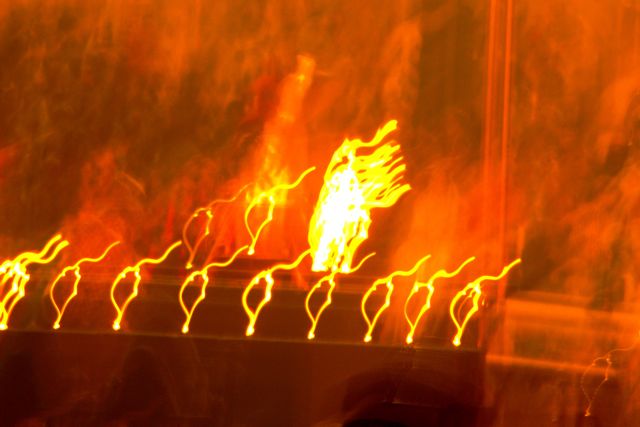
fire2I slipped past them, and followed the ash-coloured saddhu, figuring that even if he was planning to scam me too, at least I could take him. He took me up an ancient mould-racked building with a large open balustrade. He introduced me to his eighteen-year-old son, who was dressed exactly like him. The boy bowed courteously, both hands folded.
“What a sight,” said the saddhu, gazing out over the funeral pyres.
It was. Seventeen bodies burning amidst a production-line efficiency of wood and prayer.
“I burned my dead wife here ten years ago. We had been together for thirty-seven years. It changed my life.”
The heat from the fires created mirage-like puddles in the air as he spoke.
“I used to be a policeman. I even protected Indira Gandhi for a while. I was on my way to a good career. But then…everything changed.”
He turned towards me for the first time.
“It always does.”
He went quiet for a while. The smoke was beginning to get in my eyes.
“Now, I help those preparing for death at the hospice here. Look deeply into the fire. All the teaching you could ever want is there. What is important? That’s what you need to ask. What is really important?”
I gave him 200 rupees, thanked him, and left. Later someone told me that he was operating a scam. That the money he collected ostensibly for the hospice just went into his pocket.

I wished I had given him more.

Posted in epoche, Kashi | Tagged , , , , , , , , , , | Leave a comment

An Easter Tale

crazy fuckerThe other night I went to dinner with the neighbours here in the Deux Sevre region of southern France. I walked over there since it’s only about ten minutes away, rather briskly since the temperatures had dropped unexpectedly. As I was approaching the house, I noticed a large sheep running towards me. “Oh, how sweet,” I thought, “the sheep is coming to greet me.’ When it was few yards away, it became crystal clear that it wasn’t coming to say hello, it was coming to attack. Luckily, I had a tin pan in my hand that I was returning to Denise, and I began a kind of skipping side-step, stretching out the pan, matador-style, while the sheep (which was actually a hornless ram) began head-butting it and charging me ferociously.

Both my hosts have a pretty wicked sense of humour, and I was visualizing the entire family watching from the kitchen window–since there’s not a lot to do around here, inviting guests over for dinner and seeing them get attacked by their bonkers ram, providing much-needed entertainment.

By the time I reached the house, all my pride had dissolved and I was shouting for help (interspersed with the occasional “Very funny, guys!”) Denise opened the door to let me, simultaneously apologizing profusely and doubling over with laughter. She had, it turns out, forgotten to put the “crazy fucker” back in its pen, and informed me that I was “very lucky” to have had the pan with me.

At the end of the evening, Denise offered to drive me home, but said that we had to run to the car. “It hates me,” she said, seriously. Clearly, it wasn’t fond of me, either. So at midnight, we peered out of the front door to check if the way was clear, then made a mad dash for the car. We were half way across, when Denise screamed, “Oh Jesus! It’s coming!” Suddenly, out of the dark chocolate Gatine night, the mad ram was upon us, murder in its eyes. We were both laughing so hard we were tripping and running at the same time, and the copious glasses of red wine didn’t exactly make for a straight trajectory. “Je suis vegetarien!” I shrieked, to no avail.

Somehow, I managed to yank open the passenger door and throw myself in, before the crazy #&^!!er rammed the car.

I’ve been a strict vegetarian for over thirty years. But if they ever make casserole out of this guy, I might join in.

Posted in epoche | Tagged , , , , , , , , , , , | Leave a comment

City of Love, my Foot

locks1There is something both mildly unsettling and amusingly defiant about being single in Paris. True to its reputation, Paris is an incredibly romantic city. Cupids, intimate low lit bistros, cute waiters in  floor-length white aprons, all conspire to create a kind of swoony milieu. Plus, people are getting it on all over the place, which I found intermittently endearing and irritating. I’ve never seen so much public snogging, and it wasn’t even Spring. It was the end of January, and the sky was a kind of bleary hangover grey. I was winging my way to the Louvre, which was to be my very first visit, turning up my far too thin raincoat against the chill.

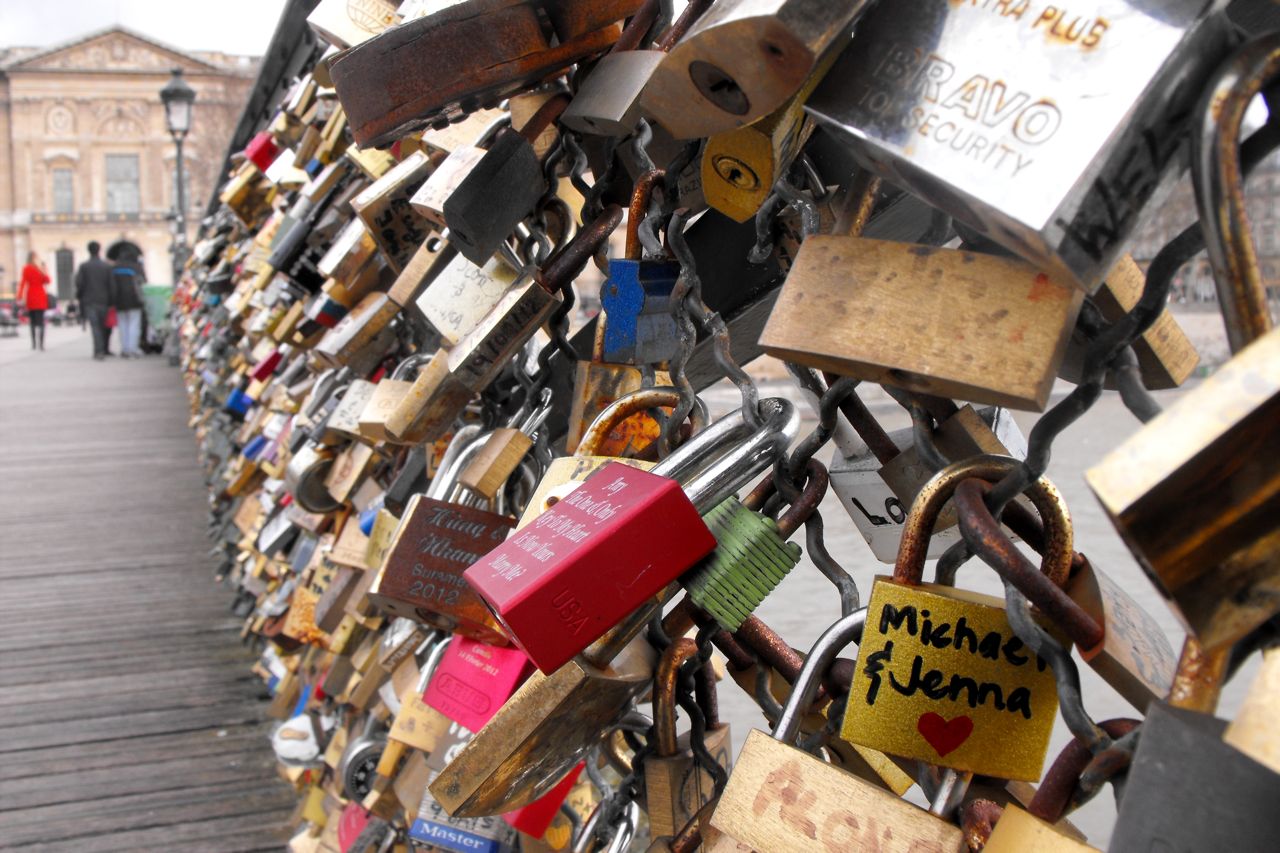
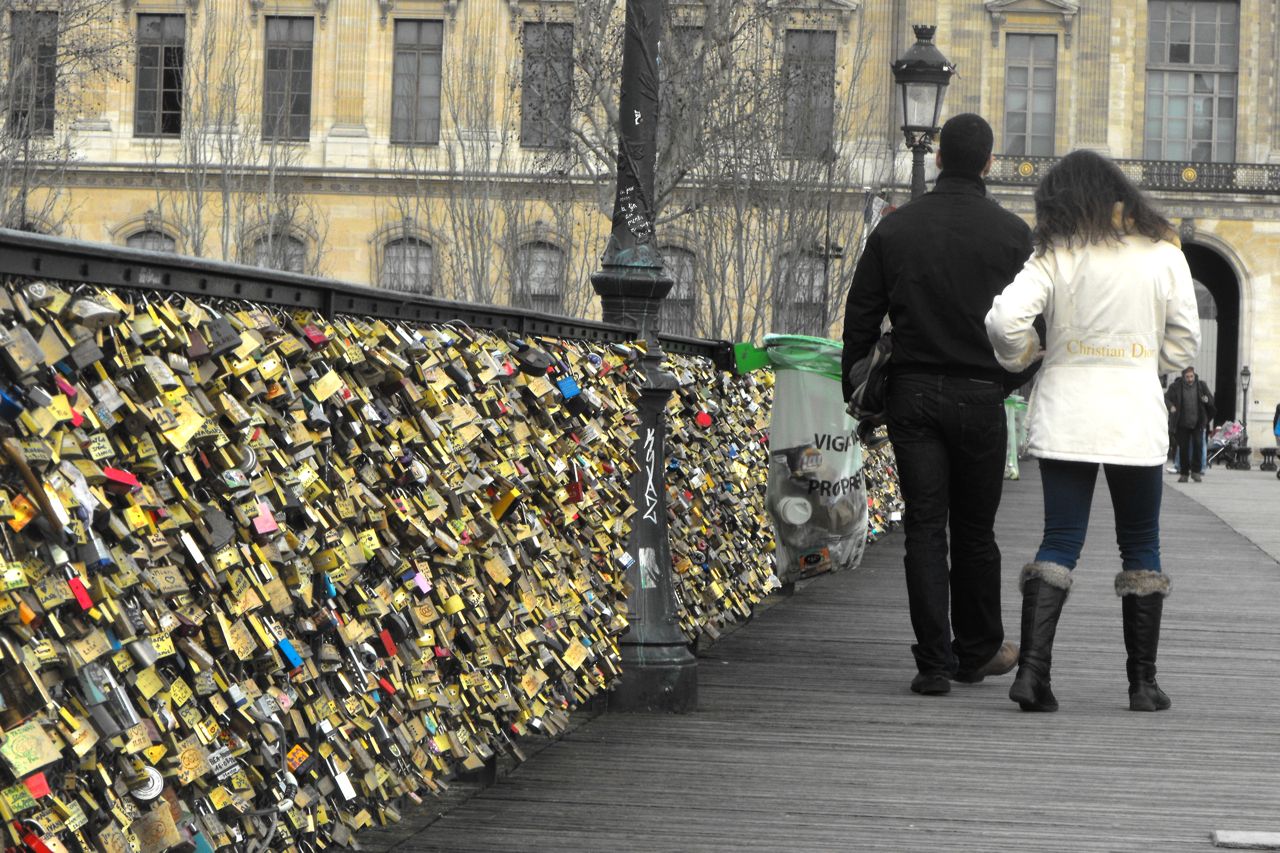
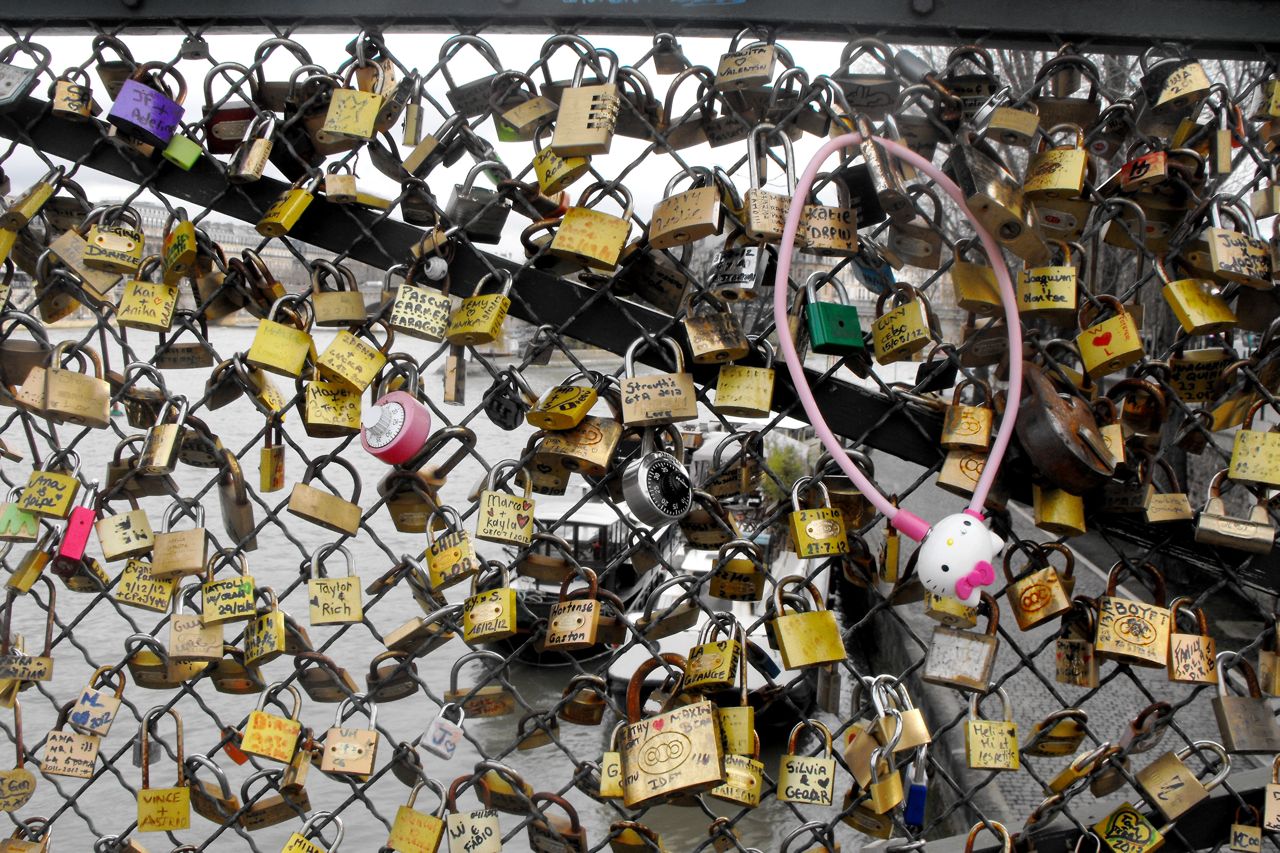
locks2As I crossed a footbridge over the Seine, my eyes were drawn to the railings that were jam packed with locks of all sizes, shapes and descriptions. I had stumbled upon Lovers Bridge, where a 21st century ritual had taken hold, of couples attaching locks with their names written on them to the wire mesh. I watched as a young well-dressed couple (well, in Paris there is no other kind) struggled to find a space for their lock, after which they kissed for such a long time that the girl had to put down her shopping bag. Many couples had obviously brought their own locks to the bridge, but in the spirit of capitalism abhorring a vacuum, a few hundred yards down the Right Bank, a number of stalls were selling your average hardware Made in China love locks for two euros a pop.

locksSkip to two weeks later. Valentine’s Day, in fact, which I was celebrating in a style that couldn’t have contrasted more with the French candle-lit city for two. I was in Boulogne for starters, and I don’t mean the nice part. I was spending the night in a budget hotel on my way to the UK. No sparten-ness had been spared; like a prison cell decorated with the stuff IKEA couldn’t shift in its half price sale. I was eating a limp supermarket salad, one eye on the dodgy heater, and trying to look on the bright side, when a news story on BBC One caught my attention. ‘Authorities in Paris have chosen Valentine’s Day to remove all the locks on Lovers Bridge.’ Apparently, they were ‘causing the bridge to become unstable’. The footage showed workmen grappling furiously against the locks with giant bolt-cutters. My heart turned yet another shade of jade. “Bastards,” I said out loud. “City of Love, my foot.”

On further investigation, I discovered that civil authorities in Rome had done the same thing a year before on the Ponte Milvio bridge, (Padlocks of love removed) and set up a 24 hour guard against deviant romantics “to restore decorum to the bridge.” Some Roman citizens were upset by the ban, mostly concerned that the trend would move to Paris, which it had, in fact, already done. In fact, much as the Romans would like to claim the ritual for themselves, love locks have been turning up on bridges all over Europe since the early 2000’s. But on Valentine’s Day, 2013, they were banned in the City of Love.

Yet if history is anything to go by, they may not be gone for good. In May, 2010, the Paris Town Hall expressed concern about the weight of the locks and “the preservation of our architectural heritage.” The locks mysteriously disappeared shortly afterwards. But in 2011, they began making a comeback. One lock at a time.

Personally, I think the City of Love moniker should be transferred from Paris to Moscow. There, instead of banning the locks, local authorities erected metal trees on Luzhkov Bridge, so that both the bridge and romance could thrive side by side. Bless their burly Russian hearts.

Posted in epoche | Tagged , , , , | Leave a comment

A touch of the Irish

“May the roof above us never fall in, and may we friends beneath it never fall out.”
Irish saying

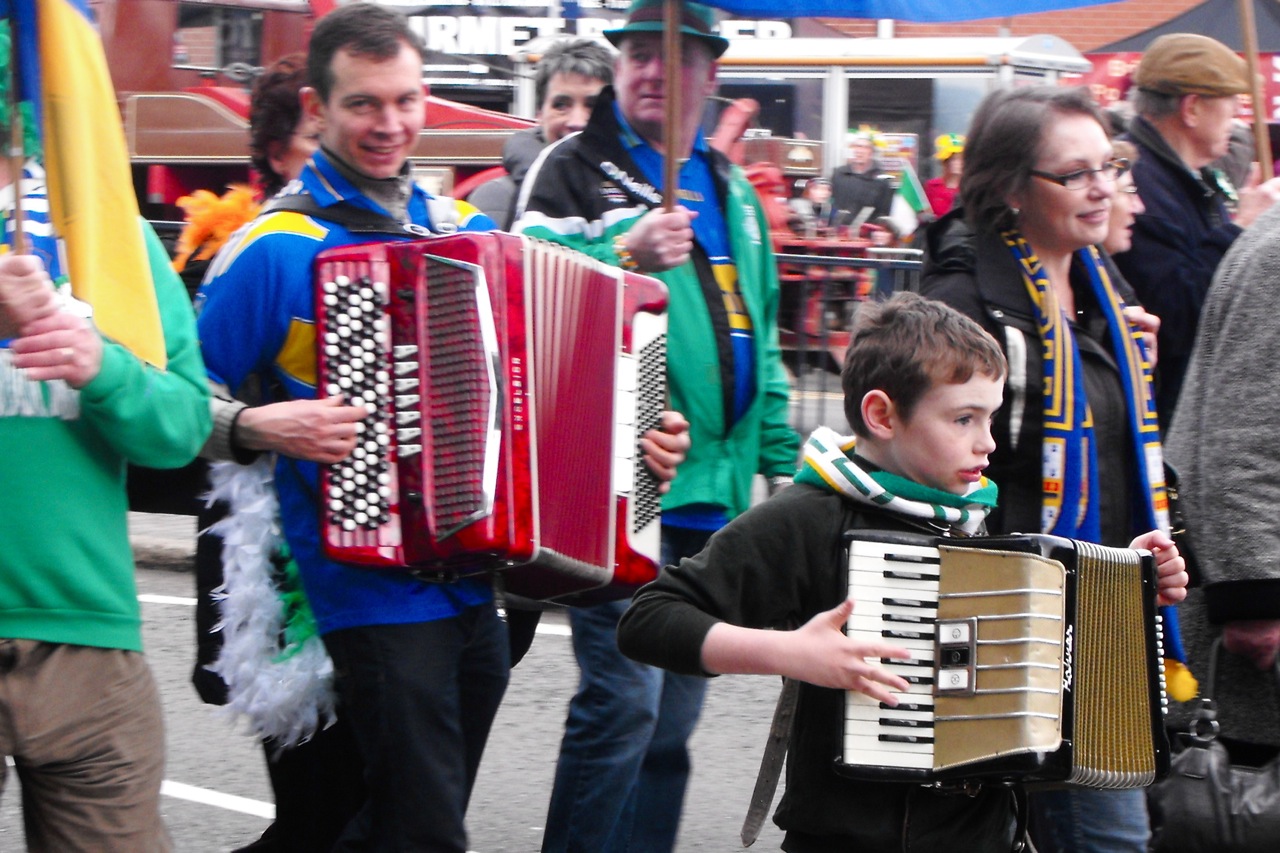
I don’t like Guinness and have a healthy fear of leprechauns, but nevertheless I joined the 29th St. Patrick’s Day Parade in Birmingham, England, on Sunday, March 17. My host, Noel, had suggested it, and I didn’t want to seem impolite. Birmingham’s parade is the world’s 3rd largest  – after Dublin and New York. The city’s Irish culture has seen some dark days, particularly after the pub bombings in 1974, which stirred up anti-Irish sentiment, and understandably took the fun out of things for a while. But the parade has come back brasher, more boisterous, and tanked up than ever. As we made our way towards Digguinnessbeth Street, I began wondering why I was actually walking towards a condensed mass of British drinking culture rather than away from it (and even though a good slice of it was Irish, it was still taking place in Britain). It was only 1: 15 in the afternoon and the rubbish bins were bloated with beer cans. At least five people stumbled into me as I moved through the crowd (the swell estimated at 80,000 by one local paper), trying to catch a glimpse of the parade that now embraced multi-ethnic themes (including Chinese ladies twirling yellow parasols) alongside decidedly Irish ones. Evidently the point was to try to get as many beers in before the pubs closed at 4 pm (to re-open at 6); an arrangement with the local police to try to curb alcohol-related incidents.  accordian St. Patrick’s Day is dubbed ‘The friendliest day of the year’, but I was yet to be convinced, holding firm associations between public drunkenness and mindless violence. The street was a reeling blur of green, white and orange; the colours of the Irish flag. Girls barely tipping eleven years of age blearily clutched at cans of Guinness.

We worked our way through an endless stream of funny hats, and between cheeks adorned with temporary shamrock tattoos, until we arrived at the Irish Centre. Needless to say, it was a teeming mob.

A trip to the bar was an inching groin-rubbing squeeze through a sea of arms lovingly wrapped around sloshing pints that earned the same priority access as pushchairs.

There was no evidence of an age-limit in effect.  I think as long as you knew that ‘Gat’ means ‘Guinness’ and you didn’t order some cissy English drink like vodka and lime, you got served. Next to where I was standing, a table loaded up with pint glasses, was guarded by rambunctiously cheerful women in plastic light up shamrock earrings and hat girlssnug-fitting sleeveless dresses. They sprayed themselves with perfume and jumped up and down giggling furiously. I decided I needed to get into the spirit of things and ordered a pint of cider. A folk rock band fired up with the Pogues’ Fairy Tale of New York, (“A work of genius,” Noel noted earnestly) and to which the tight-dressed girls jumped and squealed appreciatively, lah lahing through most of the lyrics until they belted out  ‘And the bells are ringing out for Christmas day!

Slipping into an adjacent ballroom sized bar,  a more traditionally Irish band was stirring up the room. Old men were locking arms in dance with more snugly-dressed ladies with posesoft white arms. Teenage mothers were rocking dozy babies to the rhythm of the room. Two frizzy-haired shamrock-cheeked girls were continuously swapping iPhones to take photos of themselves hugging and kissing various members of their table. One of them was sporting those light-up shamrock earrings that I was beginning to eye rather enviously. There were no windows or clocks, which made all sense of time dissolve into dancing, laughter and the ever-flowing fountain of Gat. At the food table, a hand-written sign read: Bacon and cabbage stew. Chicken curry. My second drink was kicking in and the touch of Irish in my genes (only one ear and a thigh bone, though more than most of my wannabee American friends) was beginning to stir from its generational slumber. I found myself swaying to the waves of fiddle and accordian. Irish musicians had left me distinctly unmoved before. They may as well have been ‘whistling jigs to a milestone’ to quote an ostallld Irish saying. And that was another thing. I was quoting old Irish sayings. And stranger still. No one had bumped into me for quite some time. I was now ‘co-ordinated’ Irish-style. And all of a sudden I was actually enjoying myself. There was a warm, fuzzy feeling in my chest and an unexplained love for all humanity, particularly the glittery bosomed woman astride her boyfriend’s lap, screaming “old tart!” at her good-natured mate. I had half a mind to grab an octogenarian, and tear off my polo neck to reveal my soft doughy arms.

“They’ve probably been drinking all day yesterday, and they’ll go on ’til late this evening,” said Noel. “Then they’ll get up on Monday and go to work,” he added with a note of pride.

girlAs Noel and I meandered back home, down streets with circus stalls and dangerous looking rides manned by Guinness swilling giants, I found myself humming Chicago-born singer Aileen Stanley’s, ‘There’s a little bit of the Irish in us all.’ My only regret. I never did score a pair of those plastic light up shamrock earrings. Well, “The longest road out is the shortest road home.” Whatever that means.

Posted in epoche, Moving on.... | Tagged , , , , , , , , | Leave a comment

The touching

monkeySunil and I wander down to his boat and sit on the undulating water, watching the day unfurl. A man descends the ghat steps, a small monkey grins at us from his shoulder. Sunil notices where my interest is going. The man sets the monkey down and attaches his small chain to a mooring rope, then slips into the water and begins his daily ablutions.

“That monkey was starving and now he takes care of it. None of the other monkeys would accept it. Can you see? It is handicapped.”

I look more closely. The monkey’s hands and feet are missing most of their digits. When it tries to stand, it wobbles and rolls over but it’s still lithe and agile.

monkey3It winds itself around the rope while it plays, until the free part of the chain is only a few inches long. It tries to free itself but only manages to get even more bound in the twists of chain and rope and begins to squeak and chatter in distress. Sunil shouts to the man in Hindu, who climbs out of the river and unravels the monkey like he’s done this a thousand times. Sunil tells me that the man is a Dom, a community of untouchables, low caste people who work at the cremation ghats. Because of their close association with corpses, Sunil tells me, they are spurned even by other low caste communities.

The man lifts the monkey back onto his shoulder and makes his way back up the steps. One untouchable held by another.

Posted in Kashi, Moving on...., Rose Apple Island | Tagged , , , , , , , , , , , , , , , , | Leave a comment

Tales from the time mandala

sunrise gangaThe ghats of Varanasi are the arms of the Ganges, supporting the devout as they wash away their sins or burn the bodies of those past sinning. Of all these sets of stone steps that lead to the water’s edge, Meer Ghat is my favourite, not least because it reminds me of my favourite mammal, the Meerkat. It is one of around 100 ghats (no one seems to know the exact number) that stretch along the riverside, and unlike Lalita Ghat or Raj Ghat it has little historical significance and no famous temples. But it has all kinds of stories to tell, if you lend it your ears

Sunil knows everyone on Meer Ghat. To him their movements are the cogs and wheels of a giant time piece that he can read like we might read the hands of a clock. Each dip in the Ganga is like another chime from this clock, ringing out from an invisible bell.

That night as we sat on the balcony, I watched in amazement as Sunil predicted every move as if it were written.
It was just past three in the morning when he said, “Hear that?”
“What am I supposed to be hearing?”
“Can’t you hear an old man walking down to the river?”
When I leaned over the railing, I could hear nothing. All I could see were the stone steps leading to the waters edge, a dozen boats swaying almost imperceptibly in the current, and a black and white goat curled up on a platform the size of a breadbox. But then it came. The tap, tap, tap of wood on stone. A bow-legged man in his eighties was making his way down to the river with the help of a long staff, a large orange dhoti wrapped around his groin. He negotiated each step one at a time, careful as bone china.
Sunil was looking at me.
“Can you see the other one now?”
“What?”
“There’s another man coming. An older one.”
And there he was, arthritic legs arching wildly as he moved down the steps one at a time.
“He came later, but he’ll reach before the first one,” said Sunil, yawning.
And sure enough, the other man overtook the one with the stick. At the water’s edge, he waded in up to his skinny thighs and began chanting softly, dipping his hand in the river, and lifting it to his forehead, with the tenderness of a long-awaited reunion.

I was hooked. It was better than any movie script, the commentary to this mysterious time mandala.
“What happens next?” I asked.
“Now?”
Sunil laughed.
“Now we go to bed.”

Posted in Kashi, Moving on...., Rose Apple Island | Tagged , , , , , , , , , , , , , , , | 1 Comment

2012 in review

The WordPress.com stats helper monkeys prepared a 2012 annual report for this blog.

Here’s an excerpt:

600 people reached the top of Mt. Everest in 2012. This blog got about 3,100 views in 2012. If every person who reached the top of Mt. Everest viewed this blog, it would have taken 5 years to get that many views.

Click here to see the complete report.

Posted in epoche | Leave a comment