The Fatal Accident

Debu the Astrologer was on his third whiskey. He gestured with his glass in my general direction narrowly missing hitting the bottle with his right elbow.
“Stop seeing that young man!” he shouted across the room at me.
I was still lingering in the doorway, not sure I wanted to go any further. Anand had gone ahead and was beckoning me forward. This had been his idea and I was already concocting my revenge.
“Come! Come!”
Debu pointed with his glass to the seat next to the sofa where he was sitting, lurching like a schooner, shirt out over his pants, an ashtray over-flowing on a glass table top. I sat down, uncommitted.
Stop seeing that young man!” he barked again. I hadn’t said a word, but he acted as if I was arguing with him. I shot an SOS to Anand who shrugged and looked down at the carpet.
Debu leaned towards me, eyes surprisingly focused, and spoke in a rummy whisper.
“He’s an A class bastard, my dear.”
I felt a surge of affection towards this smashed stargazer.
“He’s not so bad,” I protested, aware that in doing so I was admitting that I knew what he was talking about.

I had promised myself that I wouldn’t offer him any information. I knew how cunning astrologers could be, building confidence with informed guesses and then extrapolating from any snippets of data their clients unwittingly provide.
There was a knock at the door and an attractive plump girl with glasses entered the room. We were in a nondescript hotel in Greater Kailash where Anand had told me that Debu was getting treatment for stomach cancer.
While she and Debu discussed some personal issue she was having, I sidled over to Anand.
“It’s only four o’clock. He’s drunk out of his gourd. What kind of astrologer is he?”
“It’s four twenty five and he’s the best,” was his reply.
“Hi, my name’s Amrita,” said the girl, extending her hand. She looked in her late 20s. Bright and very sober.
“She’s my assistant,” explained Debu, lighting a cigarette from the one in his mouth.
Amrita opened up a laptop and began tapping away at the keyboard.
“I was telling her that the young man she’s seeing is an A class bastard,” said Debu, pouring himself another drink. “I don’t think she believes me. Why don’t you check her chart.”
I had given him my birth details a few days before, that apparently had been inputted into some astrology program.
He poured one for me. I downed it straight.
When he got up to get ice from the fridge I could see that it was hard for him to walk, and not just because he was inebriated. He caught my expression of concern.
“You’re in a lot of pain,” I said.
He smiled and tonged three ice cubes into my glass from a bucket.
A few minutes later, the girl looked up from the laptop and over the top of her spectacles.
“I’m sorry, ma’am,” she said, like a doctor might confirm an unfortunate diagnosis. “He’s absolutely right. A class bastard.”

I didn’t have time to ponder how being born in Epping, England, on December 29th at 6:30 pm meant that 48 years later I was dating a bastard, A class or not, because Debu then began to tell me things that no one living outside my wardrobe could possibly know, interspersing revelations about my dire love life with exclamations of “You’re a lovely girl! Why do you do this to yourself?”
Why indeed? I thought.
Debu looked at Anand as if he had the answer. Anand shrugged again and began fiddling with his mobile.
Debu was systematically blowing my mind. I later understood that he did this deliberately to win my confidence because he actually wanted to tell me something else. Something far more important than the fact I had a lousy boyfriend. I was going to have a “fatal accident”. It was going to happen in six months. That’s all he would give me.
“What’s the point of telling me I’m going to have a fatal accident if I can’t do anything about it?” I asked exasperated.
“Oh, but you can do something, my dear.”
He proceeded to tell me about a special kind of puja performed by lepers in the Punjab. Naturally, intercepting a fatal accident didn’t come cheap. Anand generously offered to pay. I had just started a new job, and hadn’t yet worked out a puja budget.
“What was that about lepers in the Punjab?” I asked Anand as we descended the stairs on the way out.
“There’s a guru who hires them to do it. No one else will give them work. They live in the temple and are looked after. They do special rituals for people who are sick or going through a crisis. It’s like a karmic intervention.”

I ditched the ‘A class bastard’ a week after my first meeting with Debu with no regrets. I saw Debu twice after that. Anand and I went over for tea. We made sure we arrived before noon, and well before the third whiskey. Debu had a tangible warmth. He was loud and kind, creative and deeply human. The hotel staff had clearly fallen in love with him, and treated him like a respected uncle. He told me he felt like my older brother, and I knew he meant it. “Don’t don’t live for yourself,” he would say. “Live for others.”

I’d crossed that Stygian road umpteen times to the Qutab Minar metro, paying the ferryman with metal nerves and visible entitlement. Crossing roads in 21st century Indra City was never a doddle, but this section of the Mehrauli-Gurgoan highway was pandemonium on meth. I felt like a true Delhiite, weaving with skill and precision between bumpers, using all the tricks of the besieged urban pedestrian to reach the other side in one piece: taking refuge in a clump of other crossers (the human shield technique), on-the-spot calculations of the collision algorithms of moving objects (take the two speeds add them together then divide by distance…okay, this is more instinctual than practical), keeping pace with the flow, invoking Hanuman, and never, ever hesitating.

There were two double lanes with a central divider so it had to be tackled in stages. I had made it to the divider and was negotiating my next move, waiting for the traffic to slow for the red light further up the road (actually a less safe place to cross as you never know who is going to ignore it). The vehicles slowed to a crawl, including a public bus, and I began to cross over, daydreaming about my future plans, when the present knocked me flying. I found myself upside down in a kind of slow-motion suspension. My attention suddenly absolute. I saw my reading glasses soar through the air and considered that if I died I wouldn’t need to buy any more. I seemed to have all the time in the world to mull over my situation the way that Alice could read books while falling down the rabbit hole. Definitely hospital came the first thought. I wonder how many bones I’ll break? and then, Maybe that bus will run me over.

The bus didn’t run me over. I landed in rather unglamourous fashion smack on my behind in front of the left tyre. A motorbike was on its side spinning its wheels near the curb. I rolled to my left and grabbed my glasses, leaped up, and raced to the pavement with the distinct impression that I had actually bounced like a rubber ball. A young man in a sea foam green tee shirt was tending a cut on his shin, his arm wrapped around another’s shoulders. He had been shooting the gap between the bus and the curb when I had walked right in front of him. There was no way that either of us could have avoided colliding. He began shouting at me in Hindi. I guessed it was something along the lines of, “What the hell were you thinking lady? You could’ve got us both killed!”

He was in shock. I checked his leg. It was bleeding a lot as shin wounds do, but it didn’t look bad enough to need stitches. I kept telling him I was sorry. As we stood there, my left hand, stinging from road burn, began shaking violently. Suddenly, the young man’s demeanour shifted from indignant to solicitous as if he’d just realized that he’d hit me. I assured him that I was okay, and his friend drove off with him riding pillion.

I boarded the metro and took a seat in the ladies car. When I reached my friend’s place, I told him what had happened.
“That was a really stupid thing to do,” he said unsympathetically. “Bikes drive the inside of traffic all the time, you know that. If you can’t see the entire road, don’t cross it. People get killed every day in Delhi doing what you did.”

I was amazed that I wasn’t hurt, but for a few days afterwards I felt strangely absent from my life. Like in that Hollywood genre of paranormal comedies where the hero gets killed in a road accident and their ghost gets up from the body and walks away. Except that my ghost was still lying on the road. It was the living being that was walking around in some in-between state. I kept having the urge to shake my body, as if I could shock myself back into total existence like banging the side of the TV set to improve reception.

Three days later, I crossed the road to the metro again and spent over five minutes hovering on the middle divider. I’d lost my street-crossing mojo. I watched my left hand shaking like someone else’s. For a few weeks I had trouble getting to the other side. I began taking autos instead of the metro so I didn’t have to try. I was even reduced to asking a friend to hold my hand across the street to the Saket Citywalk mall at rush hour, which embarrassed him no end. But that was all. That and a little neck strain that made me feel my face was on backwards. A week later, I called up Debu.
“I think I just had the fatal accident,” I said. “Thanks for everything.”
“There’s no need to thank me,” he replied.
“Yes, there is,” I told him.
It was almost exactly six months since his prediction.
The next summer I was preparing for a trip out of Delhi. I needed to get out of the city that was wrecking my lungs, plugging my sinuses and using my senses for a punching bag. For some reason Debu sprang into my mind one evening while I was packing. I called him up, even though it was well past four o’clock and I knew he probably would be past coherent. He didn’t pick up so I texted him a greeting. YES. TELL ME was his reply. He was always ready to help anyone, even though he was suffering so much himself. I texted him back that I was just wanting to know how he was doing. He didn’t respond. I had a strong urge to see him before I left, but I got busy. It’ll wait until I get back, I thought.

A month later when I returned to Delhi I called up Anand who told me that Debu had died the week before. I’m not sure I will ever understand who he was or what he did but I will never forget our brief and mysterious connection. Rest in Painless Peace Debu ji. Always my favourite astrologer. And the most unexpected friend.
Posted in epoche, Rose Apple Island | Tagged , , , | Leave a comment

No pass (or when mountain gods get eremetic)

At last they entered a world within a world—a valley of leagues where the high hills were fashioned of the mere rubble and refuse from off the knees of the mountains…”Surely the Gods live here!” said Kim, beaten down by the silence and the appalling sweep and dispersal of the cloud-shadows after rain. “This is no place for men.”

Kim, by Rudyard Kipling

The day began with promising snatches of blue over the jagged Ladakh mountains. Mumtaz, our lean laconic driver, wove steadily out of Leh, heading up the only road to our destination–the remote village settlement of Turtuk in the Nubra Valley. Turtuk is close to the Line of Actual Control (LOC) between India and Pakistan, and actually was in Pakistan until the plucky paramilitary force, the Ladakh Scouts (aka, Snow Warriors), nabbed it just before the ceasefire in 1971.

A cluster of villages that straddled the Silk Route, Turtuk’s population was converted to Islam in the 8th century from Tibetan Buddhism after an invasion led by a 20-year-old Syrian chieftain brought the region under the dominion of the Caliphate of Damascus. The locals still feel strong cultural connections with Tibet, and even invited the Dalai Lama for a visit in 2010. The place was opened up to foreign visitors only a couple of years back, and even today non-Indians can’t visit without a Protected Area Permit.

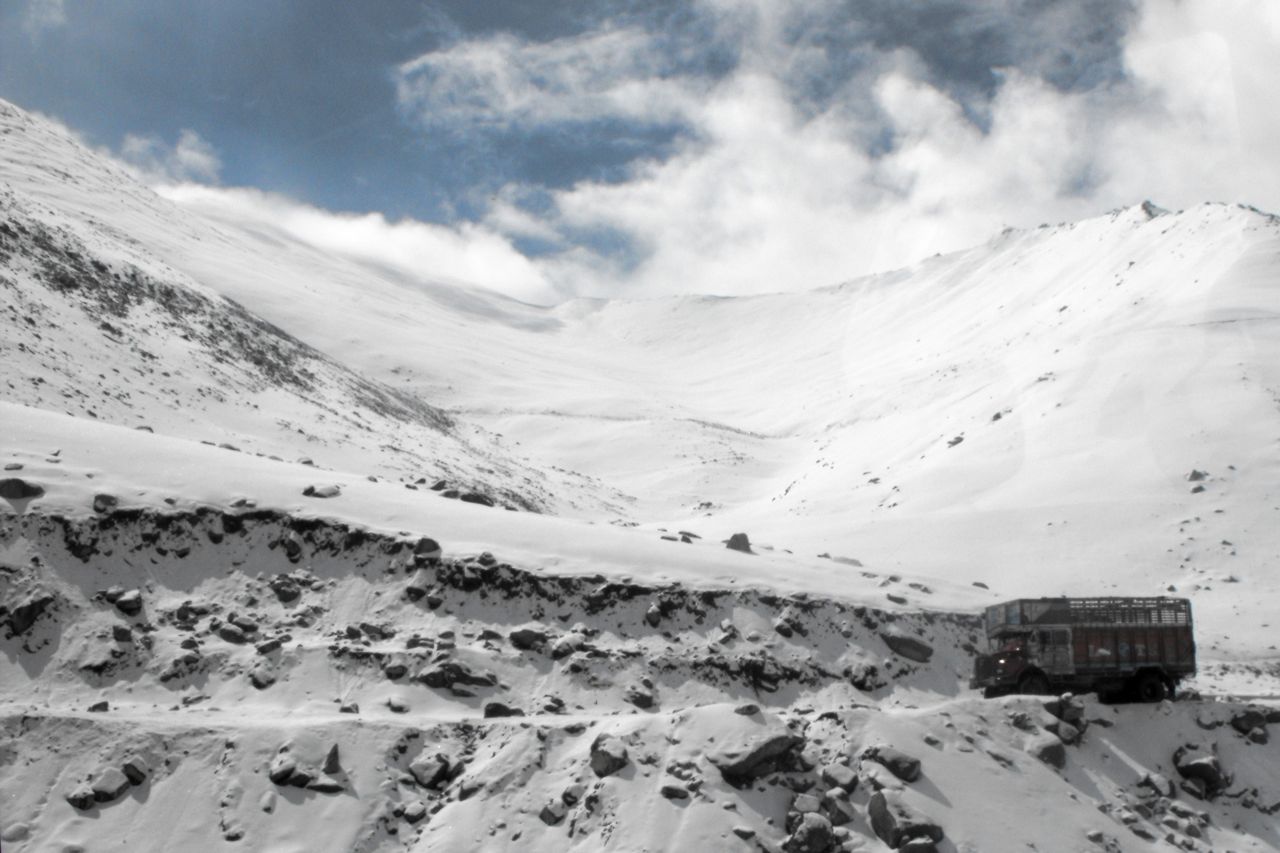
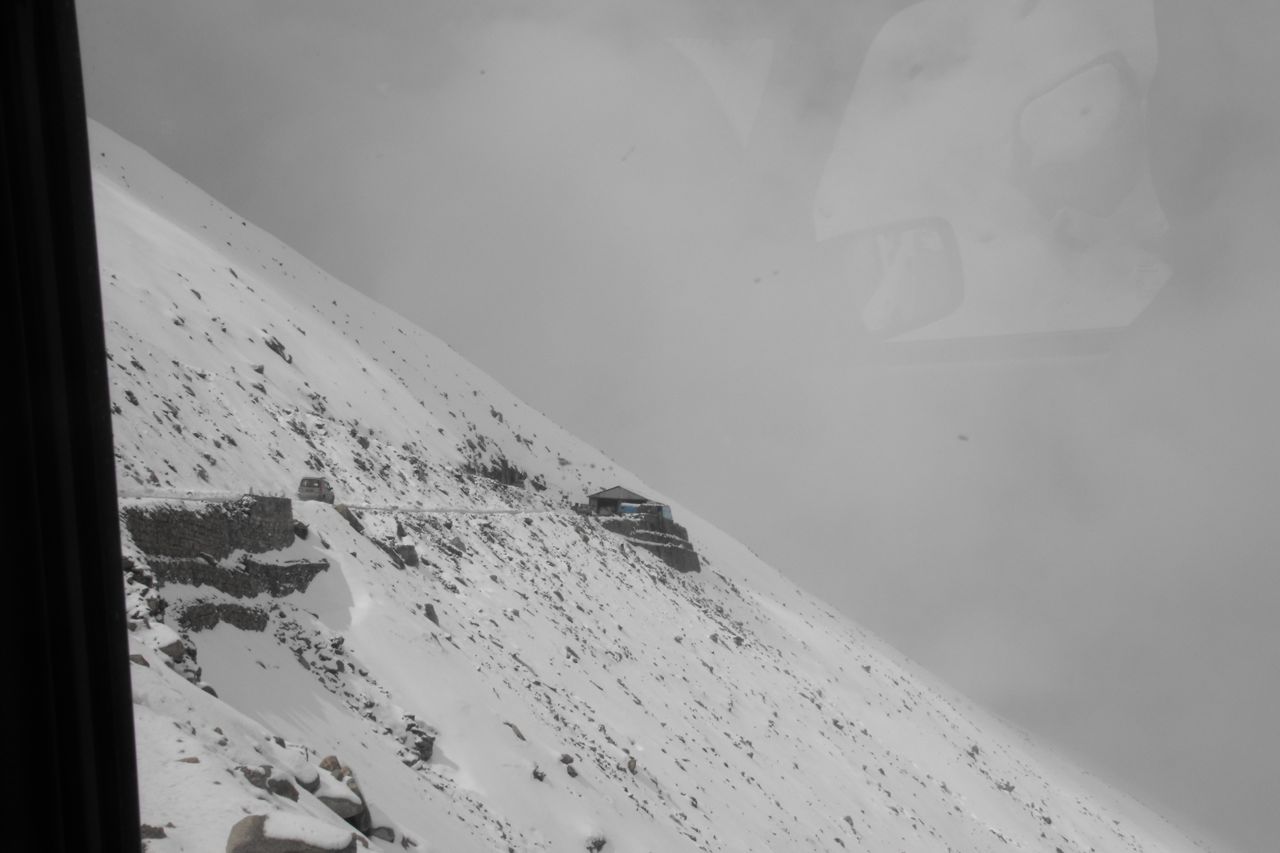
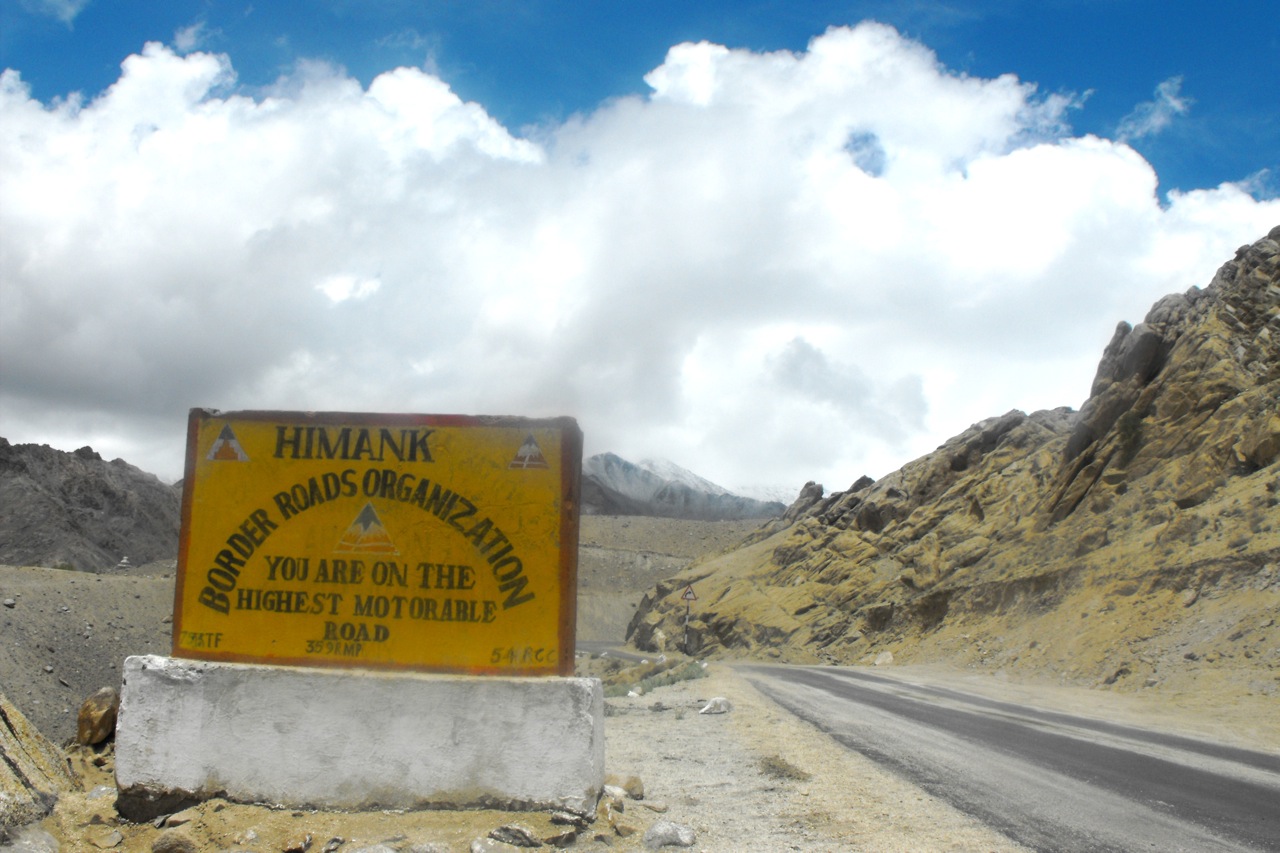
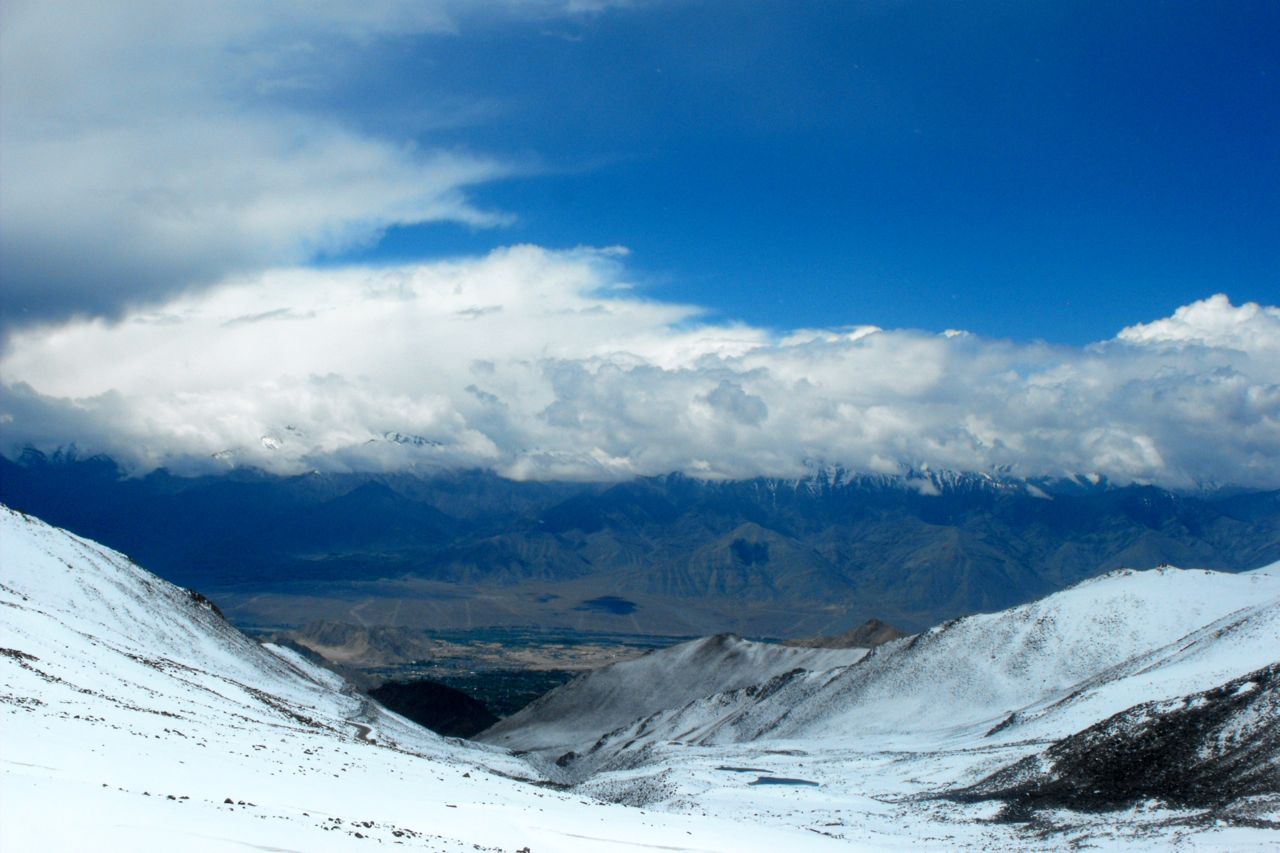
We had our permits firmly in hand. But there was something else between us and Turtuk. The Khardung la Pass–the highest motorable road in the world as those who cross it like to boast–that reaches to an oxygen-impoverished 18,300 feet before plummeting into the Nubra Valley on the other side. Although we were well into June, the weather was proving unpredictable, with bright mornings descending into brooding afternoons. At the first check post, Mumtaz got out of the car and, as was his habit, immediately fired a large globule of spittle onto the dirt road. The soldier manning the post informed us that one hundred and fifty vehicles were stuck in two major landslides higher up.

We killed time with a short unremarkable hike, hoping that the weather would clear later that day. It didn’t. That afternoon we learned that four hundred people had spent a head-splitting twelve hours trapped inside their vehicles on the pass. The army had ferried up oxygen cylinders and set up emergency medical posts for those suffering the effects of the high altitude. It took them until eleven that evening to clear the road and escort everyone down to safety. Still, Tsering, our travel agent, remained optimistic. “One hundred per cent you’ll get over the Khardung la tomorrow,” he reassured us when we returned dejected to his office. It was the second week of June after all. There were no snowstorms in June. We booked Mumtaz again for the following morning and sipped rounds of coffee at a rooftop cafe run by an urbane-looking Sardar who told us that the closure of the Khardung la had made national news. “People come here without knowing what they’re doing,” he complained. “Every year we have a few mishaps,”– ‘mishap’ being an Indian-English euphemism for fatality. “They think they’re having a family outing. They don’t respect the mountains.” We nodded solemnly, hoping he thought us respectful enough.

There are signs all along these Himalayan mountain roads, with words of caution for motorists, painted in rhyming whimsical aphorisms like these. BE SOFT ON MY CURVES. DRIVE ON HORSE POWER. NOT RUM POWER.  DO NOT BE RASH AND END IN CRASH. DRIVING FASTER CAN CAUSE DISASTER. NO RACE NO RALLY. ENJOY THE BEAUTY OF THE VALLEY. The signs are maintained by BRO, the Border Roads Organization, that I envisaged as a group of gentle upstanding individuals bound by oath to protect those who drive its tortuous lengths with generous doses of kind humour and loving wisdom. Occasionally the signs veer off from road safety into the valley of philosophy. IF YOU WANT HAPPINESS FOR A LIFETIME LEARN TO LOVE WHAT YOU DO and RUDENESS IS THE WEAK MAN’S IMITATION OF STRENGTH.

I figured that the Indian authorities wouldn’t let the Khardung la remain closed any longer than necessary. The pass is strategic to India’s border security, being the only land supply route to the Siachen Glacier (18,875 feet), a slice of the Karakorum range that Pakistan and India have been wrangling over since the mid 80s. Both sides maintain a costly, lonely, and dangerous presence there (just two months prior 135 people were killed in an avalanche that hit a Pakistani military camp). Ironically, military activities on both sides are threatening the very existence of the glacier, that is believed to be receding partly due to chemical blasting in the construction of outposts. I could see the sign. THE HIGHEST BATTLEGROUND ON EARTH. MAKE YOUR STAND AND PROVE YOUR WORTH.

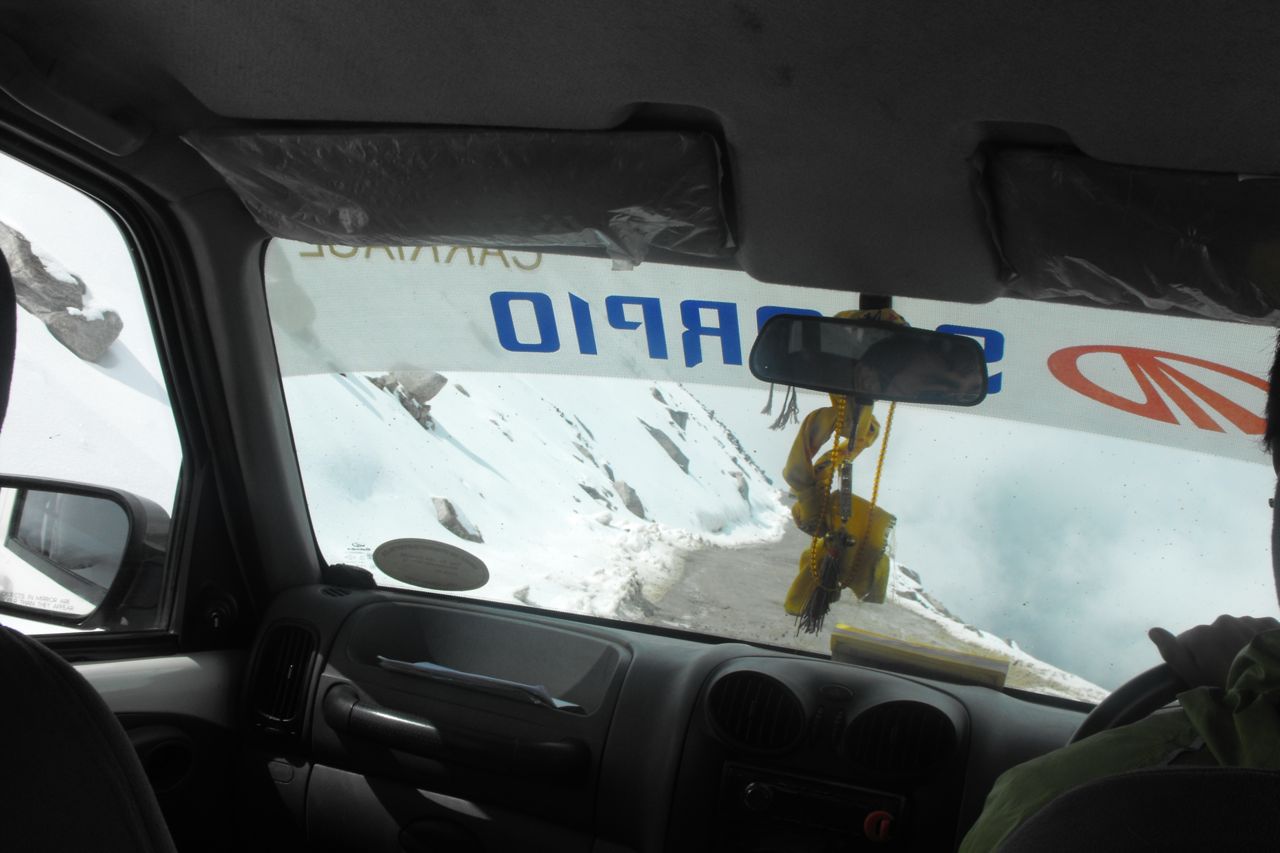
Early next morning, Mumtaz pulled his jeep up outside our guesthouse, spat on the road, and mumbled something about bad weather. I held firmly onto Tsering’s prediction, along with permits, maps, snacks and Diamox. We sailed past the first check post a few kilometres outside town, but at South Pullu Mumtaz hung back, allowing forty or so trucks and cars to overtake us. One hour later, just beyond the mini check post of North Pullu, the vehicles ahead of us began dissolving into the fog like Alka Seltzers. Soon, we couldn’t even see the road. Another ten minutes and we had ground to an adamant halt. Burly snowflakes began to whirl outside the window. Mumtaz got out, spat emphatically into the snow, and went into a hand-in-pockets huddle with the other drivers. Half an hour crawled by. I slipped out of the car to answer the call of nature, propping my back against the mountain side door so as not to be seen. Greatly amused by the sight of a woman peeing standing up, Siddhartha tried to take a photo, but clicked too late.

When I climbed back inside, his jolliness had faded. He was looking pale and restless. “I don’t feel good,” he murmured glumly. We were at 18,000 feet. The upper limit of the category ‘very high altitude’ and the lower limit of  ‘extreme altitude’. I could see mild panic in his eyes. I told him to keep breathing slowly. “Your body is telling your brain it can’t breathe properly but there is enough oxygen, it’s just thinner up here. Don’t worry.” My words that were meant to calm him down merely irritated him. Siddhartha motioned to me to stop talking and tried to lay his head on my lap. I offered him a hard candy which he sucked on reluctantly. I reminded him that we had done everything right. We hadn’t flown straight to Leh. Had driven for four days from Amritsar giving ourselves plenty of time to adjust to the increased elevation. “Do you want to take the Diamox?” He shook his head and put his finger to my lips. I ditched my plan to distract him with talk of the 10,000 camels that crossed this pass annually in bygone days, laden with dried apricots and fine pashmina wool, on their way to China’s oasis city of Kashgar.

We’d been stuck for over an hour now and I began to wonder how much longer we’d be there. It was snowing harder and getting darker. Siddhartha was looking dramatic, holding his forehead and seemingly unable to speak. I slipped out into the snow where the thin air literally took my breath away. I cautiously worked my way up the line of cars, every step an effort, knocking on windows and asking if anyone had an oxygen cylinder. No one did.

I now thought I understood why Mumtaz had held back at the check post. He’d anticipated the situation we were now in. Had made sure to be in the last group of cars in the jam for an easier return. I guessed that he’d known from the moment he picked us up in Leh that we wouldn’t make it through.

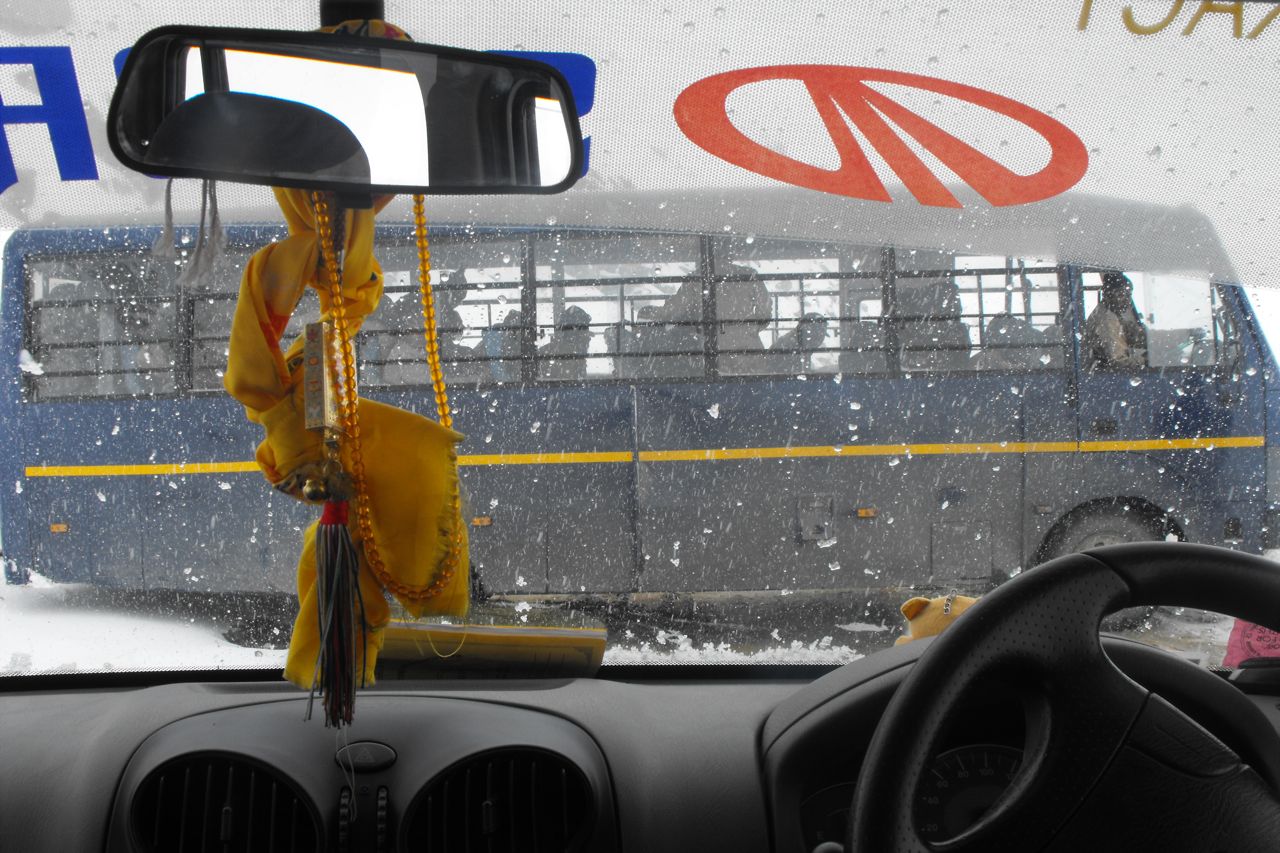
After a clumsy dance of wheels and axles, the road behind cleared enough for us to make our descent. The army bus at our rear began a slow clunking turnaround, with the help of six drivers all hollering out instructions. “Pichey. Pichey. Tora agey. Roco! Bas! Bas! OK. Ceedar. Ceedaaar. Bas!!!…..” After dozens of inching forwards, backwards and straights, the bus headed back down the valley and we did the same. We had been just one and a half kilometres away from the summit. Siddhartha sat up and the colour returned to his cheeks. I checked my travel notes for a suitable sign for the occasion. One that the fine folks at BRO had conjured up to make travelers feel better about failed ventures like this one. Aaah, there it was.

A DEAD END IS JUST A GOOD PLACE TO TURN AROUND.

Posted in Moving on.... | Tagged , , , , | Leave a comment

The world according to Jude

“Tell me anything that’s ever happened to you. And I can improve upon the story.”

From The World According to Garp by John Irving

The waiters hovered in a corner, numerous but dutifully unconcerned by the culinary aspirations of their customers. As if waiting on tables was a secondary occupation to some secret vocation known only to themselves. Jude wasn’t bothered, absorbed in John Irving’s The World According to Garp. Only Charles Dickens had captivated her more. But she was alternately inspired and depressed by Irving’s writing. She found herself feeling increasingly like one of his characters. His characters weren’t necessarily honest, but his response to them was. The book made her wonder about the last time she’d been honest with anyone. These days, anything true about her sounded ridiculous when said out loud.

How would he draw her? Would he be sympathetic? Would he at least try to understand? He would probably write that she was emotionally cheap, like a buy-one-get one-free bucket of over-stocked pre-popped popcorn at the supermarket check out line. No he wouldn’t. He would do better than that. Irving had warned against confusing art with activism. She already felt guilty about wanting to write. When people asked her what she did, she usually replied, “I’m a writer.” When they asked what she wrote about, she always talked about her human rights work. Sometimes she might venture, “But I’m trying to write fiction now” that always came out like an apology. And she always said “trying” as if the effort somehow made the endeavor more worthwhile.

She felt bad about not wanting to be an activist any more, and she felt even worse to think that perhaps she never had. That all she had ever wanted to do was write. That her mother, eternally disappointed that she was not a best-selling author by 24, had actually been right all along. Her life seemed increasingly bizarre to her. Ungainly and inappropriate, like someone laughing too loudly at a mediocre joke. But it was only in the most extreme places that her life seemed to make any sense at all.

"Life is an x-rated soap opera."
 From The World According to Garp

“What do women want?” Paul had been pouring them both a gin martini when this question emerged from a long comfortable silence. They had taken to drinking gin martinis in lieu of vodka and cokes, a mix they’d both decided was far too reminiscent of 80s disco bars.

“To be desired,” replied Jude quickly.
“Is that it?”
She took a long thoughtful sip.
“Pretty much,” she said.
He looked dissatisfied.

She wanted John Irving to desire her. She’d Wikipediad him and was mildly surprised to find that he was still alive, pushing seventy. Does he still get erections? Would she give him an erection? What would she say to him? “Your writing saved me from therapy.” He’d written. Psychiatrists are the thieves of complexity. What a line. Either he would re-think his attitude towards psychiatrists and stand up to bid her an understanding but firm goodnight. Or, he would slide his hand down the front of her pants and tell her that if he wasn’t so old and his dick so tired he would bone her all night.

Paul lit a cigarette. It was noticeably darker now, her reverie causing its usual lapse in sense-time.
“Affection. Adoration. Attention.”
“What’s that?” his attention turning back to her like an arthritic neck.
“What women want.”
“The three A’s. Easy to remember,” he chirped with mock appreciation.
“We thought we’d keep it simple.”

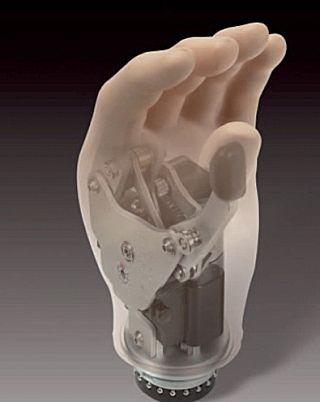
The Ganga Chronicles was becoming too complicated. There were intersections of time and place that didn’t make sense even to her. Perhaps she was just too lazy of a writer. She worried that she was making it too complicated on purpose, so she could discard it with “it became too complicated.” Few would argue simply because they wouldn’t care enough to do so. And that disappointed her. No one caring. A Californian man had described disassociating himself from his body while cutting off his own arm that had become trapped under a fallen rock during an avalanche in Yosemite National Park. He had walked to safety, almost bleeding to death, and later had done the talk-show circuit with an ugly prosthetic, chatting about his ordeal without a hint of self-pity and jovially crushing coke cans with his new ‘hand’.

Jude saw no artifice in the one-armed man, and like she always did with someone she admired, she tried to imagine being them. She had made a mental note. It’s possible to cut off your own arm and not need counseling. But she had questions about the act itself. Wouldn’t you pass out at some point? From the pain or at least from the loss of blood? And how do you cut through bone with a Swiss Army knife? Could I do it? Could John Irving do it? Could my mother do it? Why don’t more people think about these things? Why am I thinking about these things? Why aren’t I writing?

At the table to her left, two middle-aged men, a Caucasian and an Indian, were engaged in lively conversation in sign-language. The thought struck her that to be deaf in India was almost a blessing. As she glanced casually in their direction, she noticed them pointing at her and signing in a very animated way. Then they laugh-signed together, nodding vigorously. She felt a rush of embarrassment. What could they have said? “That woman is writing a novel that will never be published.”
“I know, but it’s just as well. It’s a piece of crap.”

Sign-language seemed more precise. It required getting what you mean down to the pith. Perhaps if it were socially acceptable for people to emit noises in public, like groaning over a taramisu, they wouldn’t get so lost in words. Deaf people probably don’t waste time saying things like “When desires challenge the lives they have built for themselves and who they think they are, people go crazy but they do it really slowly so only their dog and cashier clerks notice.” Varanasi felt to her like a place where desire was treated like an honored guest. It wasn’t, of course. Varanasi had all the petty jealousies of any Indian city. But nothing is about what it is, it’s about the effect it has on you. And this was even more true in Varanasi.

Paul read the first draft of Ganga Chronicles. “John Irving wrote about people who were having sex. You’re just writing about sex. There’s something sexually provocative in every passage. It’s like you have Turettes syndrome. The people seem, I don’t know. Irrelevant.” That hurt her more than anything he could have said. People were not irrelevant to her. They were all she had. John Irving had written: “The worst reason for anything being part of a novel was that it really happened.” But it seemed to Jude that her life had turned into a novel. Was her imagination second-rate because she kept resorting to her real-life experiences? Or was it that her life was becoming worthy of fiction? Could John Irving really improve upon it? She caught her reflection in a mirror on the wall opposite. Ever since her mother had died she had begun to resemble her more and more. A fact that had startled her father so much when he walked into his living room one day that he almost spilled his Horlicks. “My God, you’re starting to look so much like your mother,” he’d declared. It wasn’t a compliment. Her mother’s eyes, stubbornly blue and ready for argument stared back at her. Her hair even seemed to have fallen into that familiar late 70’s shoulder-length wave. She had spent so long fighting against her, but nowadays she grasped for any resemblance. As if looking like her meant she could become like her. Her mother was so much more resilient. A British bloody-mindedness that in ignoring weakness amounted to a kind of strength.

"What a world of illusions blossoms with the idea of 'starting over'." 
From The World According to Garp

Jude rolled over. For a moment she didn’t recognize the face on her pillow. It was a face without a story. Young. Featureless. Profoundly uninteresting. The boy moaned and scratched his nose. She wrapped a thigh around his waist and pulled him closer. He started kissing her half asleep, eyes still closed. She wondered if John Irving would be kind when he wrote about her. She wondered if she had any paracetamol. She wondered about starting an orphanage, going back to school, learning the cello. She wondered if she would ever be able to stop.

Posted in epoche, Kashi | Tagged , , , , , , , | Leave a comment

Dust in the navel of the world: part one

Photo: Wen Yan King

In the groundless dust of Bodhgaya the beggars actually chase you down. Even the ones without legs. A riot of of monks, nuns and lay practitioners from all Buddhist traditions are here for a massive prayer ceremony for world peace. It’s December 2010 and time for the 27th Kagyu Monlam Chenmo, presided over by His Holiness the 17th Karmapa of Tibet. And if you hadn’t yet heard, there are three foot tall letters in multi-coloured electric lights in the grass proclaiming the fact from two different vantage points.

The first day I bought some Tibetan momos, like little dumplings. I tried handing them out to the beggar kids, but was mobbed. It’s difficult to figure out a beggar policy here. Not like Dharamsala, where the situation is less desperate. There they will likely turn down the offer of food. Here, people are actually starving. One evening, my friend Gyamtso gestures towards rows of beggars sleeping under ragged blankets on the streets outside the temple complex. “These are the honored guests for the teachings,” he says in his typically dry style.

Strings of lights and marigolds festoon the grounds of a 180 foot tall temple, the Mahabodhi, that has a history of 2,500 years. Every day, more people arrive, and every day it seems more impossible for the town can accommodate them. It is getting hard to walk from one end of the temple complex to the other. What I thought was a circus, is it turns out, the quiet time. His Holiness the Dalai Lama will begin teachings on January 5th. “You have seen nothing yet,” everyone tells me.

Around the complex, everything is for sale, flashing light up Buddhas, prayer beads (“special price for you madam”) and leaves supposedly off the original Bodhi tree where Lord Buddha attained enlightenment, though almost certainly pulled off a Peepal, the tree of the same genus.

The actual Bodhi tree, an ancestor of the original, is huge. It seems to lean and stretch as if trying to cover as much earth as possible, like a mother trying to protect her children. It stands right up against one of the walls of the Mahabodhi temple. It is adorned with a large golden bow.

A man is selling tiny caged birds. Not to keep, but to set free. In Buddhism, there is the belief in ‘merit’ that can be attained from engaging in acts that are purely motivated to bring benefit to other beings. Gyamtso and I get him down from 1,000 rupees to 500 for the lot. He lets them go while we glare at him. “What about the parrots?” he asks, lifting up a second cage. Gyamtso leans over and whispers into his ear. I imagine he’s telling him to get another job. Later, the same man is selling the same birds. Of course, they are weak and easy to catch again. Gyamtso calls the police and has him turned out of the grounds. But of course, like the birds, he’ll be back.

Whatever the stories, the hype, the marketing of spirituality, the hustle and scams, the aching poverty….there is a beauty and peace here beyond description. Settled deep in Bihar, the poorest state of India, this is the “navel of the world.” When the world is destroyed at the end of an eon, where the Bodhi tree grows is the last spot to disappear. When the world emerges into existence again, it is the first to appear….so they say. But sitting beneath its branches, I feel that anything is possible for the first time in a long, long time.

I go at night (the quietest time) to sit on a mound where it is said the Buddha spent the first week after his enlightenment staring at the Bodhi tree with gratitude. It’s called the place of the Unblinking Gaze.

The constant chanting in multiple languages: Chinese, Tibetan, Korean, Vietnamese, Mongolian, Japanese, Cambodian, Indonesian, Malaysian, Bhutanese, Sanskrit, Pali, create a Babelesque fugue, occasionally broken by the cry of an imam’s call to prayer.

A  crowd of about 100 Tibetan monks doing the fast circuit circumambulation, began a chant–a cross between a football anthem and a dirge made up of four impossibly low notes stretched out over long intervals. Spontaneously, the monks doing full-length prostrations on wooden boards in began to harmonize with them. As the circuiting monks approached and receded, so did the sounds of the chanting–rolling through the thick night air in soulful waves. When the atmosphere was suddenly broken by piercing high-pitched wailing in Sanskrit to an actually danceable tabla beat, I had to laugh.

In the middle of all this I get an SMS from a Tibetan friend that reads:

May your Christmas be filled with special moment, warmth and happiness and frolic songs are always with you throughout the year‘.

I hadn’t noticed it was Christmas Day. It took an Asian Buddhist to capture the spirit of the season: special moment, warmth, happiness…and, of course, frolic songs.

Posted in Navel of the World, Rose Apple Island | Leave a comment

They all died in a pink submarine…

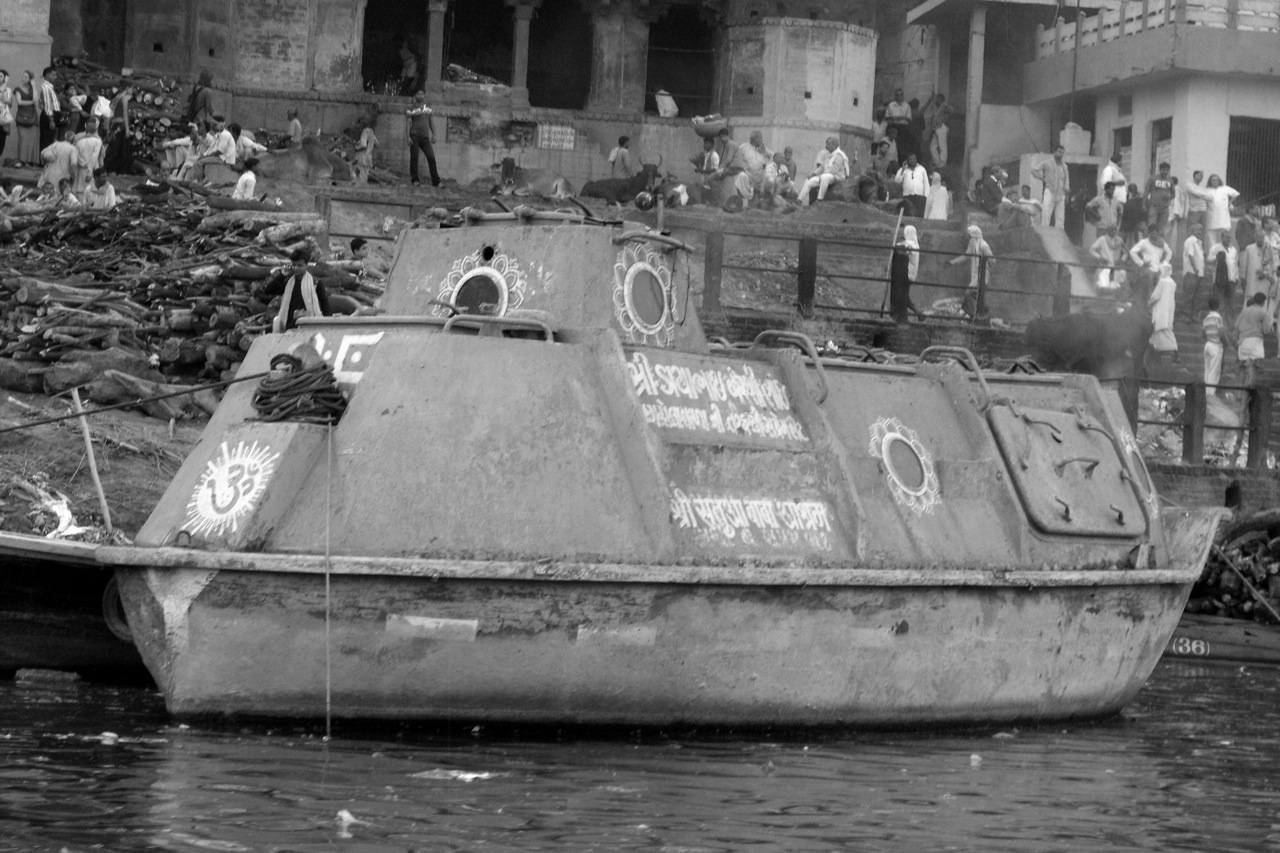
I have no idea how old it is, but it looks like it could have been designed in the 17th century by the submarine’s inventor, Cornelius van Drebbel himself, whose craft reached a depth of 15 feet during trials in the Thames River, England. It has an OM on its prow — a seed-syllable believed by Hindus to contain  the beginning, duration, and dissolution of the universe — and an Indian swastika above that — the most ancient symbol known to man, and a symbol of universal energy. The portholes are decorated with petal motifs.

“What is that?”
“It’s a submarine.”
“You’re kidding. What’s it doing here?”
“It’s suffering for its sins.”
“How can a submarine sin?”
Sunil stopped rowing and gave me one of his, ‘now let me tell you, funny Western person who understands nothing’ looks.

Everything in Varanasi has a story to tell. Why should a mini-submarine be any different? The one that locals tell (told so many times that it’s now as written as history) is that the craft belonged to the Indian navy. It sank to the bottom of the Bay of Bengal during a routine exercise, taking the lives of its forty crew members with it. Hard to imagine this tub being sea-worthy, let alone going underwater, let alone with forty people. For some reason the captain was not on board at the time. Wracked with guilt, he offered the sub to the Ashram at the Burning Ghats, where it continues to do penance for its sins…

Posted in Kashi, Rose Apple Island | Tagged , , , , , , , , , , , | 2 Comments

Epoche in the everyday

Is change a product of time or is time a description of change?

This slideshow requires JavaScript.

Posted in epoche | Leave a comment

The lop-eyed astrologer

“Look, what beautiful silks he has! He’s inviting us into his shop!”
Daniel stopped and spun around on one foot in a bouncy half pirouette.

For the past half hour, Lucy and I had been practically chasing after him through tiny streets stuffed with tiny gods and god knows what else. Every since he drank two very strong bhang lassis in the notorious Blue Lassi shop (and if you don’t know what bhang is, you probably shouldn’t be reading this blog), he had been flitting ahead of us, his wooly rainbow hat bobbing in and out of sight, like a honeybee with ADHD, sticking its multi-coloured proboscis into every flower that batted its petals in its direction.

It was amusing, to be sure, but it was also late, and the idea of losing anyone in Varanasi at midnight is not a pretty one, especially if they’re high. The old part of the city squirms and wriggles its Alice-through-the-looking-glass-way along the banks of Mother Ganga, in streets that have tendencies rather than directions. Navigating them could send Marco Polo off to find an aspirin. And I was getting tired of variations on the following.

LUCY: “Can you see him?”
ME: “Nope.”
LUCY: “Oh, I got him. 4 0’clock.”
DANIEL: “Look at this marble lingam, it’s so…….what’s the word?”

The strange thing was that Daniel was no tourist fresh off the boat. He’d lived in India on and off for years. He worked in an NGO that provides free (or almost free, like 50 cents a visit) healthcare to villagers in Bihar, the poorest state in India. Lucy was a second generation Chinese-Australian beauty who worked as the organization’s project developer. Daniel knew that everyone and his uncle would be trying to sell silk sarees to the big Australian with the woolen rainbow hat, but he was too stoned to care. Perhaps he was tired of fighting it all, and was seeing the whole exercise as some kind of fantastic oriental drama. Lucy and I, on the other hand, were just trying to get him and ourselves back to the hotel, before he spent his life savings on silk sarees, which I doubted he would ever wear.

But Daniel’s attention span wasn’t long enough to actually buy anything. No sooner had he cooed over a 3-inch plastic elephant god, with the owner standing expectantly bag in hand, then he would flit over to another bauble, generally one of the Hindu pantheon. A Shiva with light up flashing halo perhaps? Or maybe sir would be interested in a bedside lamp decorated with the lion-riding Goddess, Durga?

It’s this way!” he called out, channeling someone’s old gym instructor.
“No, Daniel, it’s not.”
“Really? I could have sworn……”
“Daniel. I know you can get us back. But it’s past midnight and the guest house has a 10 o’clock curfew. I think I might know a slightly quicker way.”
(But what I meant was “I know the way to our hotel, though I don’t doubt that you know the way to toy town in the sky.)
“Really? You do?”
“Yes,” I said. “It’s this way.” I pointed definitively down a side-street to our right. Keep close, okay?”
“Okay. Okay. You lead the way then. I can buy sarees tomorrow.”

Daniel kept dutifully behind me for about two minutes, and then somehow he was in front again. Being 15 years older than me, and 35 years older than Lucy, I think it was more of an instinct to take charge. And as as long as he didn’t go too far off the mark, we let him go– only intervening when he veered wildly wrong. Everyone in Varanasi, English speaker or not, show you the way to Mother Ganga.
“Ganga?” you’d say. And they would point (except sometimes they pointed in the direction of the restaurant of the same name). If we could reach the ghats then all we had to do was to turn right and we would eventually find our guest house.

After what seemed like hours, we reached the southern edge of Manikarnika Ghat, also known as the ‘Burning Ghat’ where cremation funerals around open pyres are being held 24/7, a dozen or more at any one time. We emerged from the jabbering maze of passages with their tacky gift shop lighting into a sudden quiet of stone temple ruins. In front of us, though we couldn’t see it, was the Ganges river, its presence affirmed by the widening of the claustrophobic streets to the sky. On the flagstone terrace before us, a vegetable cart was silhouetted against a background the colour of battle-weary armory. The temple roofs were outlined with the blunted orange light from the funeral pyres. A large pile of wood was stacked on the other end, certain of its customers.

“Oh my!” said Daniel with a sighing exclamation. “It’s the set of Don Giovanni!”
“Daniel, we need to keep going down, then we can walk back to the guest house along the ghats.”
“Okaaaaay,” he said, unconvincingly. I could sense his proboscis twitching. “But first, let’s have tea!”

I was about to break the news that there wasn’t any tea, but he was gone. Buzzing down the steps in the direction of the pyres.
“You okay?” I asked Lucy.
“Yeah, I’m fine. Just a bit tired. Do you think we should follow him?”
“No, let’s just wait here. He’s going in the wrong direction and he knows where we are.”

“Teas here!”
Daniel was coming back up the steps with a tray holding three tiny clay cups of piping hot tea. Where he had got it remains a mystery. He and Lucy settled down on the wood pyre while he began to tell her about some novel he’d read in the 60s. The persistent sounds of cracking wood and the occasional shout of a dom, the lowest of the low castes who tend the fires and the corpses, smouldered in the thick hot air.

I don’t know when it happened exactly, but at some point I became aware of someone standing in front of me. A man in his mid 50s wrapped in a grey shroud-like shawl. The first thing that got my attention was that one of his eyes was bigger than the other.
“Have you come here before?” he asked.
I glanced down at Daniel and Lucy, sitting a few feet away, as if for reassurance.
“Erm, yes, I have.”
“You see things then.”
I couldn’t tell if it was a question or a statement.
“Do you see things?” I asked.
“Yes. All the time.”
The eye that was bigger seemed to get even more so.
“What do you see?”
“Aeroplane falling, building fire, bomb boom boom boom. People dying, dying….”
I looked again at Daniel and Lucy. They hadn’t seemed to notice the visitor. They felt far away, somehow out of reach.
“Where do you see this?”
“In my mind. Then I read same in newspaper. Not easy. Difficult.”
I couldn’t take my gaze off his larger eye that had started whirling like a child’s kaleidoscope. The geometric building blocks of the universe mutating into karmic calamities. People dying, boom boom boom. Wait a minute, I thought. I’d had a normal lassi, right?
“Would you like some tea!” Daniel’s voice broke through that of the visitor like the jingle of a sleigh bell might break a dirge.
I felt mildly relieved that Daniel had noticed him. I had begun to wonder if he was a ghost.
Daniel handed his teacup to the visitor.
“Who are you good man and what do you do?”
“My name is Chanda. I’m an astrologer.”
“Marvelous! Isn’t that marvelous, Lucy?!”
Lucy gave a halfhearted nod. Earlier in the day, as we drove in the taxi from Bodhgaya, she had expressed an interest in getting her fortune read in Varanasi. I wasn’t sure that Daniel had heard her, absorbed in being a backseat driver, occasionally patting the actual driver on the back and telling him things like, “No hurry, little man,” (he was not tall by any stretch, and even with the help of a thick cushion barely made it over the steering wheel).

Chanda–whose name means ‘moon’–agreed to tell Lucy’s fortune but insisted that he couldn’t do it there and that we should all accompany him to his house.  At least, that’s what I thought he said. Later, I wasn’t sure. He led us through shadowy back-alleys like a walking shroud. In the opposite direction to the guest house, naturally. After ten minutes, I called out from the rear.
“Are we getting close?”
He came to a sudden halt. “Here it is”, he announced.
We were outside a low wooden door in an area lit by an invisible source of dun-orange gloom. There was no sign of life inside and Chanda didn’t seem in any way interested in going in. Instead, he sat on the doorstep, gestured to Lucy to sit beside him, and asked to see her right palm.

For the second time that evening, I felt that that time was being toyed with. I had thought I was standing right next to them, but when my attention shifted, I found that I was standing about fifty feet away. With a hiccup of panic I scanned for Daniel. He was happily rolling a cigarette on an opposite step. The astrologer’s voice blended with the fugue of incineration sounds that were now significantly louder. The darkness was made even more sombre by air that was thick with large sooty flakes that fell like hot black snow. As I brushed some of it off my tee-shirt, it dawned on me that it was human remains. Where were we exactly? I ventured around a corner. A blast of heat threatened to sear the skin off my esophagus. We were directly behind the burning ghat, only about a hundred feet from where at least fifteen bodies were turning to ash. The stepped alleyway had created a wind tunnel where particles of wood and flesh swirled with smoke in a choking soup.

“Want something?”
A man in his early twenties, scruffy jeans, leather jacket and baseball cap was all I could take in.
“Well, no not really. My friend is getting her fortune told…”
“Do you have a camera?”
His baseball cap said ‘Red Bull’.
“No, sorry.”
As I said this I realized he wasn’t asking to use my camera, he wanted to make sure I didn’t have one. No sooner did this thought occur to me than another man, almost identical to him in appearance, emerged from the gloom to my left.
He spoke with the sharp threat of a flick knife.
“This is not a tourist place. It’s private.”
“I know. I’m not a tourist.”
They both looked at me dubiously.
“I mean, of course I am, but I sort of came here by accident.”
“This is private place. Not to come and look.”
It came to me in a flash. They were funeral bouncers.
“No, of course not. I don’t mean to disturb you. My friend is getting an astrology reading you see….”

“You will live to 83!” Chanda’s starry voice ascended all of a sudden into the brooding night.

I turned to the funeral bouncers with a See? What did I tell you? look.
“This is Shiva’s city,” the first one growled. “If you don’t know Shiva you should leave.”

I did know a little bit about Shiva, actually. My favourite Shiva story is the one about the universal poison. When some minor gods were competing to be the first to make the nectar of immortality, they stirred up the oceans of the world and accidentally created a deadly poison instead, which began killing them all. It was called Halahala “the most vicious and venomous poison in the universe.” No one could survive the noxious fumes and people began dying in droves. Shiva offered to drink the poison and rid the world of this scourge. His wife, Parvarti, unable to bear the thought of him doing so, thrust her hands down his throat to retrieve the poison, but it was too late. Through the combined strength of his compassion and wisdom Shiva managed to survive, though the toxic effect of Halahala turned him blue.

The evening was getting too weird and I was starting to get anxious. I decided to play these characters at their own game.
“When Shiva destroys the world, he swore to Vishnu he would save Kashi.” (I used the ancient name for Varanasi for effect). “Is that why you guys live here?”
They fell silent for a moment.
Then Flick Knife said, “Got a cigarette?”
Daniel was still sitting on the doorstep opposite Chanda and Lucy, legs crossed, head back against the door behind him and cocked slightly to one side, as if he’d died while meditating.
“Daniel, do you have a cigarette?”
His eyes popped open.
“Yes, of course.”
While he and the two young men rolled cigarettes together, they chatted amicably about test cricket and the Australian national team’s recent tour of India. Red Bull and Flick Knife were no longer hired guns for the underworld. Just two ordinary cricket-loving Indian boys. I left them discussing Sachin Tendulkhar’s stellar performance that sealed India’s victory during the series, and whether or not Ricky Ponting was losing his touch.

When it was time to leave (and suddenly it was ‘time’ in that we all assembled and seemed to be ready to head in the same direction at last), Chanda offered some basic directions back to the guest house.
“There are signs also,” was the last thing he said to us, and floated off in the direction of the Burning Ghat.
The thought that it hadn’t been his own house he’d sat outside all that time, was followed by an after-thought that provided incontrovertible proof that the lassi wallah had slipped me enough bhang to get an elephant to dance the moonwalk. It was his house. Chanda didn’t live there any more. In fact, he didn’t live at all in the usual sense of the word. He was like someone imprisoned in a terminal, cursed to see the future but forever stuck in a timeless netherworld.

I don’t remember much after that except for five white puppies skipping out of a pitch black gateway, and disturbing a corpse that sat up from its bed and stared at me accusingly.

I also remember contemplating locking Daniel in his room when we finally made it back to the guest house.

Posted in Kashi, Rose Apple Island | Tagged , , , , , , , , , , | 4 Comments

India’s real superpower

In monsoon, she gets up at 5 o’clock, cooks breakfast for her family under a tarp. She then walks one hour and fifteen minutes in rain that doesn’t so much fall as gush like a fire hose, across half a mile of muddy wasteland. She crosses an iron bridge, and walks another half mile through Varanasi’s tortuous staircases and alleyways to reach her classroom in time for 8 am roll call. All with twenty pounds of text books on her back. She’s fourteen years old and she’s already trained for deployment against the North-East insurgents. Her family is planning her wedding. She’s planning her major.

This is India’s real super-power. A girl who goes to school against the odds.

I’ve known Sunita for over two years now. When I first met her, she was selling marigold flower-candles on the ghats. The ones that tourists buy to light and float on the Ganges to make a wish. She stomped into my boat and barked at me to buy her flowers. I told her that she didn’t have to shout, and she shot me a ‘who the hell are you?’ kind of look, then sat down and handed me a flower-candle for free.

My nickname for her was ‘Tarakana’ which means ‘thunderous vibration’ because she almost never spoke in a normal tone of voice. Everything about her was different. She told me she wanted to go to school, and I could tell she was serious. When I gave her a couple of English lessons, she sucked it all up like a Hoover. Her uncle and a few fellow wanderers pitched in and together we got her into a local Christian school. She’s really good at art, but her favourite subject is math. I visited her in April this year and met one of her teachers, who told me she’s doing really well. And she doesn’t bark quite as much as she did.

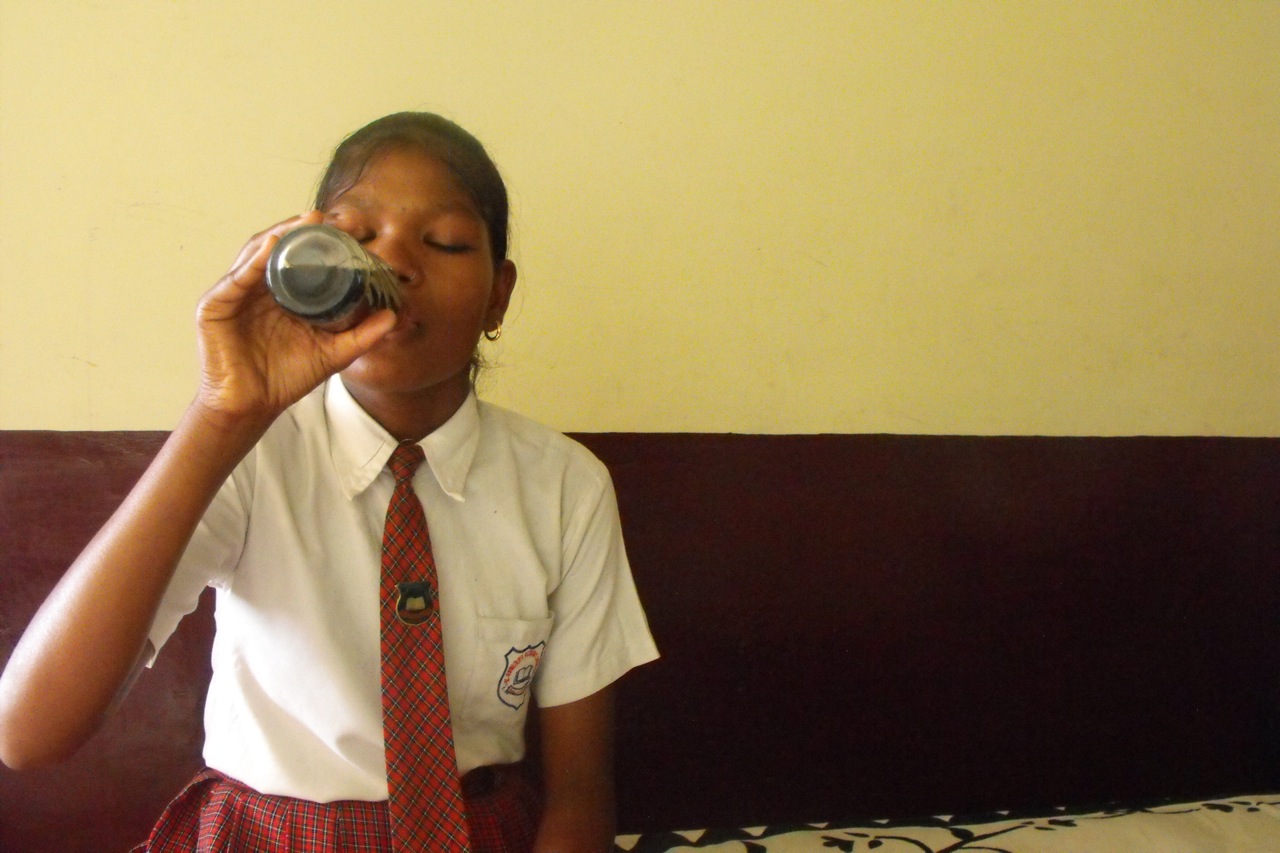
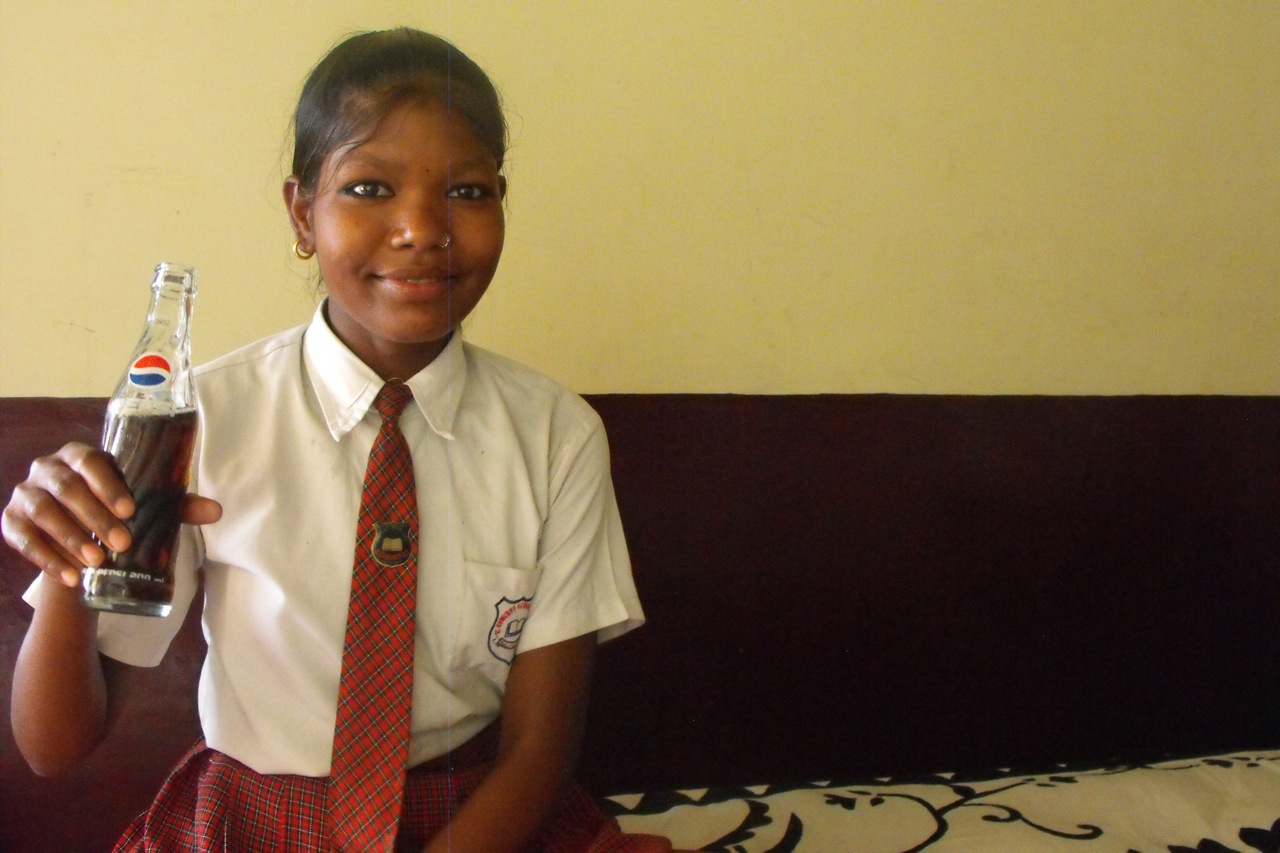
Sunita hams it up for a fake Pepsi commercial...


Posted in Kashi, Rose Apple Island | Tagged , , , , , , , , , | 1 Comment

One man’s hell…

“Varanasi is a shit hole. If you can’t see it’s a shit hole, you’ve got your hippie shit-loving head screwed on backwards. Varanasi is a holy heaven. And if you can’t see that, you’ve got your tired tight-ass world upside-down.”

Random Saddhu

Posted in Kashi, Rose Apple Island | Tagged , , , , , , | Leave a comment

Postcard from preconception…

“Remember me?”
I did. It was the same kid who had ushered me into the gift shop, probably the nephew or son of the owner.
“Sure,” I said, but kept walking.
“Do you have everything?”
“Yes, thanks.”
We were in the winding narrow streets that circle the Taj Mahal in Agra. It was hot and loud. After a whole day exploring the historical sites, I felt reasonably up to speed on my Mughal history, and I was in a hurry to get back to the quiet and air conditioning of my hotel room. In the shop, I had managed to refuse everything apart from two postcards of the Taj. I thought it would be funny to send one to my dad and his wife in Dorset, England — the first postcard from India in five years.
“Sure you have anything”?” the kid persisted. He was strolling alongside me hands in pockets, smiling sideways. He looked about ten, but here kids are often older than they look.

I tried ignoring him, but he kept following me. A few minutes later, I stopped, and trying unsuccessfully to hide my irritation, said, “I’m not going to buy anything else,  so you should probably not waste your time with me.”
He looked up at me, his smile now replaced by a look of deep disappointment.
“You left this,” he said, and opened his hand.
It was my change from the postcards. Eighty rupees.
He’d followed me for ten minutes, playfully trying to get my attention just to return this money that he could so easily have taken.
“Thanks so much, really. You’re a great kid.”
But I’d already blown it, I knew. Then, to make matters worse, I offered him 20 rupees. He refused it. Somehow, I knew that he would.
I watched him walk away and felt my discomfort transform into gratitude. Not for the eighty rupees, but for the lesson he’d given me. I mailed the postcard the following week. It never did reach my dad.

Posted in epoche, Moving on.... | Tagged , , , , , , , | Leave a comment