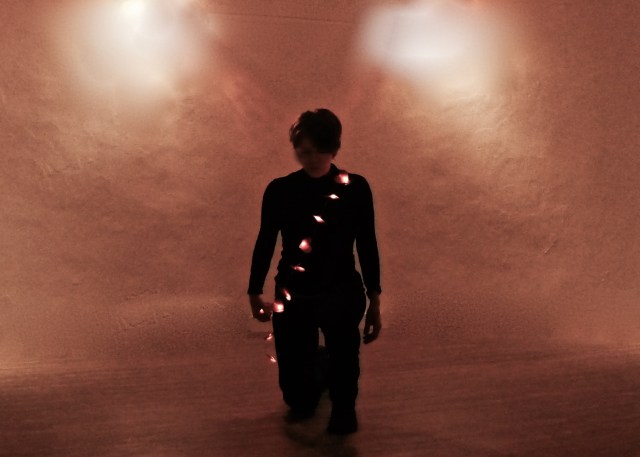
Today I took off my shame

P1110870 (1)

Today I took off my shame
I didn’t hurl it at the ground
I just noticed I was small enough to slip through it
Unmolested.

Bodiless, it fell like a pile of empty armour
On a silent battlefield.

Every strap and buckle had a war plan
More advanced than mine
So I’d dragged her with me everywhere
Every meeting, every parting, every kiss and every meal
Had hosted this unburied corpse of a guest.

And I, unable to see a life unburdened by this heaviness,
could not lay this Shame to rest, could make no funeral plans.

Did I slip through or did this heaviness slip off my shoulders, easy as a negligee?
Either way, this lightness is a new invention,
A dimension of powers lost to the absent-minded.

Disarmed I seek no more protection

Freed from support of muscle and bone
She lies in a jumbled heap
A dismembered outgrown crab shell
In the tall wet grass.

I must have slept because I woke
Startled in her shadow.
She had reassembled into someone familiar
Someone who could be seen.

She bowed down upon one knee and took her leave
She was still dark.
A sash of fireflies formed to light her way
And I watched her go for hours and hours and hours.

All the way to the thin sharp edge, the burning pyre
Of the coming day.


Posted in epoche | Leave a comment

Let me freeze again to death: the texture of depression in an obscure 17th century aria restructured by a gentle alien

The next time someone asks me to describe depression, I think that I will simply send them the following lines from this song.

Let me, let me,
Let me freeze again
Let me, let me
Freeze again to death
Let me, let me, let me
Freeze again to death…

The gentle alien, Klaus Nomi, who fell to earth in southern Bavaria, at a time in the Second World War when the US began planning the allied invasion of France. He did not write this particular song he performed, but he was credited with bringing it back into the light. The Cold Song is actually an extract from Henry Purcell’s aria Scene of the Cold, from the third act of the baroque semi-opera, King Arthur. A semi-opera is a dramatic opera where the principal characters don’t sing–unless they are drunk or supernatural as is the case with Cold Genius, the Spirit of Winter, whose Let me freeze again is a reluctant response to Cupid’s invitations to awaken to Spring in the prelude to The Frost Scene.

Nomi’s interpretation is like the unearthing of an artifact, melted down and remoulded into the same form but now of a qualitatively unique substance–a feat of musical alchemy. No matter that Nomi is dressed in a costume more Elizabethan than Enlightenment. He is more time traveler than historian. The way in which this tenderly singular German immigrant reinterprets the 17th century Englishman’s aria moved me to tears the first time I watched it. I then watched it on repeat for about thirty more times. There is another, more produced version, but this live stage version finds more emotional reach. And yet his performance appears devoid of the dramatic motions and gestures of opera. Nomi’s body language; an angular staccato puppetry, almost robotic, is exaggerated by a stiff, close-fitting period costume and theatrical makeup. Yet, like Pinocchio, instead of disconnecting us from the feeling human quality, the combined effect of all this artificiality is to underscore his essential humanity even more evocatively.

What power art thou
Who from below
Hast made me rise
Unwillingly and slow
From beds of everlasting snow
See’st thou not how stiff
And wondrous old
Far unfit to bear the bitter cold…

Nomi renders the aria’s cry of besieged frailty with hyper-controlled intensity. A masque-like face, eyes like CCTV cameras scanning a distant horizon, thrust from a high ruffled collar. I later read that this collar was to hide the sores on his neck as his immune system began to collapse from complications from AIDS. Nomi had only two years left to live and yet here he is, offering his artistry crafted from journeys most would never dare or think to make.

The aria shows us a man not up to the task to which he is called, to awaken from inertia, from a dorsal deep freeze.

I can scarcely move
Or draw my breath
I can scarcely move
Or draw my breath

Nomi’s remarkable vocal capacities as a countertenor combined with his orphanic otherworldly stage presence fit perfectly with the poetic depth and technical complexity of the work. The song appeared on Nomi’s first album in 1981 and the 1982 single reached 23 in the French music charts.

Continue reading

Posted in epoche | Leave a comment

This hole is perfect

devastated

This hole is perfect
because you are in It

Don’t even try to get out

This is the perfect shape of you
Crushed to atomic
Compounded to compost
To a mad misshapen thing

Beyond redemption or repair.

The seed song of the new
Begins as a lost cry that falls on a heart without ears.

Layers of bodies deep
Held urgently trembling in the smothering womb
of the
moistened dark.

Posted in epoche | Leave a comment

We met only in the desert

We met only in the desert
My impossible love and I
A holy cup of mutual thirst
where darkness lights the sky.                                                                          The charnel ground of galaxies desert
became our wedding lair
The howl of jackals ‘cross the sand
the vows we ached to share.
“No one will love me like you do.”
the truth in fire did yearn.
We held on tight that starry night
And prepared ourselves to burn.

Posted in epoche | Leave a comment

Abyss to home in three viewings

Sometimes when we see things from a distance, we see things more clearly. Like the view of a mountain from another mountain across a whole valley between. But sometimes, when we view things from afar, we miss something vital. Sometimes we need to lean in closer, for the details to fill in the bigger picture, and bring a clarity to what we perceive. A step back. A step forward. Both can illuminate, but differently.


distant
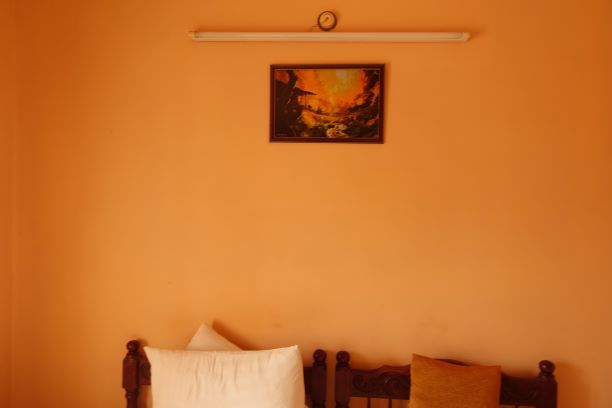
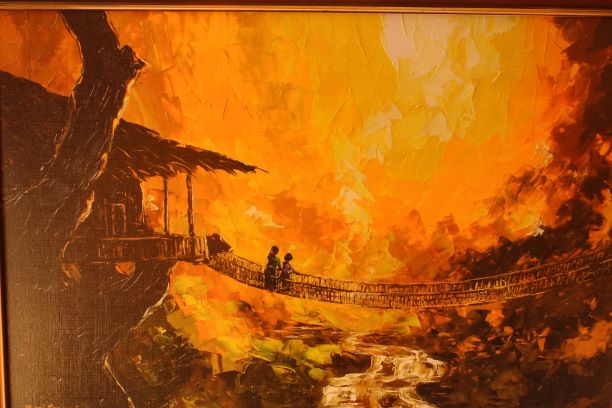
In a forgettable hotel room in Kerala, this painting sat above the bed. When I first glanced at it I saw – danger. Dark sinister shadows leaned in menacingly towards two shrunken figures who were huddled above the gnawing fiery depths. Forced by some cruel fate to cross the chasm that threatened to engulf them in apocalyptic chaos on a bridge of tinder, ripe for ignition and certain death.

ropebridgemedium
I put down my case and turned on the fan that creaked out at an awkward kilter swirling the heat around enough to suck some of the sweat form the nape of my neck. A little closer, and I saw in the painting that the hellish abyss was actually a river, spilling over rocks, alive and cool, and the menacing shadows were actually a home with a tree growing outside.

ropebridgebigger
I crawled onto the bed, suddenly aware of my exhaustion. Before I lay down, I took one final look, this time up close. How strange. The huddled figures were not huddled at all, but standing erect with quiet dignity, a mother and child perhaps, watching the brilliance of an evening sunset. They weren’t even trying to cross the bridge. They were fine exactly where they were. The whole image had changed from one of terror to one of peace. In three viewings the raging abyss had become the peace of home.

Posted in epoche | 2 Comments

Eclipsed: The passage of corresponding things

“Pijaude” they call it in the French Gâtine, the stretch of gentle hill and forest undercoated with granite so hard that the region has remained, even today, resistant to cultivation or change. The word refers to the effect of sunlight through the leaves of trees. Dappled light we English might call it. On this patch of beach in Kerala on India’s south-western shores, the palette for pijaude came from the sunlit space between jack fruit tree leaves and sand, rather than oak leaves and field grass. The spaces were small cinnamon half-moons of gliding across the sand like the light through a paper kaleidoscope from the sway of the soft sea breezes above.

But this morning, December 26, 2019, there was an unusual quality to those half-moons that had not been there on Christmas morning. My senses recognized it as eclipse light. I had not heard the news of this coming eclipse, having been out of touch with internet and news for the past week. I was astonished to find myself old enough, eclipsed enough, to recognize it. I have only witnessed 3 or 4 eclipses in my time on earth, but perhaps it only takes one. Perhaps, like the fear of snakes, it goes beyond individual memory, to shared neural imprints from eclipses of the ancients. For most of our history, before the advent of communication technologies, possibly the only event apart from comets experienced by so many at the same time. It would have been talked about and shuddered over, astrologers calculating, storytellers storying, religious zealots warning that unless this then the end that.

alchemy_eclipseWhatever mechanism of recognition was at work in my own psyche, no other phenomenon I knew could create this light. It is entirely distinct from twilight or dawn. And this was 8 in the morning when the pijaude should have had a far more polished tone. Now it was as if every atom had been covered with a very fine layer of shimmery dust. To recognize something with such clarity that one cannot easily describe is to hold one’s perception as a deeply internal, private thing. If un-shared, peaceful and uncontested. Yet singular. Devoid of the camaraderie of spirit with any other who has marveled at that same marvel. Even if only to say, “Yes, I marveled at that too.”

In a fabulous rendition of as above so below, the kaleidoscopic activity of the half-moons of light were, at that very moment, being mirrored in the celestial movements of sun and moon – a celestial pijaude. The shadow of the moon draped across the shoulders of the sun. Eclipse light is light shawled in shadow. The world through a veil. A knowledge that aches to remain hidden while the laws of the natural day halt in their steps to re-calibrate the secret.

The light held a loveliness, no doubt, but also a deep disquiet. Because it was not just about the quality of light. There was some other sense engaged. A whole nervous system sense that could feel something grand and awful was afoot. Something that could punify the biggest, the most powerful of anything we know. No surprise that eclipses have been associated with the fall of empires, with calamities, with pestilence and general doom. With the end of life as we know it. With, in short, very, very bad news. At best, it was supernatural theft; the sun had been snatched away by a giant frog, a wolf (Vietnam, Norway) or eaten by a dragon, a bear (China, indigenous north-west US). It was a time to count your sins and to pray that your soul was pure enough for the passage.

How utterly terrifying it must have been to have lived in a time when you didn’t know if the sun would return. The source of life itself. Without which nothing would be possible. No art, no love, no children, no green, no arguments, no Sundays. Maybe sun worship fell out of fashion with other forms of astrolatry–the worship of celestial bodies as deities–when we figured out that we would get the sun back in just a couple of hours. In other words, when we began to take it for granted. And maybe one eclipse the dragon will hold the sun in its claws just a little longer. Just so we learn to appreciate it again. Because I feel a small jealousy for that immense terror on such a scale, conciliated by the subsequent immense relief. Now, our fears are background existential threats, that we can neither clearly identify or adequately feel except as a kind of malaise, eclipse dust.

There remains something preternatural about eclipses however sciencey you get. And because of this eclipse superstitions are bound to endure. Although many Indian newspapers took pains to try to dispel eclipse myths one die-hard journal covering the Boxing Day “Surya Grahan” of 2019 warned the reader that during the celestial event they should eat grains, have sex, or walk into a kitchen. At Kerala’s Thiruvananthapuram sports stadium, set up for eclipse watchers who watched the event on a giant LED screen, kheer, a sweet pudding made of milk and grains, was distributed to the crowd for the very purpose of dispelling the belief that such food becomes poisoned during eclipses. One bright exception to the darker lore is the Italian belief that if you plant flowers during an eclipse they will be more colourful. But Italian optimism is outdone by the doom and gloomers. After all, the word eclipse itself is derived from the Greek for “abandonment” or “downfall”.

When I extinguish you, I will cover the heavens and darken their stars. I will cover the sun with a cloud, and the moon will not give its light.  Ezekiel 32:7

This was not a total solar eclipse, but something astronomers call a “ring of fire” or annular eclipse. The moon was in a distant part of its orbit, too small to shadow the sun’s orb completely, creating a ring of light around it. In photos it looks like Frodo’s ring burning in the heavens. Another French word. Anneau. The word for a simple circular coil or a ring with no ornamentation – a wedding ring perhaps. The marriage of the sun and moon spoken of in alchemy, that lost marriage of art and science. I like this thought, especially since for a number of indigenous cultures solar eclipses were signs of disharmony in the celestial sphere, where the sun and moon were quarreling with one another.

Syzygy is the alignment of three or more celestial objects in space from the Ancient Greek meaning “yoked together”. It can also mean a pair of corresponding things. Like the shape of the in-between leaf shadows on the sand at my feet and the shadow of the moon around me. In an annular eclipse, the shadow that the moon casts on earth from being directly in front of the sun but not ‘occulting’ it entirely (the language of eclipses is a magician’s rule book) is called the antumbra. Another French word. Ombre. Shadow or shade, from where we get “umbrella”.

Kerala was the first place in India where this eclipse was visible, but I could not see it from where I was sitting since the Indian ocean behind me faced West and the Eastern direction was blocked by a grove of trees. But I could “see” it in another sense. In that syzygy of corresponding things. As inscribed on the lost Emerald Tablet described by Hermes Trismegistus: As above, so below. As within, so without. As with the soul, so with the universe.

Posted in epoche | 3 Comments

Illusion of asymmetric insight

I spent a bit of time reading about this phenomenon – it is called the illusion of asymmetric insight – google it if you are interested. I wrote a poem about it. Maybe you will do something with it too, or at least, know it is there. Here we go….

I know you
But you don’t know me.

I can tell from the way you lift your chin
Scratch your head, lean out, lean in,
The way you order at the restaurant
Something on the side….

illusion
I can tell from the words you choose
The words you choose to leave out.

The way you turn up your cuffs
Or leave them

Down.

I can tell from the flecks of highlights in your hair,
The beats of blinking
When you talk.
The length of your pauses.
How and when you laugh.

How and when you
Don’t.

I know that I am incorruptible
Whereas you will take the bribe
Anytime.

I hold the line between me, and you
Between the ones that can be taken and the ones,
Like I,
Always in the clear.

So much I can tell about you.
Me.
I remain unknowable.
The length of my pauses,
How I laugh and how I don’t

Gives nothing,
Away.

You are all-knowable to me
I alone, am mystery.


Posted in epoche | 2 Comments

A guide to the easily startled

doll

If you want a thing
Move softly in the direction of that which reflects it.
The thing itself might find your presence too much to bear
And you will find it there, also. And less easily startled.


Si tu veux une chose
Déplacez-vous doucement dans la direction de ce qui le reflète.
La chose elle-même pourrait trouver votre présence
trop dur à supporter 
Et tu le trouveras là aussi
Et moins facilement effrayé


Posted in epoche | 3 Comments

Even on days like this

In the hungry chasm of Empty Space
Where someone else’s music plays
I, like you, keep my small quiet Faith.

I see you, though my eyes get blinded in what passes for light.
We abide in the Awful Dark
Like mushrooms, we form musty coded connections
Beneath the world that flickers its lies
On the walls raised to keep us blind, apart.

A quivering hand around the last flame,
A touch between strangers among the last stand.
A glance in the metro
That shatters the Loneliness – for a clear shattering instant.
And sets me back onto my collective and singular course.

Where there are….

No precepts, no concepts and no institutions,
No tenets, no creed, no final solutions.
No temples, directives or codes to employ
No history, no story
No art or philosophy.
No politics, no magic, and no revolution
No oppression, no freedom
No romance, no tragedy

No Me and no You
No You and no Me

window

This faith is not yours
It is also not mine.
It refuses to march, to chant or
 to rhyme. 

It knows the difference between Right and Wrong
Without preachers.

Don’t look for it in books
It would rather hit you over the head with one.

Hope I can lose like my car keys.
But Faith
Can say No to Despair
Even on days like this.


Posted in epoche | Tagged , , , , | 3 Comments

The Rest Remains

Never again
Will you look at me, in that certain way,
As if to say,
There is nothing that you cannot be
because you are a part of me.

And that part of me that knows this to be true,
I know, and don’t, and don’t, and know again…
To the Warbler pecking by my feet
I find it easier to explain
“If I seem a Cynic it is only due

To having been a rank Romantic, just like you.”

The Warbler is surprisingly soulful in reply.
“Cynics are Romantics,
Who found it all too hard to bear.
Stay here, with us, we who are beyond the Care.”
The Silence here is paper thin.
I etch and erase the lines of thought

Tracing new lines
Around that Noble cloud, though none can still its passing.
Subsuming to forces that care nothing for syntax or meter.

Or grief.

fordad

And then, by inevitable accident, words punch through the other side.
And even the most valiant cloud can’t hold together.
I wonder how you managed
the Disappointment.
The answer….
Presses deep into the wounds.
Arguing with faith and Warblers,

But always one frail finger probing, poking at the possible….deepening the Opening.

It is not the Silence but that finger
That keeps me from descending now.

The Wound so open it opens to a space wider than I can contain.
Ready to Un-know. To unravel all my journeys
And have them begin again. On the spot.
Beyond doubt or faith.
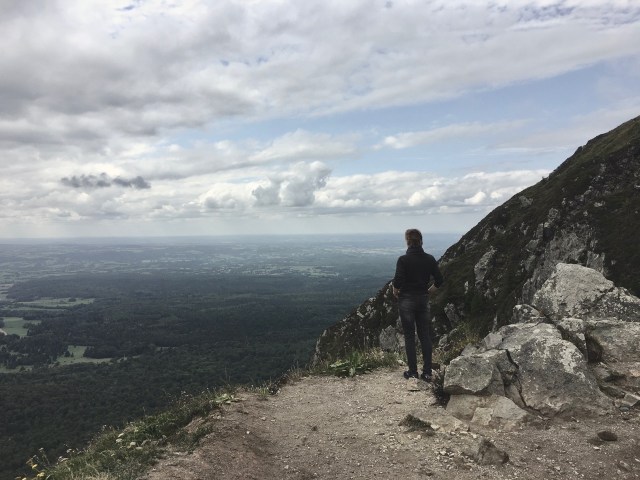
On the mountain top, when I can struggle up to it.
I know only one thing.
That this love was always part of me.
Where can it possibly go?
Into that cloud dissolving in the very act of being seen on that far horizon
Falling to reflection on forested lakes,

Impossibly lovely.

Give me the mountains
I would rather deceive myself with this rarified air
Than any deceit I can win
Down there.

There is solace in this place.
Where Sorrow can stretch out
naked and unexplained.
Without the self-consciousness of Company.
It is time to descend but still I linger….
Breathing in the next untaken step, like it’s my last or first.
Like a tender stage in Evolution.
The air here is too pure for me to inhale for long.
And the Valley calls with its homely lights and hearthside chatter.
The Step is taken
But only my body moves.

The rest remains.

Posted in epoche | Tagged , , | 2 Comments