 I boasted among men that I had known you.
They see your pictures in all works of mine…
I put my tales of you into lingering songs.
The secret gushes from my heart.
Rabindranath Tagore
Mr. Sharif parted the crowds on the platform of Jaipur train station like the Red Sea. Maddy and I had staunchly forged our way past the “money mosquitoes” as Mr. Sharif later referred to the hopeful gaggle of drivers and hotel wallahs that hovered around us. To hesitate was a sign of weakness; to stop was complete surrender. But Mr. Sharif moved with a focused grace; relieving us of our bags, launching them into the open trunk of his black and yellow Ambassador, and flicking open the back passenger door in a single seamless gesture. I’d been told that our hotel was fifteen minutes from the station. I was already visualizing a warm shower, a soft mattress, and a generous shot of the Scotch whiskey that I knew Maddy had stashed in her travel case. Mr Sharif carefully adjusted the rear view mirror. He was dressed in the standard uniform—black trousers/white shirt—of waiters and drivers, Arabica-coloured eyes gleaming beneath a prominent groomed hairline, a dash of grey at the sideburns. He was only 29 I learned later, but he looked closer to 35. Absent was the well-worn expression studiously designed for the foreign tourist, cheerfully resentful and wearied by repetition. Mr. Sharif was fully engaged. I’m sure he had said it all a thousand times, but somehow had not lost enthusiasm for the delivery.
“See the book beside you?”
Between us on the seat lay a worn hard-backed notebook with red cotton binding—the kind found in every schoolchild’s backpack.
“Please read the last thing inside.”
I complied with an internal sigh, wondering what the scam was this time. Using the light of my mobile phone, I began to read. The writing was elegant, old-fashioned. My wife and I are eternally grateful to Mr. Sharif for all his kind assistance…
“Please read speaking, Madam.”
My internal sigh almost achieved audible capacity as Maddy gave me a we’re not going anywhere until you comply kind of look.
I cleared my throat.
“My wife and I are eternally grateful to Mr. Sharif for all his kind assistance on our first visit to Jaipur. In his capable hands we explored the fascinating historic sites of Rajasthan for two glorious weeks. His knowledge, integrity and concern for our welfare, but above all, his generous company, will be warmly remembered in years to come. You who are reading this are lucky to have him in the driver’s seat. With much appreciation, Arnold and Bessie Wahlberg from Oklahoma.”
 When I looked up, Mr. Sharif’s eyes seemed to have percolated an extra shine. It was then that a penny rather long in the dropping, registered that this must be the first time he had heard what the Wahlbergs from Oklahoma had said about him. It was quite likely that he didn’t read English, and certainly not Mr. Wahlberg’s elaborate cursive. By way of this ingenious method, Mr. Sharif accomplished a dual benefit. He learned what his last customer had said about him, and impressed the new customer with this knowledge. It was a leap of faith on his part, for he had no idea in advance the substance of the most recent entry. But that was likely part of what kept it interesting. Mr. Sharif believed in himself and was very much his own man.
It was two days before we saw Mr. Sharif again. Properly stimulated by India’s literati at the Jaipur Literary Festival (with inevitable discussion over how exactly racist was Rudyard Kipling—a less ponderous exercise if he hadn’t muddied the waters with the poem We and They), we had a few spare hours for shopping and sightseeing before our bus headed back to Delhi. He seemed genuinely happy to see us, and was patiently attentive, though clearly amused, by our rambling discourse about where exactly we wanted to go. He was immensely likable, and took no advantage of our indecision to whisk us off to his third cousin’s pottery factory.
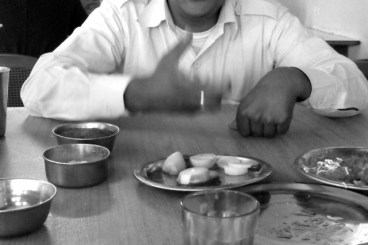 After an extended period admiring the handiwork of pillow cases and bedspreads in one particularly well-stocked textile shop (and having been talked into buying more than either of us felt we could afford) Mr. Sharif took us to lunch at what he assured us was the “very special best” restaurant in Jaipur. The place was an unadorned canteen-style concrete square on the first floor of a tatty shopping block. But being seasoned veterans of India’s commonly inverted relationship between ‘upscale’ and ‘delicious’, Maddy and I remained optimistic. When the vegetarian thalis arrived – the masterful blend of colour and spices with the piping garlic nans, a succulent buttery shine between heat-bubbles perfectly browned, grabbed our helpless appetites and spun them into a rumba. We began to politely ease the nans apart, but after the first mouthful, all decorum had been tabled, and we were ‘ripping and dipping’ like starving babies. Mr. Sharif launched into a story about his childhood. I glanced up at him over my spoon every now and then, to give what I hoped passed for an ‘I’m listening’ nod, but the contents of the little silver plates before me held my attention far more firmly than Mr. Sharif’s reminiscences. Though this was about to change.
“When I was twelve, my family moved to the city so my father could find work. He had been a farmer before, but things hadn’t gone well. In Jaipur, he couldn’t find any work. We were so poor, we could barely afford to eat. I used to hang out near my uncle’s chai stall near the Jaipur post office. I liked watching the foreigners. They were so interesting to me. One day, an American man and his wife came with some textiles they wanted to send back to the US.
 I noticed that they were having a lot of trouble figuring out how to wrap it and fill out all the forms, so I offered to help them. I took care of that parcel and a few others for them over the next couple of days, making sure it was properly stitched up in white cotton by the local tailor and addressed in black marker pen. On their last day, the man shook my hand and thanked me. He pressed some money into my hand. I didn’t know what it was so I took it to my uncle at the chai stall. He said it was fake and that it was worthless. I began to cry. I was so upset that after everything I’d done the man had given me fake money. I hadn’t even asked him for a fee. I would have done it all for nothing. But fake money? I was so angry I ran home. I didn’t want to see any more tourists that day. My other uncle was in the house and he asked me what was wrong. I showed him the note.
“This isn’t fake,” he told me. “It’s $100”.
I almost fainted. I got the money changed into rupees and I wrote down on a piece of paper exactly what I was going to do with it. I bought rice and daal and other tinned food to last my family for three months. I bought my mother a new sari. I gave my father enough money for one month’s rent. The rest I kept for myself.
Then I stationed myself outside of the post office, and whenever I would see a tourist, I would offer them my help. I did this for a whole year. One day, an American woman asked me to help her to send a package home. After I helped her she came and sat next to me. She asked me all about myself and my life. I found her easy to talk to. Then she told me she wanted to see something of Rajasthan, beyond Jaipur. I told her that I knew many beautiful places to visit, and she asked me if I would be her guide. I said, “Of course I will.”
I barely knew how to drive, but my uncle lent me his car. Her name was Jenny. I told her about the Western deserts of Jaisalmer, how black the night sky is there, how bright the stars shine. She said, “Okay, let’s go there.” On the way she asked to stop at a Beer & Wine shop. She bought some beer and drank it in the car. She offered it to me but I didn’t take any. I’m a Muslim, and we never drink. She got quite drunk that day and at one point she cried. I think she had some troubles.
 When it was getting dark, she asked me if I knew a hotel nearby. I told her that I could take her to my uncle’s guesthouse” (Mr. Sharif seemed to have an endless supply of uncles). “I was very happy. I told her that I would make her mutton for dinner. It was my most famous dish. Like gourmet style. Everyone loved it when I made mutton. When we reached the hotel, she said she wanted to walk to the market to get some more beer. I went into the kitchen and began to prepare our dinner. By eight o’clock it was ready. But she didn’t come back for dinner. I watched it turn cold. I couldn’t eat any of it. Finally, I threw it to the dogs. I didn’t know where I was supposed to sleep, so I crawled into the car with a blanket. She eventually came back around eleven on the back of a motorbike. The driver was a young man from the village. She took him into her room and closed the door. That night I didn’t sleep a single minute.”
Maddy and I were nodding and emitting the occasional “hmmm” and “aha” to show that we were listening–though truthfully we were more concerned in getting as much daal as possible onto our nans and getting the whole to our mouths before splodging it across the table. But I admit that by now I was getting intrigued. Mr. Sharif was a consummate story teller. It was like he was reliving every word.
 “In the morning she came out and asked if I wanted to take a shower in her room. The man must have left already. I couldn’t look at her. I didn’t want her to see that I was crying. She kept asking me what was wrong. Finally, I couldn’t stand it any more. I shouted, “I spent the whole night cooking mutton for you. I had to throw it away. I cooked it especially for you! Now it’s all ruined!” I could hardly speak through my tears. She was standing directly over me. Her hair was golden and the sun shine on her blue eyes, ahhh so beautiful. Then she looked at me for a long time without saying anything. I kept crying and going on about the mutton. Finally, she said, “Come with me.” She took my hand and led me into her room.”
Mr. Sharif paused while my head arose from the daal, the last piece of nan dangling in thin air. Maddy was in a similar state. Both of us staring at Mr. Sharif in amazement.
“Then what?”
Mr. Sharif put his chin in his hands and shook his head slowly as if he himself could hardly believe his own memory.
“I did not see the sun for five days.”
 Maddy’s eyebrows were levitating ever higher up her forehead.
“How old were you?” she asked.
“I was fifteen.”
“Was that ….erm…?”
“Yes, it was. My first time.”
He was not about to elaborate, which made it all the more compelling. There was nothing rude or lascivious about him, or the way he shared his coming of age story. It was all very natural and deeply human. I wondered who else he’d told; and why us, why today. Perhaps because he sensed we wouldn’t judge him or think he was trying to pick us up. I could picture it all so easily. Little Mr. Sharif, crying into his mutton. I was intrigued by this mysterious woman, somewhere in her thirties and her decision to be the leading lady in the carnal rite of passage for this romantic entrepreneurial teenager from Rajasthan. I could see him entering her room; a besotted boy, wiping away his tears. And coming out a man.
“That began something in me. I was never the same. A year later, my parents arranged my marriage to a local girl. I’d known her for some time. She was lovely. I liked her a lot. But I knew I would cheat on her. I told her I could never be the husband she deserved. She was very understanding.”
“So you never got married?”
“No. Never.”
“Don’t you get lonely?”
“Of course. But I decided that I’d rather be lonely than be dishonest. You see. I only can be with foreign women now.”
“Isn’t that difficult?”
Mr. Sharif laughed.
“Yes, it’s very difficult. But a year later, when I was sixteen, I met a girl from Germany. She was much younger than Jenny.”
 Maddy and I’d had this vague plan to visit Jaipur Palace, as one does. My Delhi neighbor, Tsering, had insisted that I see the imperial Moghul harem where, according to legend, the concubines and their lovers bathed in hot milk laced with hashish. But Mr. Sharif was far more entertaining than the ruins of an ancient harem. I could see by Maddy’s face that she was in full agreement. Mr. Sharif did not disappoint.
“She had gone through a crazy time, this German girl. I think she was a little crazy. She was in a hospital in Berlin. She couldn’t stop cutting her arms. She had tiny scars all over them. Someone told her she should go to Varanasi to find a guru. When she got there she met some saddhu and asked him for a mantra, or some meditation she could do, that would help her when she felt crazy. But instead of giving her a mantra, this saddhu told her she needed ‘man energy’.
“Man energy?” I intercepted.
“Yes. And he told her she would find it in Jaipur. So, she came to Jaipur.”
“And?”
Mr. Sharif smiled.
“And we stayed together for some time.”
He was not interested in bragging about his sexual exploits as would many other young men who had found themselves in this enviable position.
“And how many days did you not see the sun this time?” Maddy piped in.
“Seven.”
 I was a veteran of tall tales, but this was for real. I knew it down to my shoes.
I couldn’t help emitting a soft “wow”.
Maddy was less restrained. “Seven days!?” she exclaimed.
“Yes. She told me I must have Mughal blood!”
Mr. Sharif looked momentarily shy at having succumbed to a boast.
“And did it work? I mean did she get better?”
“Oh, yes. She was fine after that. She seemed very happy.”
“How did you know she was happy?” I ventured.
“She was peaceful and she smiled all the time.
“And were you happy, Mr. Sharif?”
“Oh yes. I was very happy. For a while. She taught me a lot. We stayed in touch for a few months after that. I loved her very much.”
“Do you mind if I write your story, Mr. Sharif? I think people would be interested to hear it.”
“I don’t mind at all. I have nothing to hide. But you must promise me one thing.”
“Sure,” I said, leaning in a little.
“Don’t say the name of this restaurant. I don’t want it to…you know, get ruined.”
“Like the mutton.”
Mr. Sharif threw back his head and laughed so his belly shook.
“Yes, madam. Like the mutton.”












 subincontinentia