Cats of Zanzibar 2


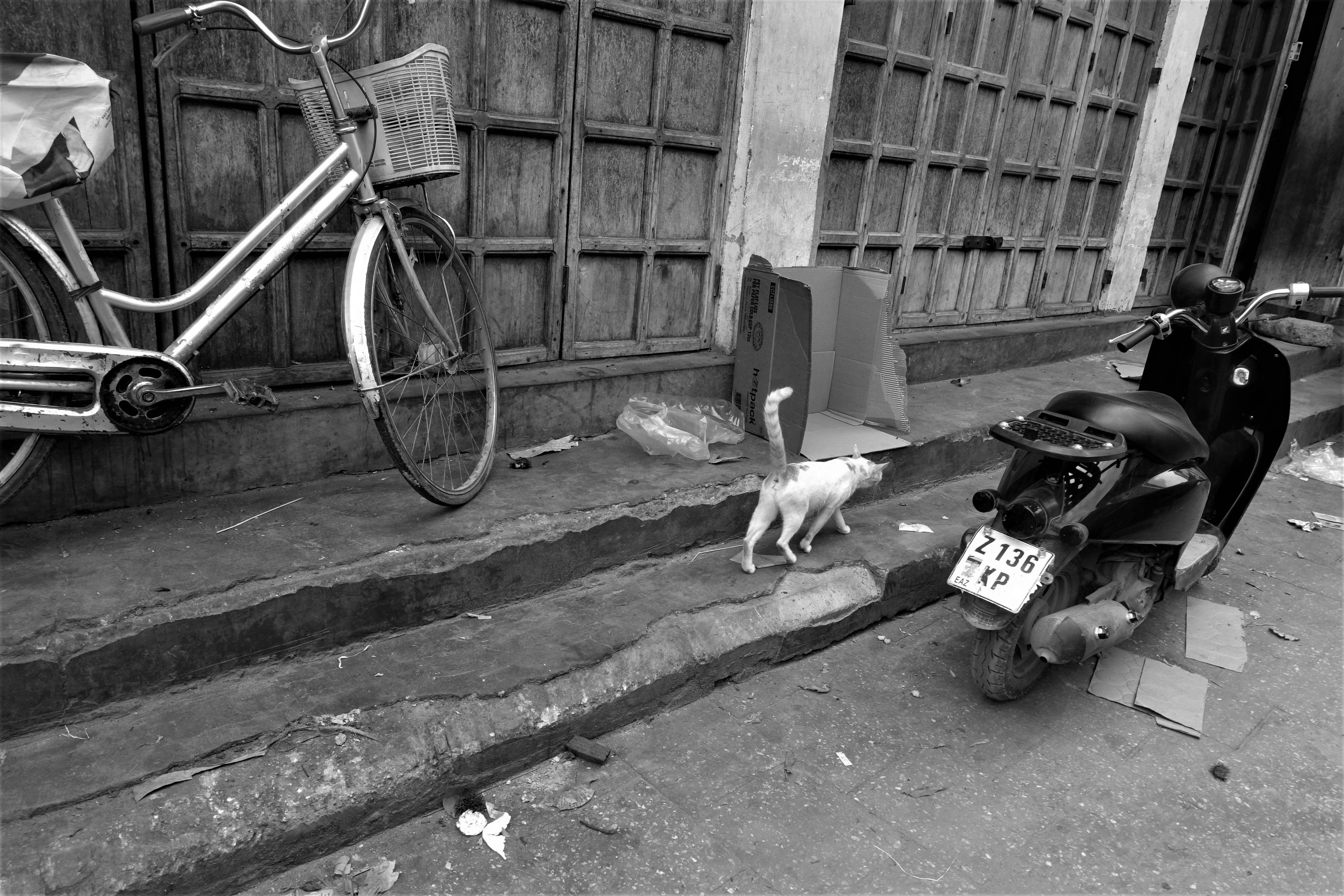
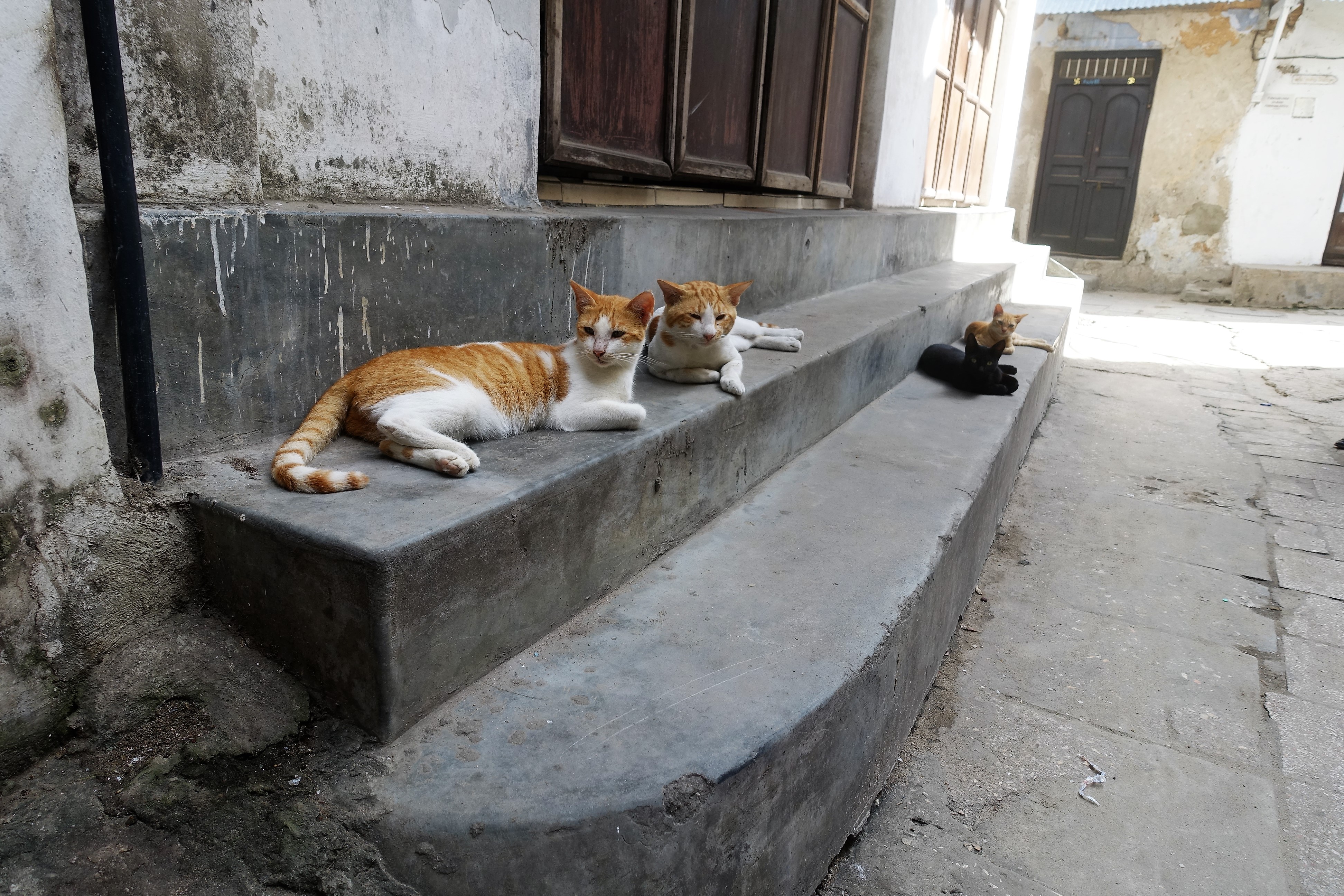
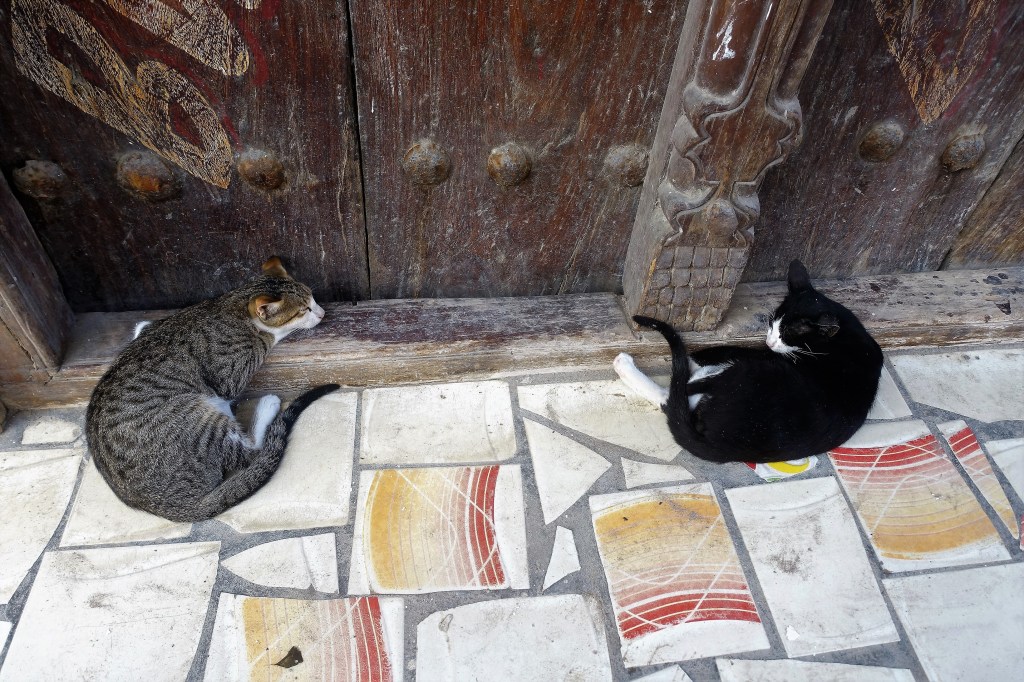
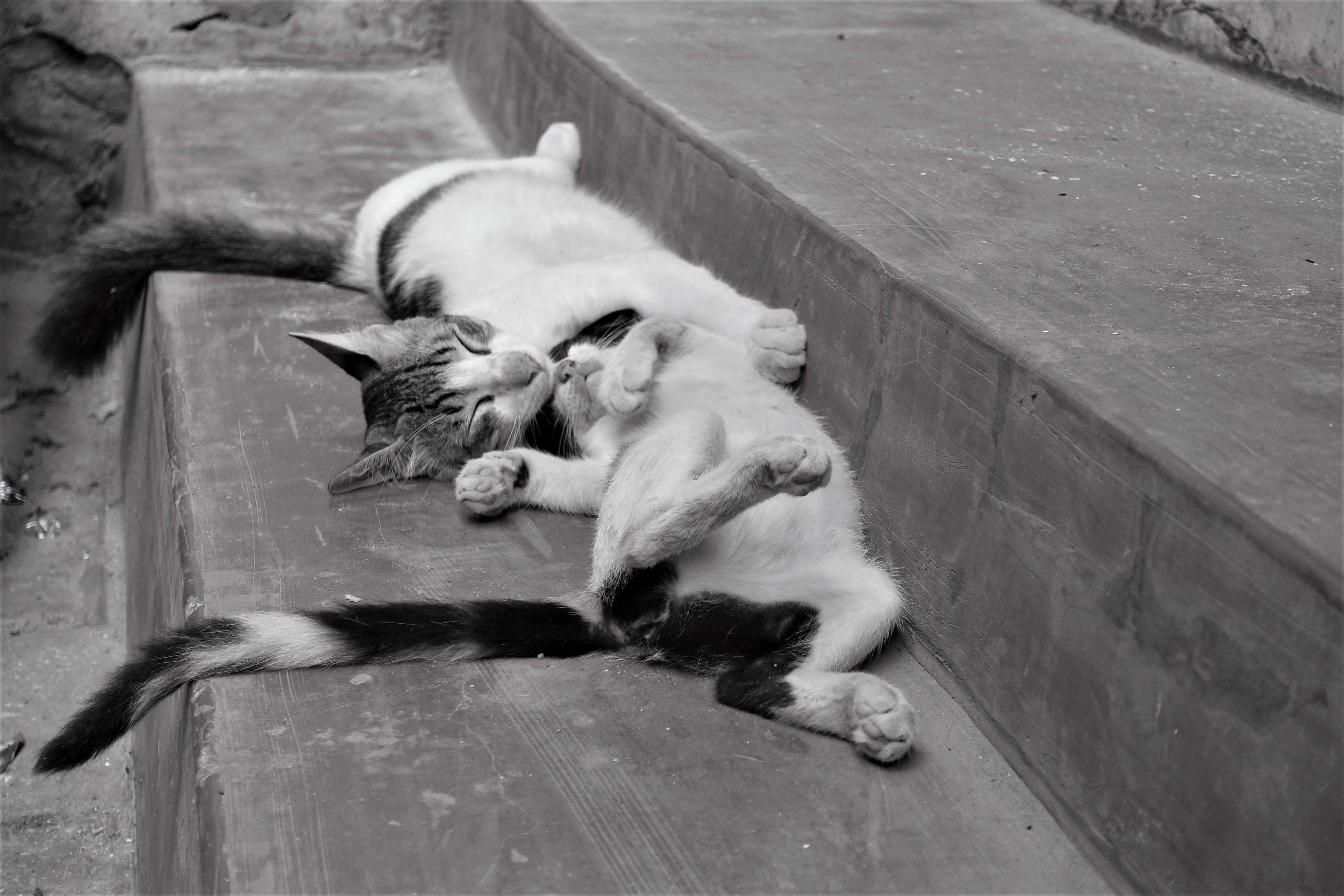
The cats of Zanzibar have a presence that I’ve rarely seen in the stray cat world. You see them in full and unguarded sleep on foot-worn steps in the middle of the day in the relentless cacophony of commerce. Since there are almost no dogs in the urban areas of this island archipelago off the East African coast, and since they are more than tolerated by the locals residents, they have little to fear except the traffic.


The Zanzibar cats also have very clear and marked out territories and are often ‘adopted’ unofficially by the hotel, restaurant or shop where they have staked their claim. It is rare to see one even flinch amidst constant weaving of cars, people, scooters and vegetable carts. They have learned to hold their ground.


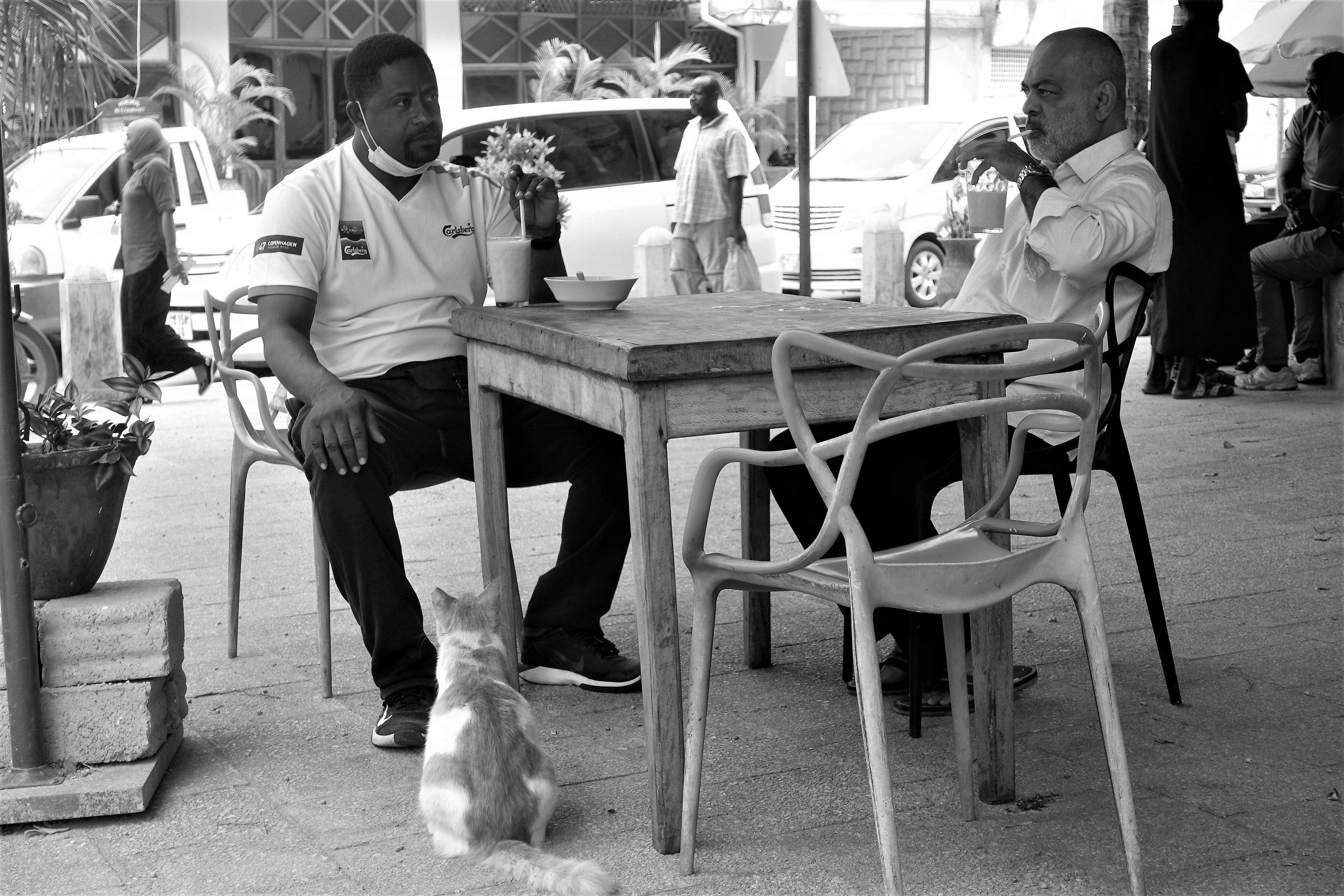
They stake out the tables at outside cafes, and in the evenings when many people are enjoying the chance to eat in the cool air, three or four will attach themselves to a table, and wait and wait and wait for the accidental, or sometimes if they catch a sympathetic eye, purposefully dropped morsel.

Lena is in another category. I’m pretty sure that she would be appalled to be included in a blog about street cats, since she occupies notable pride of place in an Arabic-style four star beachfront hotel. She can often be seen lounging in the middle of the lobby while guests carefully steer their luggage around her. In the hotel office she has her own custom-built house and food and water bowls.


Firoz, who works at the reception desk, knows all about Lena’s family history. Two of her sisters were run over as were two of her kittens. Lena is a survivor. No, more than that, I think, when I look at the sleekness of her coat and the smile on Firoz’s face as he pets her, even though he is allergic to cats. She is a thriver.

Posted in epoche | Tagged , , , , | Leave a comment

Hinglish—a language all its own

There is a language few outside of India have encountered that – like so many trends originating in the sub-continental mind – is quietly going global. This is Indian-English or ‘Hinglish’ as it is affectionately known. Spread mostly by Bollywood movies and within the liminal world of the NRI (non-resident Indian)—that is, Indians living abroad—Hinglish has even begun to rub off on foreign visitors to India. The influence of Hollywood movies and American music on Indian youth means that Hinglish can often sound more like “Himerican”, though the American part sounds quaintly dated. Indians youths of both sexes call each other “man” and “dude” more than any hippie did back in the 60s.

Even with the creep of modern slang, the English skills of the average eight-year-old Indian schoolgirl is more sophisticated than today’s average British child. Indians inherited English as it was spoken in the days of the British Raj, and have maintained much of its Victorian character and clipped precision that would sound very old-fashioned to the ears of someone in the streets of modern-day Manchester
or London. There are subtler influences too that can often be overlooked. I had a funny debate with an Indian shopkeeper who insisted that “almiri” was the English word for wardrobe (he had never heard of the word “wardrobe” or the more American “closet”). When I did some research, I found that “almiri” entered Hindi not through the British but via earlier colonizers—the Portuguese. (Other Hindi
words of Portuguese origin all seem to be connected to either tools or architecture; words such as hammer, sword, spanner and room.)

This Victorian-style Indian English is even more pronounced in the written word. In newspapers it is often used for effect to condemn or malign an opponent that gives a certain Gilbert & Sullivan tone to it all. For example, you might read about such-and-such a party or political group described as “rascals and scoundrels”. A victim in a fraud case might be described as having been “bamboozled” or an
academic might call a questionable historical theory “bunkum” meaning that it’s nonsense. Perhaps due to the influence of British military culture in colonial times, a number of everyday expressions sound like armed forces banter. When someone is out of town they might text you to say that they are “out of station.” (When I first received this message I thought they meant they were at the train station waiting to be picked up.) A play or cricket performance that’s considered high caliber might be described as “first class”. Politicians give speeches reminiscent of Churchill, with this or that policy decision described as “the need of the hour”. When a young man told me that he had “passed out” from college, I initially thought he was saying that he’d partied too hard when he should have been studying, not understanding that the phrase (which in the military means to graduate from a class or course) is used by
Indian students to mean graduating from college.

Some Hinglish expressions are altogether Indian and yet a non Indian English-speaker can quite easily infer their meaning. For example, an office clerk might complain that his boss is “after his life” or “on his head”, meaning that he is being pressured by higher ups to deliver something or other. Office English is its own special dialect. In an email, a colleague might ask you to “kindly revert” which means
you should get back to them about the topic at hand. If someone asks you to “do one thing”, you should understand this as a prelude to a request or advice that may well involve you doing multiple things. You may also be asked to “do the needful” which assumes that you actually know what to do with the information you’ve been given (and if you ask what it is you are supposed to do, the response may well start with “you do one thing…”) Meetings can be “preponed” meaning set at a time before the
original schedule—a handy reversal of “postponed” and a term that I think should
get more traction in the West.

After only a few days back in the country, I would find myself slipping into Hinglish, responding to people with phrases like “rightly so” or “as he rightly said”. I enjoyed this tremendously because it sounded like the way people spoke in boys adventure books from the fifties. Have a go. To ease your way in, you can start by adding the words, “in fact” after sentences. You can do this quite at random without concerning yourself over whether it’s an actual fact or not. You can add it to the end of pretty much any statement. “I’ve had enough to eat now, in fact,” or “Darjeeling has the best sunsets, in fact”. Then there is the liberal use of the word “only” at the end of a sentence to emphasize the action, as in “I am doing that now only.” It sounds odd in the beginning but it’s funny how sentences began to seem a bit bare without the occasional “in fact” or “only” tacked on the end.

Although you may never quite master the Indian headshake, since there are levels of significance to this gesture that would take a lifetime for a non-Indian to comprehend, there is one expression you can use that will make you sound like you’ve been around the chai shop a while. It’s actually more of a sound than an expression. You often hear it when someone is listening to someone else explaining something. It sounds like a very nasally haaar that emanates from deep in the back of the throat. It roughly translates to “Yes, I’m listening. I’m hearing you” (although I suspect that sometimes people do it to pretend that they’re listening when really they’re thinking about something else.) It doesn’t necessarily imply agreement though, except when it’s articulated repeatedly with gusto.

I first encountered this lingual habit while I was telling my bus companion about my trip to the Jaipur Literary Festival. After almost every sentence (and sometimes in between them), she interjected with a vigorous “haaar, haaar, haaar.” I thought there must be something wrong with her. Perhaps a sinus infection or a nervous condition. Two years later, while talking to a wildlife conservationist who was
briefing me about her work with Himalayan elephants, I began “haaaring” it up with the best of them. I was so engrossed in her story that I didn’t even realize I was doing it until she stopped speaking in mid-sentence and declared with astonishment, ‘You sound just like an Indian!’

You’ll often find English and Hindi mixed together in a melange whimsically called
the “chutneyfication” of English. One example is “ek minute” meaning I’ll be with
you in one minute (although you should take the ‘one’ with a grain of salt since
when people say “ek minute” they often just mean that they have noticed your
request and plan to attend to you some time in the foreseeable future). You also might
hear English words sandwiched between two Hindi words, as with “kya problem
hai?” What’s the problem? To confuse you further Indians regularly sneak in English
phrases when they speak to one another. You might hear two colleagues chatting away in Hindi and then suddenly break into “totally off the charts, yah?” For a moment you think, Wow, I’m beginning to understand Hindi! But when you tune in again, it’s gone. You wonder if you just hallucinated that snatch of English, but then it happens again. Hindi, Hindi, Hindi “90% rating” Hindi, Hindi, Hindi “it was terrible, dude” Hindi Hindi Hindi “adjust the ratio”. If you don’t actually speak Hindi it’s a bit like listening to a radio with dodgy reception.

There is often a curious lack of formality on the phone (and a curious excess of it in person). “Tell me” is a common way for someone you have already met to answer your call. When this first happened to me and the woman I was calling answered by saying “tell me” in a softly therapeutic voice, I had the urge to divulge something personal, like, “Well, actually, I’m having a really tough day….” when all she meant was, tell me why you are calling. But the phone is an altogether different animal in India, and I’ve never quite got the hang of it. One of the most frustrating things is that no one ever says who they are when you call them, so you are never quite sure if you have the right number. If you call a bank in Chicago, the person at the other end will answer by saying the name of the bank and their name, followed by something along the lines of how can I help you. In India you are lucky if you get a
hello. You are left to flounder in uncertainty until you are able to determine their identity through induction. The conversation might go something like this.

Dial tone, phone picks up
[PAUSE]
YOU: “Hallo”
THEM: “Hallo.”
YOU: “Hallo.”
THEM: “Hallo.”
YOU: Hallo. Is this State Bank of India?
THEM: Hallo.
YOU: Yes, hallo. Is this State Bank of India?
THEM: Hallo. What do you want?
YOU: Is this State Bank of India?
THEM: Yeeees (said with deep suspicion, since obviously no one in their right mind
would talk to them like this).

To this day, I struggle to break this odd semantic glitch. I think the assumption is that I should just dive in and state my business because when I try to clarify the identity of the person on the other end, I am generally treated as if I’m an idiot. Of course, it’s the State Bank of India, I can almost hear them saying, You called this number, didn’t you?! It’s possibly an example of how Westerners always want to assure designation before engaging. An Indian is much more likely to steam ahead, even if he or she
finds out half way through that they’re talking to the wrong person. But it also works the other way around. I’ve had dozens of people call my mobile number by mistake who continue to shout “Hallo” down the phone at me, leading to a comical exchange of hallos that threaten to never end. I now think I was supposed to say “tell me.”

On the whole though Hinglish is more fun than frustrating. It’s hard not to love being invited to “full enjoy” a trip or a meal; an expression that I have come to fully embrace. And I find it endearing that most Indians, except those who have lived abroad, seem unaware that Hinglish is any different from the English that’s spoken in Britain. Another fun cultural moment is when some asks you the question, “What is your good name?” instead of just “What is your name?” It is always amusing to see foreigners grapple with this question for the first time just as I did once. It is not, as it might first appear, simply a quaint Olde English form of respect in the style of Downton Abbey, as in “Tell me, my good man, how many pheasants have you shot today?”

Indians have two names; a ‘good name’ and a ‘pet name’. The ‘good name’ is the name that a person uses to the world, to their colleagues and acquaintances. Their ‘pet name’ is only used by family and very close friends. It is similar to a nickname but not quite. A pet name can be an abbreviation. Samiha might be known at home as Sami, or she might be called something completely different like Nannu. A person might introduce himself as Mishra, but then you hear his brother calling him Gugaloo. Pet names are usually very cute, like something you would name a puppy—Kuti, Pappu, Chiku, Chota–and sometimes, especially with the youngest child, the pet name sticks more than the good name.

Knowing a language is one thing, knowing how to use it is quite another. While Hinglish can be charming and fun, there are cultural differences to watch out for to avoid offending people. Something worth bearing in mind is that in India it is considered disrespectful to say “no” directly. People will say almost anything to avoid having to say the dreaded “no” word, especially to someone senior in age or
rank. So while you may be convinced that the person has just agreed to do something for you, it may not be the case, even (and perhaps especially) if he or she has responded with something that sounds on the surface to be quite encouraging such as; “I will do my level best.” After a little practice, you will be able to confidently engage in conversations such as this one.

PHONE RINGS:

YOU: Tell me
CALLER: I’m calling about the meeting on Thursday
YOU: Didn’t you know it got preponed, man?
CALLER: No. But I can’t miss it. My boss is after my life.
YOU: Ek minute let me check.
[PAUSE]
Yup, preponed to Tuesday, in fact.
CALLER: Oh, that’s a problem.
YOU: Kya problem hai?
CALLER: My son is passing out from college on that day. Couldn’t we do it on
Wednesday?

YOU: Wednesday I’m out of station. Okay you do one thing. Give me the dates
you’re available and I’ll revert.

CALLER: Okay I’ll do that. Can you send over the agenda?
YOU: (mentally shaking your head) I will do my level best.
Posted in Lessons from India | Tagged , , , | Leave a comment

The Cats of Zanzibar

The cats of Zanzibar have found a 10th life – an island paradise of dog-less streets (they just blink lazily when you ask them why), with scores of wide and shaded smooth-stone steps, the languid hours staging few interruptions to their long, hot, slow-eyed days.

In Stone Town, stretched out in front of metal-studded doors designed to keep even rampaging elephants at bay, their formidable freedoms rub up next to plastic bowls of water and food scraps placed by unseen hands; a feral life of liminal domesticity.

Not a flinch passes beneath their fur though the echo of human footsteps must seem clamorous inside their soft-padded world.

Sometimes battered but never bare to the bony, they pay for the countenance of shopkeepers in the corpses of rodents that nibble away already paltry earnings.


These little island tigers stalk the promenades for food, at times they work alone, at times in loose groups held loosely together by tactics and hunger. They eye the fishmongers with Zen-like concentration and they eye one another with less restraint when one of them lands a catch.

Thoreau said “It is not worth the while to go round the world to count the cats in Zanzibar”. The cats of Zanzibar would, I’m sure, agree. They count themselves perfectly well. And can even count themselves lucky compared to some. Or so it seems to me.


Posted in epoche | Tagged , , , , , | Leave a comment

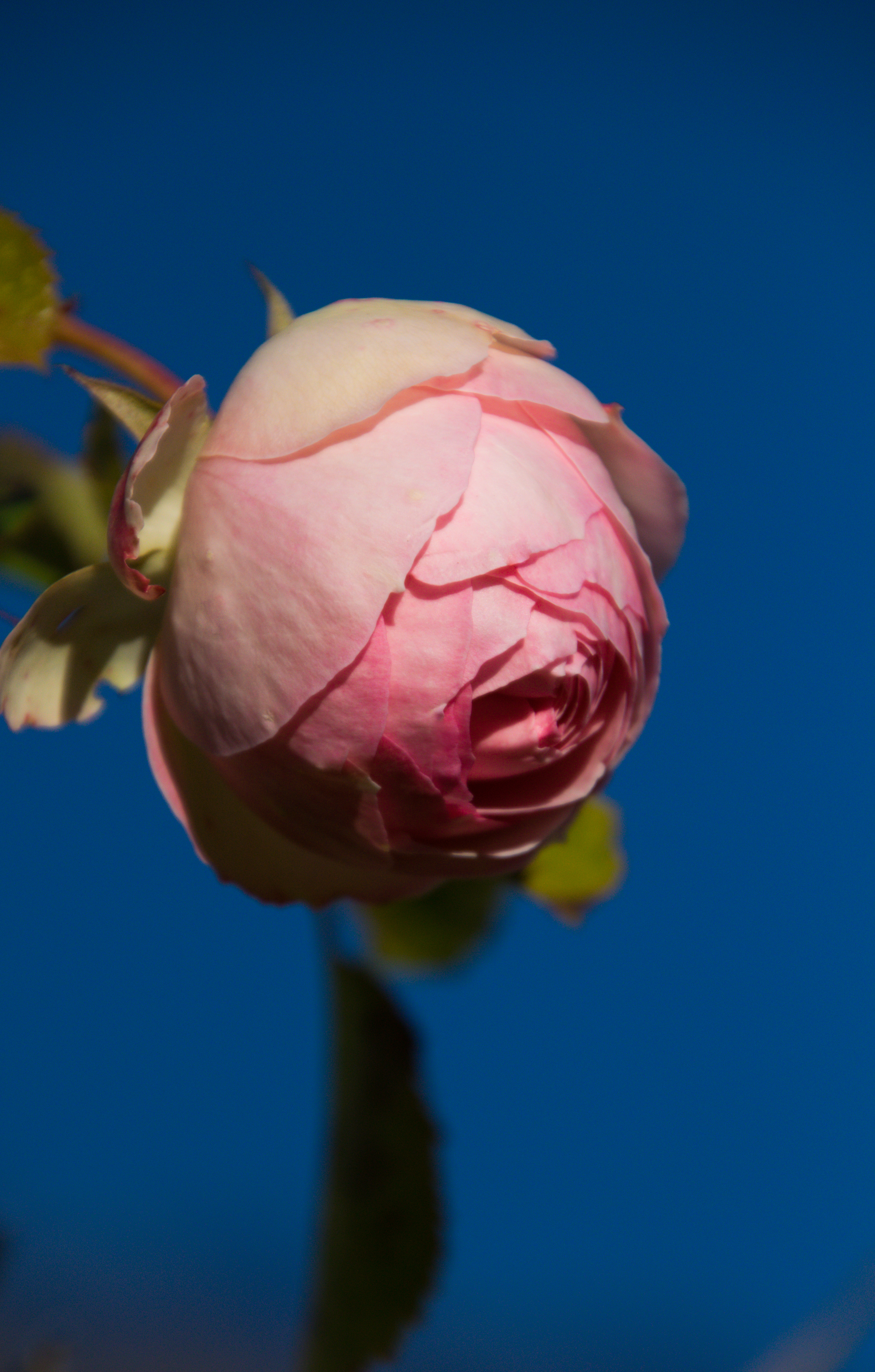
You are the perfect bud

You are the perfect bud
In every flower
The bloom, the wilt, the petal fall
Mirrored to Infinity.

You are the dark-fingered howl
That rips the brittle stem
The long and deathly still decay
The tight dry seed, blind
to its changeling form.


Photo by: Susan Burgess

You are the frost that snaps at twigs of hope
The broiling storms that trample embers past
The snowflake, fractal of impermanence
Upon the blood-life cheek, that you also are.

The earth-cloaked melt
its drops of secret powers
Winding its ways of dark and sacred duty.

While up above, the petals sing
To the softening mud they’ve fallen in.
“In every flower
We are the perfect bud.”

Posted in epoche | Leave a comment

Welcome to the disconnect

Welcome to the disconnect
word by word

and step by step,

You think you’re free

But you’re just not one of us — Yet.

Eyes downcast

or staring bare

Into a world

Beyond all care.

Forgotten how to say “hello”

A sound so strange like a sick bellow

Helllooooooo.


Welcome to the disconnect

Where old friends flounder to remember

Times when they have laughed together

At the the same things

At the same time.


Welcome to the disconnect

Where staying safe is all the rage

And all the rage is staying safe

Inside you.


Watch your world disintegrate

With online Bordeaux by the crate

Don’t worry if you think you’re late

— We’ll educate you.


Welcome to the disconnect

We’ll be your guide, we’ll call you next

Shhhh don’t worry, it’s not your job

The hanging of each act of love.

Don’t pull too hard on the tether

It makes for such unsettled weather

Hey but isn’t it grand to pretend

That this is not the end, my friend

That we’re all of us in all of this

Together.

Posted in epoche | Tagged , , , , | Leave a comment

Fisher Men


I've seen the oily-legged saddhus on the Ganges
In their tumble-down monsoon-moulding houses
Brewing chai on wooden fires like practice funeral pyres
Eyes as deep as wells
In the ringing temple bells
Casting their minds towards peace
Fishing for the ultimate release.

I've seen the crusty-fingered pêcheurs on the Thouet
In their tumble-down cabins by the pré
Brewing coffee on wooden fires like practice funeral pyres
Eyes as deep as wells
In the ringing of church bells
Casting their lines towards peace
Fishing for the ultimate release.

And if ever these old strangers chanced to meet
Somewhere in between along the street
They would nod and understand
that what they hold right in their hands
Is all that it takes to keep life sweet. 
Posted in epoche | Tagged | 3 Comments

Cracks


I’ve known a lot of people in my time
Hugged strangers in the street
For no other reason than my arms were cold.

Seen them laugh and seen them fall
Seen their hearts dart in between
I’ve fallen with them, with the boot upon my chin
I’ve been the forklift
Up and over the toxic sad canal.

I’ve known a lot of people in my time
Kissed strangers in the street
For no other reason than my lips were on fire.

And all I’ve ever cared to see
In their eyes restless brown blue eyes
Beyond the blinking tube lights in the Underground
Was the crack in the dark mirror
Where we both knew
We knew just a bit more as we
Where we knew just a bit less as I.

Subincontinentia – under the surface in India and other domains

Posted in epoche | Leave a comment

Back to the ocean


You crawled together out of the blue. You –
brushed your hair in the light of his naked skin – He
smoothed his rough edges on the pumice stone of your shyness – You
leaned on his shoulders after one too many, then
lifted him up one-handed after one too few.

You both –
laughed in the light of your newborn love.
Cried at the sight of a fallen dove.

Virgin, Lover, Wife, Mother, Nurse and Widow
All six names can swallow you whole….

Emptiness blown in the shape of your soul – wide
as the grand blue Pacific, where
waves surge like churches on the backs of the beauties – The ones who
ride the waves with us, who know
the building swell from the crashing surf
like no one could, or ever can.

I want to return to the ocean – to
the rounding swell and the curling crash
and the wet, wet bodies
so small, so just born.
Wailing against the first breath.
A lone flame yearning to burn, though
destined for ash.

Posted in epoche | 4 Comments

The unmasked ball – an old revolution in rural France

“How did it start?” I asked my friend.
“Well, we were at a gathering just after the lockdown lifted. We were all wearing masks. I’d forgotten mine and had to borrow one from someone. But this guy entered the room, and recognized a friend of his and just strode up to him. His friend pulled off his mask and embraced him.”
“And that’s how it started?”
“Well, that’s how it started for me, but the same things were going on everywhere. It just takes one.”
I asked him if they were afraid of getting caught.
He laughed.
“You mean the virus?”
I had meant the ‘authorities’ but he knew it and was just playing. “Well, I think everyone there just decided on their own that they were okay with the risk and that got expressed collectively in a group of people who knew and trusted one another. They’d decided that this was more important.”

THIS was the Bal Trad. Bal Folk as its sometimes known. A dance form indigenous to Northern Europe with an embedded footprint in rural mid-Western France. It is Gaelic in origin and has more than a touch of the Irish about it. The individual steps are angular and spiky, but the linking group form swirls in circles and spirals.

The little community hall was empty when I arrived except a white-haired man with a trim waistcoat and his rather elderly looking dog who sat on a chair perfectly composed like someone’s uncle, while his owner or should i say, partner, swayed around the floor, practicing his steps. By the time I had finished the overly sweet glass of apple cider there were four more people, two couples, and then more, until we were in the upper 40s in number.

The band began to play, a medley of French country songs, high octane Celt, hide toned drums shepherding notes from fiddles tripping over themselves but never falling on their faces as bright as freshly minted daisies.

And here we were. No social distancing, no masks, and lots of ‘bisouses’ (both cheeks in this region thank you) And the average age? 70. Eyes catching eyes. Hands reaching out then clasping to pull each other around the floor, toned legs leaping like green shoots through concrete. It dawned on me that these were the people we’d been told needed the protection of the rest. The so-called weak and vulnerable. Bold-faced, trim and fit as the fiddles that were dancing them.

I am in no place to judge them. They simply are not from our ‘there, there, generation’

They know the risks of the virus. Probably more than most. Hell, some of them were so old they were only a couple of years shy of the last pandemic. They had lived through world wars, rationing, births, sickness and recovery, love, marriage, divorce and reconciliation. Leagues of death and loss between them. The rise and fall of rock in all its forms, umpteen presidents, more disappointment and failure than most of us can imagine, had eschewed vanity and by-passed social media almost entirely. And they can dance for several hours straight into the small hours. Perhaps they’d lived long enough and well enough to have decided for themselves what their destiny would be. The residents of the Deux-Sèvres have the greatest longevity of any department in France. Whatever, it’s a stretch to call them ‘the vulnerable’.

It wasn’t that they were trusting one another not to be contaminated. They were trusting one another not to mind. While, I suspect, keeping a watching brief on the case and death statistics, which have remained far less alarming than the news headlines. The statistics show that indeed 91% of cases have targeted their age group – 75 years and over. But since the first recorded cases in the beginning of the year, there have been 22 Covid-related deaths in the Deux-Sèvres; a department with a population of 369,000. Fourteen of these deaths occurred on a single day–April 25. The Deux-Sèvres is one of several French departments that has consistently recorded fewer than 3 ICU cases per 100,000, and only 1 positive case per 10,000. Over the course of the pandemic, only 123 people were hospitalized for the virus here. At the time of the dance, however, there that number was zero and in the past three and a half months, their had been a total of two deaths, the last one occurring over seven weeks ago.

Case numbers remained more or less stable in May even with the lifting of the most severe lockdown restrictions and as people began moving about again outside and gathering in groups. But after June 2 when the bars and restaurants re-opened, the numbers began to creep up again. The good news was that far fewer people were falling ill and dying. This is a trend seen all over Europe; a post-lockdown spike with a significantly less lethal tip.

Up until the end of July, the department had reported a grand total of 332 positive cases. Nervous about the increase in cases, from August 6, the prefecture organized free screenings at several locations in the department. Hundreds of people have been getting tested at these centres; 4483 in the last week of August alone. Unsurprisingly, case numbers have risen since the testing drive was put in place and the department’s incidence rate has risen from 1.0 to 1.9.

On September 6, the Ouest France paper somberly announced that detected cases of the virus had doubled from the number of cases the previous week to reach a total of 550. And yet all of these new cases were asymptomatic. Whereas previously people would only get tested when they showed up with nasty symptoms at the hospital, now people are being encouraged to get tested simply as a precautionary measure. The departmental authorities, quoting the increase in cases, are cautioning for increased vigilance. Part of their concern is the increase in positive cases among the young who may not suffer themselves but might pass the virus on to those with compromised immune systems and the fragile elderly. And yet here we are, several weeks into an uptick in cases still with zero hospitalizations and zero deaths. What has happened?

If you look at the Coronavirus case numbers for France as a whole, from June the graph is a mirror image of the first few months. More experts are dismissing the concept of a ‘second wave’ that came from our experience with the influenza virus in favour of the idea that the corona virus never went anywhere and that after lockdown, people became exposed to it again in greater numbers. But the burning question is, why did they stop getting fatally ill from it? Perhaps the virus has mutated to a less virulent form as some epidemiologists have suggested, or perhaps there is something to this herd immunity business after all. Perhaps both are possible.

I’m in mid-thought as a firm arm slips around my waist and I’m whisked to the floor. My partner is a slim Astaire-type gentleman somewhere in his 70s with a full head of sleek grey hair, a set of imposing dimples and a pair of feet to beat the band.
“Vous n’avez pas peur?” I managed to pant in between accidentally kicking his shin bones.
“Oui, bien sûr,” he replied, “Mais pas des choses que vous pensez.”

I imagine the arrival of the Police Municipale, or even the Gendarmerie, shouting down the music and escorting my septuagenarian partner and the other unmasked revelers out the building. What a picture for the history books that would make.

I do a quick scan of the other bodies spinning around me. I catch several ladies around my age. 50ish. We do that ‘Not doing so badly for a woman your age’ once over nod and veer off towards another sector of the almost sacred geometry of that evening, the embodied mathematics of motion and form, seen from above like the patterns of cells dividing, the primordial contours of life itself. Not just in form but in time. Time enough to know that innocent people get punished and the guilty walk free. That life is not known through hiding. And the geometry of thought. That all the best ideas repeat, and the best ideas are the ones that set us free.

The kind of calculation that people who’ve lived a while can do. The risks they’re facing just getting up in the morning. The risks they’re willing for. They dance like teenagers with the engines of twilight. But their horizons are not endless. They have seen the edge of the abyss rising towards them. They have survived cancers and cancer scares, marriage, childbirth, child-reading and divorce and reconciliation.

Their eyes blink in octaves, five steps at a time.

But it’s not the courage that I’m in awe of that evening, but the vitality. I envy that, with my jaded pseudo-political ideals and my post-feminist regret. Where did they get that….joy? And it is. Pure joy that emanates from them. Galloping around that drab community hall like it was the Elysian fields, for four hours forty minutes straight with barely a pant between them.

I walk out into the night of the Gâtine and look West towards the Atlantic where the breeze is cooling the fields around me, hot as tumble-dried sheets. And I am filled with the vastness of the ancestral terrain around me, so under-estimated, so unknown. All over France this must be going on. A secret underground of long-lived dancers. A force to be reckoned with in panicked times.

Posted in epoche | Tagged , , , | 1 Comment

Afterlife

afterlife

We wonder what it’s like
the Afterlife
Where they go, the close departed
The ones we always felt would stay.
Could never feel so far away.

Is it a black brick wall in time?
Just a stop along the circle line?

But it’s us who live like Dante’s shades
Half-removed, half-known, half-seen
The mourners hanging in between
A curtain neither pulled nor drawn
From longing night to barren day.

We haunt the hallways of our past
Spooking those who fear our breath
Walking advertisements of Death
That even the brightest colour fades,
That nothing stays, that nothing lasts.


Posted in epoche | 7 Comments