This is a longer version of an interview conducted with Catriona Mitchell, founder BRAVA a creative forum for women across cultures.
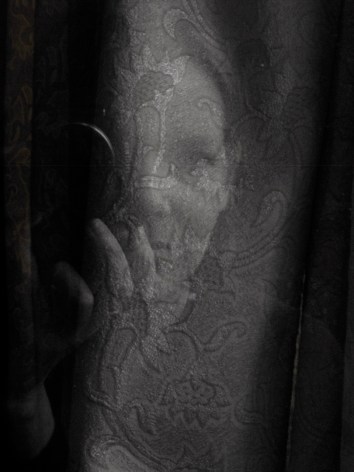 BRAVA: Rebecca, as a survivor of sexual assault, you are now (many years later) finding an unusual way to investigate your relationship to your body and perhaps re-frame it: with the camera, in a series of nude auto-portraits taken in your home. The photo series was an entirely private endeavour for you until the Harvey Weinstein story broke, and the ’me too’ social media campaign took over almost every woman’s postings across Facebook, Instagram and Twitter. Now, you find yourself opening up to discussion about something that you’ve been keeping quiet – not just the photo series, but the experience behind it. Why has the ‘me too’ campaign changed your attitude towards speaking out?
First of all I feel I should point out a certain irony here, in that I’m not actually a big supporter of Facebook even though I use it compulsively at times. I’m one of those irritating people who think social media is ultimately eating away at our attention spans and capacities for meaningful engagement with others but post about these concerns on social media. Having said that, the ‘me too’ meme did have an impact on me. It was the enormity of it, really. Pretty much every woman I knew posted something about it. Some elaborated and others chose not to, but I know how much courage it takes to talk about this stuff in a public space. As you say, this all came on the heels of the Harvey Weinstein revelations that exposed him as a serial sexual predator, so I think there was a feeling of it being time, time to say something, even if it was just two words – “me too”.
I had gone in and out of the idea of sharing the photos. On the one hand there was a natural shyness around it, but also I didn’t think anyone would be interested. It was so deeply personal, though I was a bit curious how an outsider would see the project. Would they understand what I was trying to do? Would it translate? But what I feel moved to share more than the photos themselves are the reasons behind why I took them and what the process of taking them taught me.
BRAVA: When did you start taking the photographs?
I took them over a period of three months. It started in Rishikesh, India, in March 2016 and I completed the first phase that June in France. Then I began another series in Varanasi later that same year. It was really only five or six ‘sessions’. I wasn’t taking it terribly seriously and only did it when I really felt in the mood. But every time I did something interesting happened, so I kept going.
BRAVA: What gave you the idea? What was the impetus behind it?
I had been taking selfies to post on a dating site. I had never taken a selfie in my life before that. I didn’t know what it was. I first heard the term from a 22-year old boy who sent me a naughty message. I was like ‘”Selfie? What’s that?” He thought I was joking. I actually thought it was slang for masturbation. This was 2014. I had been based in India for years and had really fallen out of touch with Western cultural trends. (I have to say that Indians picked up on the selfie craze pretty fast after that in no uncertain terms!) Anyway, I started taking these photos to post on the site, and I found the process of taking them really intriguing, far more intriguing than what was happening online with these men which was mostly just guys wanting casual sex or sexchat, often to satisfy their MILF fantasies. That got dull pretty fast.

The word that come up later around this photo was “ready”. A primal, intensely natural feeling. The will to survive, the intention to thrive.
I had never felt particularly attractive before and certainly not photogenic, and I found the element of control immensely satisfying; how you could photograph yourself from every angle and find the one that made you look the best. It was all intensely narcissistic, but it led to something else. I began to observe the process itself and what it was bringing out in me. I was presenting myself in those photos in ways that seemed to have little connection with my everyday personality; as a seducer, as a vamp, as a highly sexual creature. Interestingly, a few men saw right through these attempts at reinvention. What I thought was tough and seductive, they saw as vulnerable.
I began to think a lot about self-image, about how we choose to project ourselves to the world when we have the tools to do that, what makes that projection believable or not, and how we work so hard to avoid being seen or seeing ourselves in more authentic ways. I found the idea of controlling my body image very appealing, and this probably links back to certain formative experiences where I felt a total lack of control. I’ve always liked the Tantric idea that anything can be taking into the path of self-discovery. The selfie is a cultural trend that’s mostly about putting on an act, about distancing ourselves from ourselves. I liked the idea of turning that on its head, as a path to exploring that act, as a path to self-intimacy.
I became curious how I would photograph myself if there was no intended audience other than myself. Would it be different? In what ways? So I decided to cut out the middleman or men, as it were, get off the dating site, but continue to take selfies – which you so nicely describe as ‘auto-portraits’. I really had little idea what was going to happen. It was all a big experiment. I decided to photograph myself naked because that felt scary and vulnerable, and I knew that vulnerability was important if I was going to discover anything of value. I only had one rule—that I wouldn’t shy away from what I saw no matter how embarrassing, or disturbing or difficult, and that is what kept it real, and ultimately what kept it interesting.
BRAVA: To what extent is this about an invisible, intangible exploration rather than an end result? How much of the project is geared towards creating a tangible artwork?
It was all very intangible at first. Mostly because I wanted to see where it would take me without having a preconceived idea of the destination. It felt like a bold exploration, like going out into a snowstorm without a compass or flashlight. At the same time, I think I did have a sense that this was going to end up as a body of work, although I always thought of it as something I was only doing for myself and not for anyone else’s consumption. This was really important, especially as the project developed.
BRAVA: Whose ‘gaze’ are you seeing from, when you take the pictures? Do you imagine a male gaze? Do you imagine /experience yourself inside your body, outside, or both?
Well, that is the entire question, really. The whole project was an exploration into that. I think I had this rather naive idea that I could achieve some level of non-dualism, that I would somehow manage to transcend the personalization of that ‘gaze’, but there was always another pair of invisible eyes, always a witness there somewhere. At first I couldn’t stop posing for some invisible man. He wasn’t there, but he was having an impact in how I was holding and presenting myself. Once I had managed to more or less exorcise him, there was a whole bunch of invisible women in there wagging their fingers at me! And then, of course, there was the revolving door of alter-egos.
Then instead of seeing this as a problem to be solved, I realized it was an opportunity to examine how I actual saw myself. I kept peeling away at these levels of self-perception and self-deception, until I got to a place where I realized that these layers are endless. In the end, I became comfortable with the fact that the camera was creating an artificial presence in the room. Marshall Mcluhan’s the medium is the message kind of thing. It seems obvious to me now, but it was something I had to recognize. Still, I managed to access some pretty deep layers, certain levels of conditioning around body image that I simply hadn’t been aware of before.
I didn’t have expensive equipment. I had a Lumix DMC-FS3 digital camera that a friend had given me. It wasn’t an amazing camera but it had a really good timer capacity. I used all sorts of tricks to get the angles I wanted, and to make the most out of natural light. I had no idea what was going to happen each time I set the timer. The not knowing was thrilling. There was always this rush of adrenalin right before the shutter clicked. I mean what was I going to do once I put the camera on myself for no one but myself? There were so many possibilities, but which ones would manifest?
Basically the camera was like another version of myself. I was on both sides of it at the same time, playing at being the witness and the witnessed. Watching myself watching myself. It tugged at the boundaries of self-identity, which was simultaneously frightening and liberating. Again there was this great feeling of being in control, of being completely free creatively, and yet at the same time there was this wonderful surrender to the unknown. This play of control and surrender was immensely satisfying.
BRAVA: How have the pictures evolved, from the first one you shot to the most recent?
One evening in Rishikesh, there was this gorgeous late afternoon light streaming in through the window of my room as the sun set on the Ganges. It had a soft, pinkish ethereal quality that reminded me of landscapes by the romanticists or a Maxfield Parrish painting. It inspired a series of photos where I played around with a theme of quiet stately erotica. I was mostly just getting comfortable and figuring out the technical issues at that time.
Later, other themes developed, some much darker. I just let them happen. I became less attached to looking good and better at jumping into that abyss. I began to trust what was coming up in the sessions. It was the last two photographs of the series that became the title for the project – Enter the Animus. I had been interested in Jungian psychology for some time, but I no idea that this is where I was heading when I started, that it would become about the integration of the male psyche, but that’s what happened.
BRAVA: If there have been changes, is this a marker of shifts in your psyche?
Yes, definitely. It felt like I was writing, directing and acting my own mythic story. And I didn’t have to explain it or rationalize it or apologize for it. I could just play. It was only later that I began to write about it. A turning point came when I sent one of the images to a guy I had gone on a date with. He was an artist and he became intrigued by the project. Although I didn’t want to take things further with him romantically, we had kept in touch as friends. I sent him one of the photos to get his perspective. He asked me all these questions about it and as I began to answer him I had all these insights that had eluded me earlier. It forced me to articulate intellectually something that had been mostly sensory and emotional.
He ended up doing a portrait from the photo I’d sent. I actually saw it when I went to his house in England. His walls were covered in paintings he’d done of women in various states of despair and depression. I suffer from depression, and although I hadn’t been depressed in the photo, the image looked like I could have been. When I saw the portrait I was horrified. It was a good portrait, he was very talented no doubt, but I felt somehow really exposed, hanging up there with his sad collection of limp miserable ladies! I was more protective of the project after that.
BRAVA: Your suffering must have been enormous both in terms of the assault and the more insidious effects that have followed over the years. In what ways has the photo series helped you to resolve and heal the pain, if at all?
To be honest, if I had felt more pain at the time of the rape I think it would have done better. For 30 years I barely thought about it. Occasionally, I got the idea that it had affected me in ways I didn’t understand, but I had shoved it deep down inside me in good British fashion. And then the lid came off in my mid-40s. I don’t think it was all about the rape, but that was part of it. I didn’t feel inclined to delve into it, but I just couldn’t ignore it any longer. There is a great quote by Jung that ‘All neurosis is a substitute for legitimate suffering’. I think there’s a lot of truth in that.
I very much believe that we are more than the sum of what happens to us, but in a very real sense I had removed myself from the experience. I knew so many women who’d suffered far worse experiences than me. It felt indulgent to dwell on it. I think I had become afraid of my own feelings. Maybe I thought they would engulf and overwhelm me if I let them in. But I had already been dealing with several years of depression and anxiety by that time so I didn’t feel I had a lot to lose. The photo project was part of a broader exploration that included yoga, meditation, dream analysis, etc. It’s hard to say what became the trigger for what, but I had all kinds of bizarre dreams, emotional lows, panic attacks, and so forth. There were a few red pill moments.
One thing I’ve learned is that you can only ignore the subconscious for so long. If you have disallowed genuine feelings at the time of some key traumatic event in your life, at some point you will probably have to feel it. If you don’t it can keep raising its head in other ways—in fits of inappropriate anger, in depression or hyper-sensitivity. It can mess with your relationships, with your confidence, with your ability to carry out your ambitions. It can muzzle your true voice and hijack your talents. And you’ll always sense it lurking somewhere like a Gollum, like a shadow self. I’m not talking about reliving the emotional pain of traumatic experiences. But when you bring a level of awareness to the physiological effects of trauma and allow yourself to feel the unfelt in the body itself, you can generate a different response. This is why body-centred systems like yoga can potentially be so liberating when seen as more than an exercise.
This photographic project is just one tool in my toolkit to reframe my connection with my body. Different people are bound to have different experiences. But I can honestly say that it has helped me get in touch with a side of myself I’d been missing. The side that can look after myself and look out for myself. The side who can spot a predator a mile away and who is my own ally, defender and guide. In other words, the Animus. I realized at some point that I was having a conversation with myself in images, a conversation that for some reason I hadn’t been able to have in words, even with a therapist. Each photo was a like a piece of code. I was telling myself a story. Of course people have always used art as therapy, but this was very direct. And I still have a long way to go. It’s early days.
BRAVA: What have you learned from this project that has surprised you?
At first it surprised me how difficult it was to let go of how I present myself to the world and to jump into the abyss, even if I was the only person there to watch. I was also surprised that even being the photographer, being naked in front of a camera was intimidating. Luckily, I got over that pretty quick. There were so many surprises. How attached I am to my idea of what beauty is and how conditioned that idea is, how limited. How afraid I am of ageing, of no longer being attractive. But then I sort of stumbled on a new kind of beauty, one I had never identified with before, that was sensual and strong and unapologetic. It was a kind of beauty that I actually liked, one that I wanted to hang out with. It was this coming into comfort with the inevitabilities of this changing physical form that was one really positive outcome. In a very real sense, it helped me to grow up. I don’t think I would have done a project like this in my 20s or even my 30s. I would have been too self-conscious. Being in my 50s I had more perspective. I could observe these levels of identity without getting so caught up in them.
But actually every time the camera clicked it was a surprise. I did part of the series in Varanasi, India. Varanasi is a very powerful place. It’s basically a charnal ground. It’s where people go to die. Sex and death are so intertwined in our psyches. I did a photo series in my room. I felt very safe and I was in a really good space mentally. But when I looked at the images there was a lot of sexual violence in them.
BRAVA: Do you plan to take the project further into the world, or will it go back to a quiet endeavour, one that’s just for you? If you do now want an audience for the pictures, why so?
It was never intended for public consumption. I felt it would be like publishing transcriptions of sessions with a therapist. It never crossed my mind, at least in the beginning. But later I did wonder if the images would make sense to anyone else but me. I’ve shown parts of the project to a couple of photographer friends who took it seriously as a body of work and seemed to understand what I was up to. I discussed the possibility of one of them curating an exhibition. I had self-published a small book and had printed one hard copy. I had problems with the program and wasn’t able to get another one made to send to him. I took it as a sign and didn’t pursue things further. Although I have great respect for him as an artist and trust his integrity completely, my instincts were not to share it at that time.
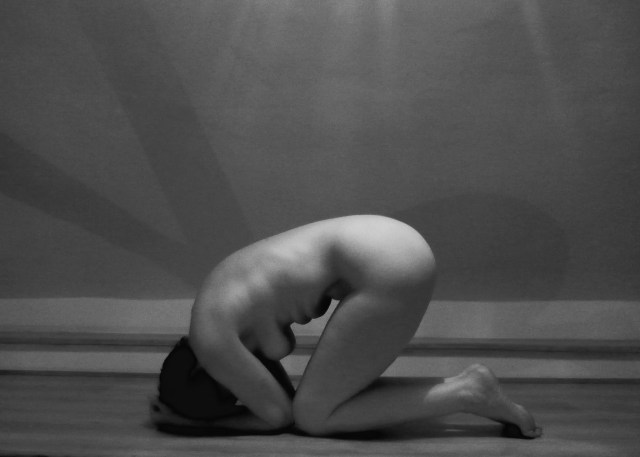
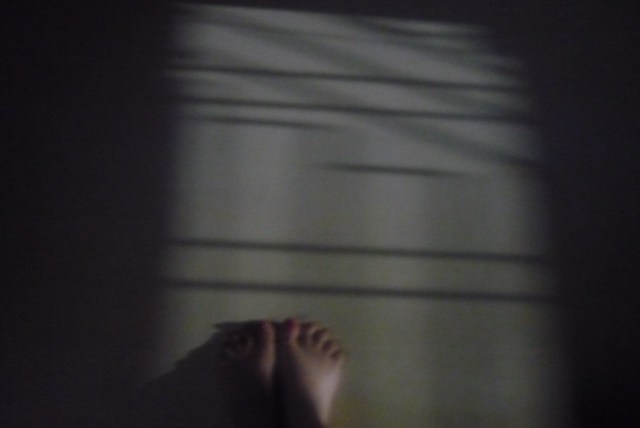
The word that came up around this photo was “safe”. It was after a series of photos that examined levels of shame. This was a turning point, when the shame dissolved into a place of self-acceptance which was its own security.
I had spoken to a French photographer about doing a photo series where he took the photos. We met a few times and got along well. I trusted him and the work he’d done with other women was really impressive. I felt that technically I had reached a wall, and I just couldn’t achieve the kinds of portraits I wanted. But it didn’t go anywhere because a huge aspect of the project is that I take the photos myself. If someone else is behind the camera then it changes the dynamic completely. I might work with this photographer in the future but on something different. I’ve shown the photos to two women so far, and you are one of them. I’m more nervous about how women view it actually. Women can be so vicious to one another! So that makes six people in all who have seen it.
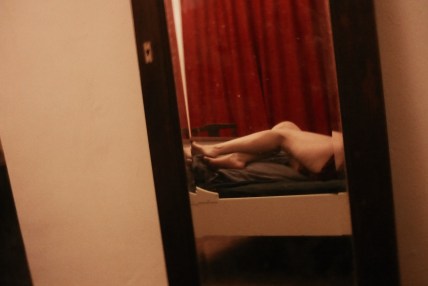
I guess I’m not terribly interested in getting an audience for these photos. I’m a writer, that’s what I want an audience for. Female nudity has been so co-opted that it will almost certainly be misinterpreted. And that misinterpretation would likely entangle me into a defensive posture that would sap my energies. Even posting one or two less revealing shots on this blog to give visual context for this interview is dipping into tricky territory. You and I discussed it a lot. Should I? Shouldn’t I? It’s scary. We have so much negativity and projection around the body. Prudishness can be the result of interior shame, while exhibitionism can be the flip side of that same coin—another way of coping, a defiance. It all gets so complicated and messy that I find it refreshing to remind myself that we came into the world unclothed! Our ideas around public nudity are pretty much limited to porn or the classical arts, with little ground in-between. Erotica can be beautiful but it’s still sexually driven, and mostly by men’s sexual fantasies. I’m not against erotica or porn for that matter (except bad porn which is 90% of the market) but that’s not what this is about. But I do think that sharing the idea of the project in the context of passing it on as a potential therapeutic tool is worthwhile and I’m interesting in exploring that and writing about it more.
BRAVA: Do you think there’s something in this process that might be really helpful to others, as a safe form of self-exploration and expression? Can it perhaps repair some broken links for them, in their relationship to their own bodies and agency?
Yes, certainly. That’s why I can talk about it. It’s not that difficult to do. You just need a camera with a good timer, some private space and a willingness to step into the dark. It’s better to have as few preconceived ideas as possible. You don’t have to do it naked. If you do find its something you want to share it’s easier to do so if you’ve got some clothes on! I would actually like to do some sessions where I dress up. I know it all sounds deadly serious but there’s a playful aspect too. But I would urge anyone to put the idea of anyone else seeing your work aside, at least in the beginning. The whole point is to get beyond this voyeuristic patterning, to deconstruct self-image to find a new friendlier and more honest relationship with yourself and the body. But that isn’t likely to happen until you create the right conditions to be able to examine how you see yourself in the first place.


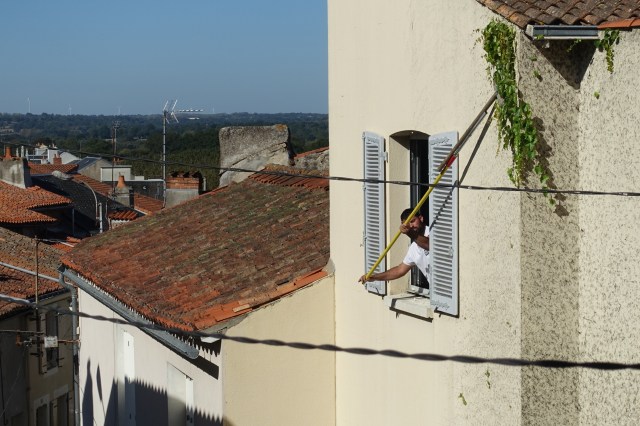 And then, some time around the first week of June, I would notice a burst of greenery on my neighbour’s barren wall. In less then three weeks, it would go from that vanguard to a most definite and confident ascent, an entirely new route would be found than any year before, through the great impulse of Life. This impulse soared through its constituents, giving direction. Grow. Grow. Grow. With no other particular instruction. I marveled at this Creativity. This impulse to start again. With no regrets or fears. But perhaps that was only from my point of view, eyeing the scene from my balcony. When I could no longer see the vine, I assumed it was no longer. I had somehow forgotten the less visible continuity below my own horizons. What seemed like a new beginning to me was aeons old a performance.
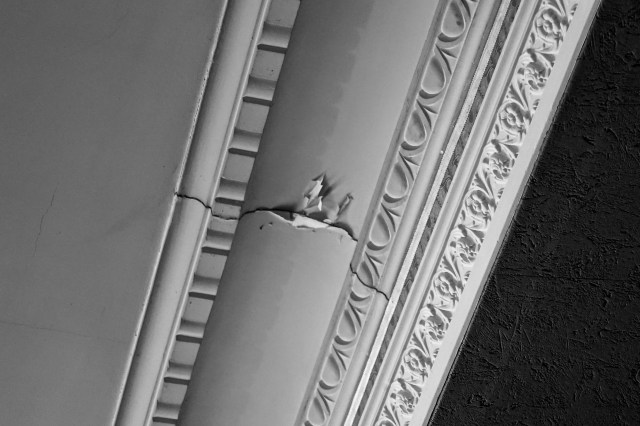 Above a quiet pool of eyes, a humming bird feeds from the cracks.
 Something has been bothering me lately about Facebook. Or should I say, about how perceptions operate on Facebook because actually Facebook bothers me on so many levels that it is amazing I still use it. I use it because I seek to connect, because it is a piece of armor against isolation.

 subincontinentia
The Politics of Unfriending
Lately, I’ve seen a number of chaps on Facebook posting their intention to ‘unfriend’ Trump supporters or those promoting his views (if Obama can say “folks” then I can say “chaps”). This has led me to contemplate the politics of unfriending—partly because contemplating anything else right now is too painful. It is something that can be done so easily, with the mere click of a button. The act itself feels trivial in the larger scheme of things. But the larger scheme of things is so damn overwhelming that it can also feel strangely…..significant.
I think in light of the latest US election, it is pertinent to take a closer look at the politics of unfriending because although it is often done in a fit of pique, I believe it is not always so perfunctory. When implemented by those whose normal modus operandi is inclusion, unfriending someone has less to do with politics and more to do with instinctual mechanisms around circles of trust. When I consider more deeply, it wasn’t politics that prompted me to unfriend these people. It is not as if I can’t stomach sharing a forum with those who think differently to me.
One man I unfriended repeatedly posted anti-gay rhetoric and seemed fond of shaming individuals towards whom he clearly felt superior. (When I met him, none of this was apparent).) Another, went from posting thoughtful pieces about drug policy to incendiary (and inaccurate) remarks about refugees fleeing war zones. These differences are fundamental as are the differences that divide America right now. For those who call for unity, pray explain how to unite with someone who cleaves to what you abhor and abhors what you embrace?
Our choice of Facebook friends is not going to change the world, but in some small way it changes our own private world, and it speaks to a larger trend of isolating ourselves from the ‘other’. Americans have already paid a heavy price from distancing ourselves from what we don’t want to see. But Facebook has never been a forum for mediation. It is more of a personal scrapbook. Anyone who has ever tried to have a meaningful exchange of views (apart from the resolutely polite) has witnessed how rapidly it sinks into mean-spirited solipsism.
It might be time to give up on the future as a singular concept – if indeed, it ever was one. There will be multiple futures going forward as we come to terms with the fact that the forces that divide us have become—at least, for the present—indomitably greater than those that unite. The choice is how we respond to this reality. Do we cling to those whom we recognize as our siblings in spirit, or do we continue to try to engage the ‘strangers’ who seem to have lost faith in their own ability to live in peace with the world? Is there a middle ground and if so, where do we find it? Not on Facebook, that’s for sure.
Jim Morrison chose the ‘feast of friends’ over the ‘giant family’. But was the giant family ever a viable alternative? Do we have time to bring everyone around to the ideals necessary to create a world worth saving for our children? Perhaps the best thing we can do is salvage decency and hole up with the like-minded around the fires of reason and kindness while the bitter winds howl around our ears.