Breath by breath, walking the pilgrim’s way

We were stretched out on the grassy slopes of the medieval walled city of Forteleza in Valença, a stone’s throw from the Portuguese-Spanish border. I was gazing at a bee clumsily mounting a dandelion. The simple act of removing shoes and socks felt like a luxury spa treatment after seven hours of pretty much constant walking. My sister, Melanie, was nose-deep in a torn-out page of a guidebook by John Brierley, the Irish chartered surveyor and Camino veteran, whose books have been so instrumental in making the Caminos, the Portuguese variant in particular, more accessible. Like every other pilgrim on the Camino, we were heading to the cathedral city of Santiago de Compostela in Western Spain. We had nine torn out pages in all (when you carry everything on your back, every ounce matters) each mapping a portion of our two-week trek of 294 kilometres (183 miles). I warmed to this old school approach, bypassing the vagaries of mobile phone reception in the Iberian hinterland.

“You want to know something funny? If we drove to Santiago from here it would take us less than an hour and a half.”
“And how long is it going to take us in reality?”
“Erm….seven days.”
We both laughed at the charming absurdity.

Twelve hours later, in the murky pre-dawn light, we strolled through Forteleza’s cavernous deep-stone arches and tunnels and across the Rodo Ferroviaria (railway) bridge and into Spain. It had been forty years since I’d journeyed from one country to another on foot, when my boyfriend and I hiked – also carrying backpacks — from Northern Greece across the Turkish border, on another murky dawn. These two events resonating across several decades, speak to a wholly different relationship of time and geography, where time is not something to be ‘saved’ but to be spent well, and where distance is not something to be ‘covered’, but to be witnessed by all the senses, as the land itself: to be trodden underfoot, to be listened to, smelled, felt and seen. And this you only get by walking. Step by step. Breath by breath.

No one asks you why you’re walking the Camino, or ‘the Way’ as it’s called. It may seem the most obvious question, but you soon realize that the ‘why’ of it is both simultaneously accepted as private and broadly understood. And the reason for this is that almost everyone you meet has done it before. Why someone would peel themselves out of a bunk bed at five in the morning to walk for six or more hours, lugging all their supplies on their back; blisters popping up like mushrooms, skin frying, hips aching, sleeping fitfully in dormitories with dodgy showers, stinky shoes, mad snoring and plastic mattresses, day in and day out for weeks on end. Why someone would choose to walk for seven days to get somewhere they could reach in under an hour and a half. There is no easy answer to that. Not one that glides off the tongue anyway. The answer to the why is found in the doing of it. It is why no one asks you why. And it is why so many who have done it come back for more.

The question you get instead is, “Is this your first Camino?” I assumed there would be many first timers like me, but I met only two. There are veterans of three, four, five or more Camino journeys. And there are many Camino routes to choose from, some shorter, some longer, some hilly, some coastal, some wilder, some well-established, and others being developed all the time, crisscrossing Spain, Portugal and even Morocco, intersecting with one another like the veins of a leaf but all branching towards the same ultimate point – Santiago de Compostela. When I admitted that yes, this was my first Camino, I would get the same response–a slow nod of the head, followed by, “Well, it won’t be your last.”
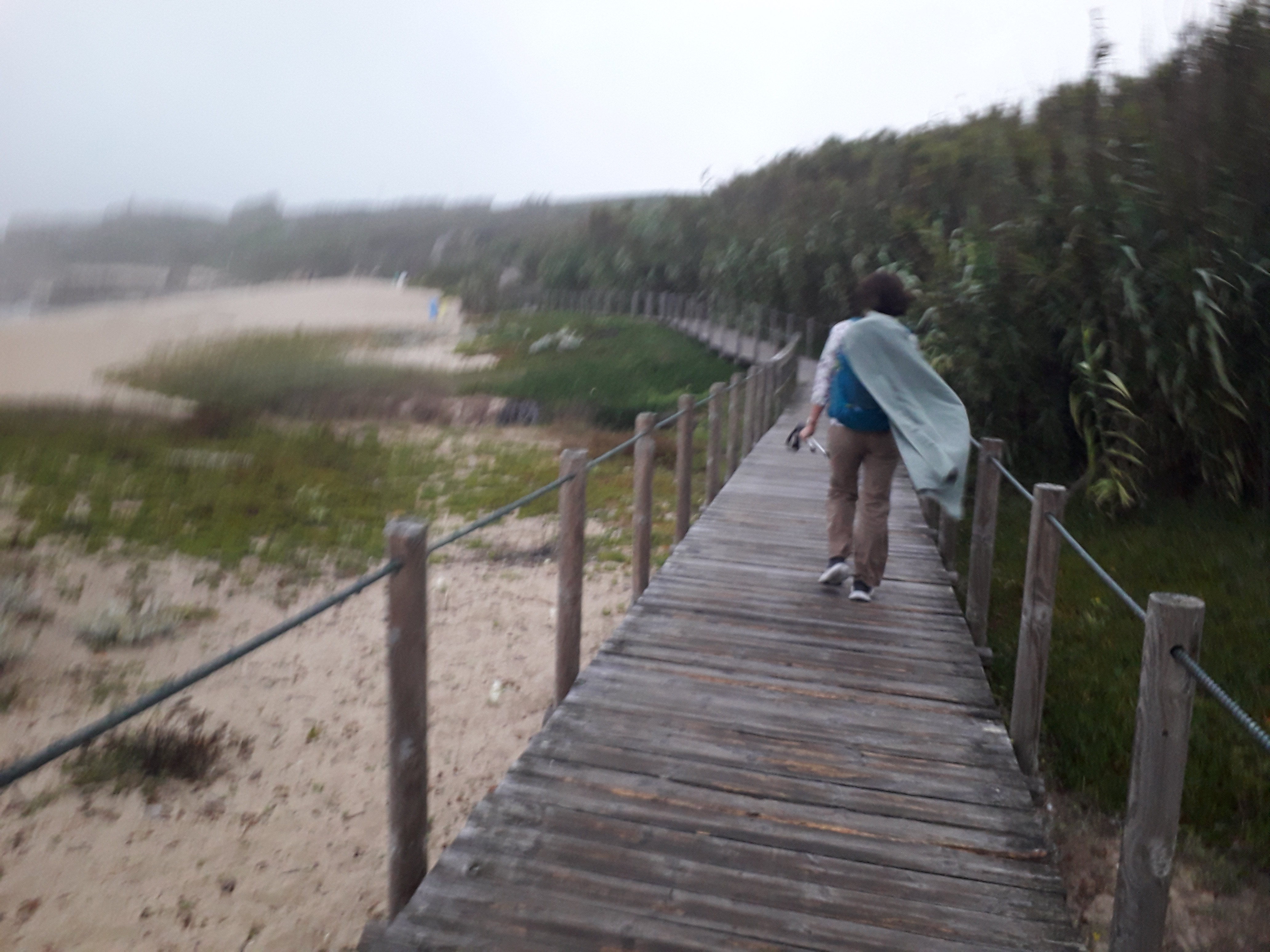
My sister and I had begun in the town of Porto on the Douro estuary; the most popular starting point for the Portuguese Camino. A few start in Lisbon, 300 kilometres south, but from the stories I heard, this section is brutal in that uniquely soul-crushing conspiracy of urban concrete and urban heat. Few come through it without some kind of road trauma. My sister had completed the month-long Camino Frances (the French Way) ten years before, and a year ago she had come up with the idea of us doing the Portuguese way together; “To build memories we can share for the rest of our lives.” she said one morning as the church bells belted across the curvaceous landscapes of Northern Portugal.

I was touched by her candor. The Camino was a chance for us to get to know one another again, and in some ways for the very first time. After a fractured childhood of constant moving from one military base to another, boarding schools, then our parents’ divorce and all that comes along with that, then moving to different countries, she to Canada me to California, we never really had the chance to bond through shared memories. Growing up, my three sisters and I were like a loosely connected group of satellites, often only vaguely aware of one another. We had ended up scattered like wildflowers: California, Canada, South Africa, England. Family reunions were major organizational campaigns.

The idea of pilgrimage had long appealed to me. I’d had an itch about the Camino ever since I came to live in Parthenay, a small millennium-old town in Western France that in the Middle Ages was a key point of passage on the Way for the faithful from the Netherlands and Britain. Back then, the journey from the home door to the door of Santiago Cathedral would take several months. For Catholics, it was the experience of a lifetime with the power to purify the soul of its full burden of sins. Parthenay looks like a fairytale in suspended animation, curled up within circles of crumbling castle walls and fortified towers. Back then, a constant stream of pilgrims would have trodden the cobbled stones on what is today the longest authentic medieval street in Europe. They would have continued east to Poitiers to join the ‘Tours Way’ and then south to Saint Jean Pied-de Port, gateway to the Pyrenees and what most people today consider the starting point of the French Way.

Camino references and imagery are everywhere in Parthenay. The scallop shell, the emblematic symbol of Saint Jacques (Saint James for Anglophones), the apostle whose relics are believed to rest in the Cathedral in Santiago, is carved into door lintels and chiseled into granite. Milestones indicate the distance to Santiago (1,492 km to be exact), the original gated tower to the city is Porte Saint Jacques from where you ascend Rue Saint Jacques towards a two-headed statue of a Camino pilgrim, scallop shell emblazoned on his chest, one face turned back to his point of origin, the other looking in the direction of Santiago. An intrepid few do venture on the Camino from Parthenay itself, or pass through it on the way, but sadly the French part of the old French Way has not been revived, and without the support infrastructure of the other Caminos, a clearly designated walkable route, well-placed cheap lodging, food, signage, guides, and so on, pilgrims are left largely to their own devices. I wonder with the ever-increasing interest in the act of pilgrimage as a very different kind of holiday that perhaps one day this will change.

So here we were, my sister and I, in our late middle-age, getting to know one another through shared memories of five o’clock risings, packing in the dark, nursing blisters and shin splints, hand-washing knickers, drying laundry on our backpacks, paddling in the sea, deciding when to stop, when to continue, planning the next day’s route. Placing one foot in front of the other. Making a journey together.

What is the difference between walking the Camino and, say, hiking in the Alps? For sports enthusiasts, the Camino is not especially challenging. But those who see it as just a nice long walk are missing the point. As Melanie explains.

Both offer the delight and stimulation of meeting new people from around the world, the wonder of walking outside in nature, the satisfying tiredness and appetite you feel when the daily walk is done. However, the Camino touches and affects people in a way that isn’t the same as a hike in natural surroundings, however awe inspiring or uplifting. I think this due to the fact that the Camino has been created and walked by countless, unknown, and ordinary people before you. You are literally walking in the footsteps of pilgrims from centuries ago…

The echoes of the footsteps of the pilgrims that came before are all around us. In the very structure of the route, the yellow arrows painted on telegraph poles and flagstones that beckon and guide you onwards, the hostels and restaurants, the chapels and churches, the vines and fruit trees planted along the pathways that pilgrims have foraged for centuries. And just like them we meet our fellow pilgrims with an open heart, as fellow travelers, as friends in spirit. We meet not as bubbles of opinions or identities or preferences, all ready to go pop at any moment as new opinions, identities and preferences replace them, but as unique expressions of something unifying, something lasting, that moves within and between us and that bonds us to one another in cheerful simplicity.

I am certain that if we had got down to bases we would have found much that divided us – but the spirit of the Camino is always drawing your attention to higher ground. You cross paths with people from every background, country and walk of life with no obvious outward sign of the life they lead; their job, their economic status, their origins. You can walk with someone for days without knowing their occupation or their politics, but you will come to know something of their kindness, their joys, their sorrows, their humour, their hopes, their strength. You meet in a background of simple moments, beyond even the divisions of language: the relief of finding an open café for the first cup of café com leche after a six-kilometer walk, the delicate sweetness of that glorious Portuguese pastry the pastel de nada, the mingling scents of mint and eucalyptus rising on the damp morning air, roosters crowing their hearts out at the prospect of a new day, and the feeling that this is how life is meant to be lived.

I’m not claiming that the Camino is the cure for all our divisions, but it points towards its essential ingredients – to meet first as fellow pilgrims on the path of life, respectful of each other’s pace and rhythm, welcoming each other’s unique contribution, assuming the best of one another before all else. And then, if differences do raise their head, to root these differences in the common ground of ­­human experience.

Josh goes even further. A tall, noble Texan, with a quiet considered manner, he is one of the brave and the few who walked all the way from Lisbon to Santiago; 694 kilometres (432 miles) in 24 days. A convert to Catholicism, he illuminated me about the history of the Camino and the significance of Saint James whose ‘Way’ we were following, and he spoke of the powerful connection that is formed between fellow pilgrims:

Pilgrims do not see nationality, skin color, religion, or gender. They see a lifelong brotherhood and sisterhood. Camino brothers and sisters are forever bonded in a sealed for life friendship. It is nothing I have ever experienced before.

Julie also started this Camino in Lisbon. A Canadian army veteran who has served in Afghanistan, Julie is no stranger to physical and mental hardship. But the first stretch of her Camino pushed her to the edge of her endurance. Relentless searing heat devoid of shade made more savage by the alarming proximity of trucks and other vehicles on pedestrian-despising roadways, she ended up falling unconscious into a ditch. She describes what she calls her “Eat, Pray, Love moment”, when the message of her Camino all fell into place.

Many changes, internal and external, motivated me to do my second Camino. I was turning 50, between employment, planning a move to yet another country. My plan was to use this Camino as a path for inner reflection, a reset so to speak. This was to be a completely solo journey, avoiding distractions. I wanted to do this on my own, alone, be one with my path. This lasted until Porto and for that I was grateful. Grateful and completely miserable.

The biggest change in my life that has been inspired by my Camino is the fact that although individual experiences are good for reflection, shared experiences are essential for the soul, essential for love, essential for happiness. I needed to make more room in my life for love, life and happiness.

There are some people you meet on the Camino for just an hour or two, and others with whom you cross paths again and again, who become part of your Camino family. This bond between you comes on like a natural high–quick and sweet–with no agenda other than the shared joy of the connection itself. These are not necessarily people like you, in fact they are often not at all like you. But they are people you feel free to be yourself around, who help you to forget that your feet hurt, that your shoulders ache, that you’ve been wearing the same tee shirt for three days, that you don’t know where you’re going to spend the night. You walk alone for a while, then you walk alongside another, and then you part ways, and then you’re alone again. But not really. Such meetings play along the Way like pools of light on a river.

I only walked with Patrick for a day (or perhaps it was two; the Camino toys with time like elastic), but his gentle manner and poetic spirit made a deep impression on me. It was Patrick who told me that I needed to at least once walk the Camino alone to truly experience it. But it was also Patrick who told me that “without the other, there is no Way.”

I am normally of a shy nature, a little wary and reserved. Not far from being a misanthrope. But on the Camino I am transformed; open and available, curious and happy to share with others. Connections are formed quickly and very often they persist long after the path.

Without the other, there is no Way. Patrick’s comment makes me think of Hadda, a tall gangly South African girl who told us that her most meaningful Camino had been with her father. He had never left South Africa before and wasn’t much of a walker. Suddenly, at the age of 76 he finds himself walking for five solid weeks, 900 kilometres across mountains and arid desert. Hedda recalled. “His feet were so blistered. Every morning I would put a piece of Compede (a plaster-like product that acts like a second skin) on each of his toes before we left.” When she showed my sister and I the photo of her and her father in front of the Cathedral in Santiago, tears came to our eyes. That smile on his face. Pure gold.

Pilgrims often say that “the Camino provides”. And it is remarkable how often you hear stories of people losing things only to have them returned to them later, or who wished for something and received it, as if it had been presented to them by some invisible hand. Both of those things happened to me. I left one of my only two pairs of trousers at a hostel. Two days later and forty kilometres north, Lu, a Camino sister returned them to me with a wink. And on one rainy morning, just as I voiced regret at not bringing a poncho, my sister called out “there’s one” and voila! a poncho appeared that just happened to be the colour and make of my backpack, neatly folded on the verge.

Everyone you meet has a little Camino magic to share, as if the route is sprinkled with pixie dust. I prefer to think of it as the spirits of pilgrims past, who still bless the Camino with their presence, and who continue to guide and protect those who journey here. Here’s Rushy, our first fellow pilgrim, a plucky Indian-Australian who walked with us the whole day out of Porto, and who became the first member of our little Camino family.

Every time I was injured there was help available at hand in some way or other: The first day, I overdid it. I walked thirty-seven kilometres against the advice of other travelers. I ended up injuring a tendon in my knee. I could barely put my foot down it was so painful. I was on my own on the coastal route, still two hours away from the hostel where I was planning to stop for the day. I was thinking how great it would be if I could find a stick for support. Fifty metres on, I found the perfect stick lying across the path as if it had been waiting for me. I then met another pilgrim who was heading to the same hostel. She patiently walked with me and helped me in every way possible. I felt as if she was a guardian angel sent to help me.

There is also no shortage of support from local communities along the route. Several times a day people call out “Bom Camino!” as you pass. Sometimes it is just the boost you need to bring the spring back in your step. Early one morning I listened quizzically as an old scratchy recording rising from the valley below. I recognized the singer as Amália Rodrigues, famous in the 50s and 60s. She was known as ‘the queen of Fado’, that soul-stirring Portuguese musical form that makes poets of us all. It was utterly magical. We met up with Julie at lunch.
“Did you hear the Fado this morning? Wasn’t it beautiful?”
Indeed it was but I was confused. Why would anyone be playing Fado through a speaker so early in the morning in the middle of nowhere?
“The locals were playing it for us! For the pilgrims. The rhythm of Fado matches the ideal pace for walking.”
That was my emblematic Camino moment.
Melanie says more about the spirit of local camaraderie:


Hedgerows and fields have been planted over the ages with herbs and fruit for passing pilgrims to forage, local residents call out to pilgrims who have dropped something or who are heading down the wrong fork in the road, people have carefully and thoughtfully placed yellow arrows and Camino signs at every junction along the way. Even the roosters seem to cheer you on.

There is a broad encouragement, expectation even, for each one finding their own ‘way’ forward; not as an act of defiant individualism but as a personal commitment — to discover one’s own pace, style and rhythm, as well as the measure of one’s own depths and widths, capacities and limitations, that can shift and permeate several times over the course of a single day. “It’s your Camino” is a phrase you hear often.

Some people plan every phase of their journey, Googling Tripadvisor reviews about where to stop for lunch. They get out before dawn and set a rigorous pace for the day to meet the targeted distance for their pre-booked lodgings. At the other extreme, there are those who prefer to meander out after chatting over coffee and let the fates and whimsy decide where they will stop for the night. Most find their sweet spot somewhere on the spectrum in between. My sister and I steered towards a strict disciplined approach with a certain amount of wiggle room. Ultimately, you alone are responsible for making your own journey, even while there are forces around, both visible and invisible, that influence the decisions and choices you make.

The most touching example of this was overhearing Tony, a solid thoughtful gentleman from Washington State, in conversation with his sixteen-year-old son, Sam, who was debating whether to part ways with his parents for a few days to join a Dutch family with whom he had become very close. Sam is a bright, sweet, inquisitive lad, whose disarming smile and cheerful nature had made him a firm favourite among our Camino family. In a way he became everybody’s son; everybody’s younger brother, nephew or grandkid. Tony listened to Sam equivocating over his decision for several minutes before answering. When he spoke, his words were concise but straight to the heart of the matter.

“This is your Camino, Sam. We came on this journey to support you, so that you could get to know yourself better. This is your decision to make.”

I remember thinking what son would not want to hear such words from his dad? It was the perfect reply.

Sam passed us on the road the following day, chatting merrily away with the slightly older Dutch girl, an extra bounce in his step. There were some ground rules his parents had set (he was not allowed to go off on his own, for example) but he had made his decision, and perhaps most importantly, he had earned the trust to make it. His mother, Lu, who with her ability to gently gather us all together for mealtimes, and melt our hearts with her kindness and affection, became the undisputed mother of our Camino family, told me later that Sam had made another, even more important decision, upon his return to the States. He had brought to an end an unhealthy romantic relationship with a girl who clearly didn’t deserve him. The Camino was something of a rite of passage for Sam, who seemed to grow from child to man before our very eyes.

It’s still amusing to observe how judgements about how the Camino really should be done manage to still crop up. Some people disapprove of the pilgrims who stay in private guesthouses rather than the public albergues (hostels), others don’t rate first timers like me (“you’re not a true pilgrim until you’ve reached Santiago,” I was firmly instructed by a truculent Swedish leprechaun), some consider that the Camino can only truly be experienced alone, while others look down on those who only do the last 100 kilometres – the minimum distance to qualify as an official Camino pilgrim). And pretty much everyone looks down on the cyclists. You have to draw the line somewhere.

Nevertheless, everyone is free to do the Camino how they like (and others are free to quietly shake their heads at them) while experiencing the real-world consequences of their decisions, which in turn shapes the subsequent choices they make, like Rushy’s over-reaching on her first day that cost her so dearly.

It’s not just new injuries one needs to watch out for. Caminos seem to elicit a purging of both body and soul. Like an archeological excavation that layer by layer reveal old bones from forgotten lives; old battles, old wounds, old talismans, old habits and rituals back to pre-history, the embodied memories of old griefs and old loves half-buried in the silt. The Camino brings the hidden parts of us into the light of the present and then helps us to find the strength to let go of the past.

Julie, one of the most unique and gorgeous souls I have ever met, who brightens up everyone’s day with her cheeky grin and entertained us no end with her politically incorrect humour and endearing honesty, had this to say when I asked her to describe a moment that captured the Camino spirit for her.

I was walking through a village, when an elderly man standing in front of a chapel gestured the pilgrims to come inside. We were welcomed by a lovely couple who wanted to sing a pilgrim blessing for us. As I sat down in the pew and the song began, I felt immediately overwhelmed with emotion. I was sobbing. All the loss I had experienced over recent years – my father, my marriage, my home, my children, my mother, my business – it all came crashing down on me. It felt like my soul had been ripped into a million pieces. I left bereft, empty, but interestingly also much lighter. This surreal experience allowed me to make room for new experiences, new people, new love in my life. It made me a better person. 

Josh had struggled with foot and back injuries only a year earlier. I am sure he still suffered, but he never complained. His pack weighed a ton. I joked that he had the body of Saint James tucked inside it. When we reached Santiago, Josh bought an over-sized tee shirt with the red cross of Saint James on a white background. He looked like a Knight of old with all the courage and gallantry it takes to fill that role. Josh was a reminder of the Camino’s religious roots. His openness about his faith was as challenging as it was refreshing to a lapsed Anglican like me. He later told me that on the fourth day of his Camino he had suffered such horrendous pain in his ankles that he thought he may have to quit.

Then a thought entered my mind, Jesus’ passion was far worse than my stupid ankles. I had forgotten to pray to God.

Josh prayed the rosary, and his pain gradually subsided.

Walking the Camino allowed me to break my body and soul into jigsaw puzzle pieces and then it allowed me to rebuild myself into a new person. It was the simple things – my daily struggles; constantly adjusting my backpack, hot weather, little shade. Not enough water, my feet grew tired and blistered with each step, my entire body was sore. Then to find a place to eat and sleep…. It is a simple life, your only objective is putting one foot in front of the other.

Things seem to work themselves out somehow. At first, I was struggling to keep up with my sister. And then at some point I just let it go. Whether I sped up or she slowed down, or a bit of both, I don’t really know. But when I let it go it was no longer an issue. My biggest physical challenge also involved my ankles, my left ankle anyway. In the second week, an old injury from a motorbike accident in my teens that I had barely thought about in years flared up and threatened to put an end to it all. I was able to manage it with elasticated supports and Ibuprofen.

Things arise, we deal with them, and continue on. That’s life on the Camino.

Did something change in me? Perhaps nothing changed so much as shifted into deeper relief. I returned with the conviction that I can do more than I had imagined. I realized that I had made a habit of giving up on things too soon. When you think you’ve had enough, the Camino spirits lean into your ear and whisper, “keep going”.  Perseverance. That’s my  Camino word. And yes, gratitude. Gratitude to my sister, Melanie, for being the catalyst for it all, gratitude for the pilgrims past and present, for having found something I have been looking for my whole life without even knowing it. And yes, I am planning the next one….

I later discovered that John Brierley, whose guidebooks we were following religiously, had died on July 2nd, the day my sister arrived in France from Canada to begin our adventure together. Brierley walked all the Caminos himself and poured all his knowledge into the first comprehensive guides that have been translated into several languages. They are clear, concise and practical. When I read his obituary in the Irish Times, I burst out crying. It was like he was speaking directly to me:

John was one of those rare individuals who could inspire people to do things they thought themselves incapable of doing…Or to believe in themselves when they felt the world was against them. People walk the Camino for many different reasons…Many are carrying heavy burdens, have suffered unbearable sorrow and loss in their lives, some with broken hearts and others with terminal illnesses. The reason why John was so special was because he had empathy with those suffering a personal crisis, those who were struggling with life. He had overcome his own struggle and understood how hard theirs was as they made their way on the road to Santiago….His mantra in life was simple: have an open mind, an open heart and be kind. May his good soul rest in peace.

John Brierley believed that walking the Camino could change people for the better, and in doing so, could change the world. Beforehand, I might have considered this a rather grandiose thought, but now that I have completed my first Camino, I’m with John. I’m a believer.

Rushy had this to say about the impact of the Camino on her life:

The Camino taught me to find and appreciate the simple pleasures in life. It has taught me to trust in the unknown and go with the flow. I find happiness in little things. As simple as the glow of a sunset captured in a cloud, or the colours of the sea as you walk along the coast, the shape of a leaf. One of the biggest lessons I have learnt is perseverance. The infinite potential available when we put our body, mind, and soul to test. The result of the connection and balance between the three is pure magic!

Patrick told me that before his first Camino in 2015, he had suffered from insomnia for ten years, deeply impacting his personal and professional life, and tipping him into depression. Sleep had become a source of anxiety. He was worried that he wouldn’t be able to sleep in the hostel dormitories and that the Camino might exacerbate his condition, but the opposite happened. When he came home to Brussels after a fortnight of walking the Way, he slept soundly for almost a whole week. A minor miracle. Two weeks later, he was back on the Camino, this time for ten days. Patrick returned almost every summer after that, walking the French way in sections.

What the Camino has brought into my life above all is the knowledge that there is a place on earth where I can reconnect with the feeling of freedom. I approach the difficulties, failures and sorrows of an entire year with the thought that I have this appointment with myself that awaits me each year. I just go there and walk.

The Camino is openly welcoming to pilgrims of every faith and philosophy. You do encounter practicing Catholics like Josh. But you also meet atheists, agnostics, and a broad group of people like Patrick who clearly have a spiritual orientation of their own that connects them to universal forces beyond the limited confines of the ordinary ego.

Several times on the Camino I experienced a very strong phenomenon of mindfulness. It was as if my mind opened up to the vast expanse around me; of horizon, space and nature. My mind expanded and I became part of a whole; part of the forest, of the sunlight, of a bird singing above my head, part of the path where my feet trod 40,000 times a day…

Not only is the Camino welcoming of all faiths, it attracts people from all backgrounds and cultures. It is as if the Camino exists in a dimension of its own where the idea of a human family is a real and present reality and not just a cliché hippy dream. As Melanie writes:

There is a feeling that you are connecting with a history and a culture that isn’t just Portuguese or Spanish. It is universal. It is any community of any culture because that is what all people do: look for meaning, create stories, develop beliefs, then together build rich and beautiful expressions of those stories. I feel a connection with not only the unique and wonderful people I meet on the Camino but with all people, throughout human history. It feels like a celebration of all that is good with humanity.  

You hear the Camino often described as a kind of microcosm of the path of one’s ‘ordinary’ life. The lessons learned here seem to have more force and weight to them, are somehow more enduring, more easily emblazoned on the mind. Perhaps it is the embodied way that we receive these lessons, through every step and every breath, transmitting the message Fantastic Voyage-style throughout the very sinew and blood of our being. Patrick again:

The Way of Saint James invited me to be more positive. It is a process of long and difficult change, with setbacks, but it is a process that has been set in motion and I am moving forward on it just as I do when I am walking the Way.

Alessandra, another Camino sister, walked slower than most but she rarely stopped. With her sweet open-hearted face and unbending determination, she seemed to me like a flower with a stalk of steel. We all decided that Alessandra was the tortoise from the Aesop fable. She was always overtaking us, smiling and waving as we finished up our sandwich or coffee, even though we had passed her way back and had imagined her to still be somewhere far behind. I asked her to share something of what the Camino means to her and this is what she wrote.

On the Camino I feel that each step brings me closer to myself, to my truth. I make a void within and I let myself be overwhelmed by silence, and in this way, I overcome my fear of loneliness.

Personal to universal, inside to outside, above to below, the Camino is always weaving between the two. Here, Melanie speaks to how the Camino seems to capture the movement of human history within itself:

A hike in the mountains may lift the heart and excite the soul but often it is often a way to get away from people. The Camino has a different role. It reassures the heart that we each are on a journey and that we tread in the footsteps of many before us. That many before us have suffered and laughed and have got lost and been redirected. And even when there’s not another pilgrim to be seen, we can look for the signs left by others and know that actually, despite how we might feel sometimes and despite how we may sometimes want to, none of us ever are really walking alone.

I realize that I have hardly mentioned Santiago. Not being Catholic does not mean that I am immune to the power and sanctity of such holy sites, and we had somehow managed without planning it to arrive on July 25th the Feast Day of Saint James, which did seem properly auspicious. But I must admit that I had mixed feelings about arriving at the Cathedral. Of course, there was a wonderful feeling of accomplishment, and the building itself is properly imposing and a fitting end point to such a pilgrimage. But our arrival also meant that it was over. For now, at least. And there was a kind of heaviness to that. Our celebration was also somewhat marred by the King of Spain closing the Cathedral to pilgrims while he celebrated Saint James’ Day with a private mass, which seemed antithetical to the spirt of the Camino and left a bad taste in everyone’s mouths.

All Caminos begin and end with the pilgrim, Josh had said. And all Caminos end when the pilgrim ends. Kings and others who seek to monopolize the Camino would do well to remember this. It is the pilgrims that keep the whole thing running; this beautifully eccentric, deceptively simple reset mechanism for the human spirit, not entirely of this earth, suspended somewhere in between the soil and the firmament. The pilgrim is the Way.

And when, as I surely will, get lured once again into the petty squabbles of the mind, I’ll let myself be soothed by the thought of all those Camino pilgrims; plodding along, looking out for yellow arrows, speaking bad Spanish and worse Portuguese, snoring their hearts out, bandaging each other’s knees, being cheered on by roosters, foraging for grapes, standing quietly on ridge tops, among forest pines, crying in a chapel, returning to the simple things, returning to what matters, losing and finding their way, losing and finding each other, losing and finding themselves. Breath by breath and step by step.
Posted in epoche | Tagged , , , , , | 3 Comments

the unwritten letter


Two years ago, someone very close to me sent me a message that was deeply hurtful. Reading those words was like eating glass. I was shocked, astonished, angry, and wounded for a long time. They never apologized or even acknowledged what they had said. I suspect they had been drunk at the time. Tonight, I decided, in the spirit of healing all my relationships in this lifetime, to write the letter I wished they had written – or something like it. And in writing it – because I know this person to be a beautiful soul, damaged by life – it is healing all the last threads of discord. I intend to address this within my personal space, yet somehow felt that there may be those out there who could do with a letter like this. Because we have all been hurt, have we not? Especially by those closest to us. It is not an irony. If they were not so close, how could they manage to pick all those carefully constructed locks and reach our tenderest parts?

When we decide, finally, to put our past to bed, that is when we find our true selves. Because, as someone far wiser than I once said, forgiveness is giving up all hope of a better past. It goes further still. Forgiveness is also giving up all hope the for a better future. Forgiveness is, in fact, the very act of giving up – of letting go. Right and wrong remain. Don’t misunderstand me. Forgiveness does not condone wrong, it is freedom from the tortured cage of the wronged self.

This will seem like nonsense. It will seem unjust. It won’t seem right. Until it happens. And it will happen. You will not ‘do it’. The bitterness will simply slip away – when you are ready. I don’t urge you to let it go. I urge you only to Be Ready.

When you are truly ready, that lesion in your heart with fill up with peace again – and you will find a wiser, more grown up love. A love that does not depend on the love of another. The kind that can take some knocks, that can care at a distance if the object of that love stays all prickles and spikes. Don’t force your forgiveness on the other, don’t expect it to change the other. Let it change you. And then sit back and watch the story you have told about it all unfold itself, like the pages of a book into a flower, and watch those agonized pages turn, like petals to the rain, and wash themselves clean.

Dear One,

I never mean to hurt you. I lashed out when I was in pain and couldn’t see how it would land. And when I saw…well, it was too late, wasn’t it? It doesn’t seem like it, I know, but you always meant so much to me. We have known each other so long, but we drifted apart, to the point I barely felt I knew you. I admit, I was angry. Looking back, I realize how the things I said have torn a further rift between us. I want to heal that rift, but I don’t know how. We are so close, and yet, not. I feel your distrust, and I don’t blame you. I want to make it right, but I don’t know how. I hate how you know me so well. I hate how you see through me. Perhaps you hate me for the same reasons? I hate your forgiveness. It makes me feel weak. I hate myself for those moments of hating you. But that wasn’t the real me.

So I’ll go on pretending like nothing happened because the alternative is too frightening. To speak about it means that I have to meet again that part of me that sent those unkind thoughts. And I’m not ready for that encounter.


I just want you to know. There is another me, who cares for you, and shows it better.

Posted in epoche | Tagged | 2 Comments

The Great Divide


Tonight I say farewell to those
Who sing the songs of all our woes.

Tonight I stumble on the chance
With them who still know how to dance.

We speak about the Great Divide
Our differences so yawning wide.

And yet you take my hand to swirl
And I take yours, and so we whirl.

Have we forgotten who we are?
Is it true we’ve moved so far?

It seems to me, if I might say,
We’re but a hand outstretched away.

Posted in epoche | 2 Comments

The importance of social connection to feeling safe


Our sense of safety and social connection are intrinsically interlinked, creating feedback loops that allow us to not only form healthier connections with others but to combat loneliness and be more gracefully alone.

Dr. Stephen Porges calls the ventral vagal complex the “social engagement system” and refers to Polyvagal Theory as “the science of feeling safe”. What is the link between social engagement and safety, you might well ask? The answer to this question offers insight into one of the most important features of our nervous system.

Remember, the primary job of our Autonomic Nervous System (ANS) is to keep us safe. Its our main protector; our personal bodyguard. It does this in several ways. We can think of these as different programs that our nervous system runs. These programs produce their own particular physiological responses in the body, with their own particular set of hormones and neurotransmitters.

In what I have termed the three GROUNDS OF BEING of our ANS, the Vagus Nerve informs the GROUND OF CONNECTION. The two main programs we generally hear about are the fight or flight (the GROUND OF defensive AROUSAL of the sympathetic system) and the rest and digest – perhaps better identified as the tend and befriend program which is run by the ventral vagal complex. Fight or flight is a state of defensive mobility in the face of a threat. Either we’re moving towards the source of the threat to tackle it head on, or we’re moving away from it, to escape it. There is a also state of defensive immobility (GROUND OF WITHDRAWAL) when the nervous system shuts the body down in response to an extreme threat from which there is no obvious means of escape.

The first two programs, the GROUND OF AROUSAL and the GROUND OF WITHDRAWAL are both foregrounded by our nervous system in response to danger. The third state, the GROUND OF CONNECTION of the parasympathetic, is non-defensive and is foregrounded when we feel safe. This is the domain of the Vagus nerve. And this is where the social connection comes in because humans are social animals. For hundreds of thousands of years, humans have engaged in non-defensive group and coupled activities when they feel safe. When the feedback loop that is always occurring in nervous system states is operating optimally, not only do we naturally engage in these other-connected activities from feelings of individual safety, engaging in them helps to make us feel safe.

When we feel safe and secure, in other words when we background our defensive systems, we can relax. It is in such a safe and secure state that we most easily engage in non-defensive behaviors, which is why this state is often referred to as the ‘rest and digest’ state. Relaxation states are certainly conducive to resting and digesting, but also involve many other behaviors such as nursing babies, cuddling, massaging, healing, etc. These are all non-defensive activities with little to no mobility. But the parasympathetic Vagus nerve complex is also very much involved in activities of non-defensive mobility.

Mobility is not always about defense. There are playful, creative and explorative forms of mobility that engage the Vagus nerve to run completely different physiological programs than the fear-based grounds of arousal and withdrawal. This includes all forms of play, exercise, sports, ritual, dance, playing music, creating art, and so on. Now these activities can be performed alone, of course, but there is a powerful feedback loop of safety and relaxation signaling that occurs when we do these things in groups or even with just one other person. Just like how puppies play in litters, we also play and perform other social activities in order to enhance our social intelligence.

So how does this work? Well, the feedback loop of the Vagus nerve helps us to interpret signals from others to determine whether they can be trusted or not. It also ensures that the signals we are sending to others are aligned properly with our intention. What signals are these? Primarily, they involve facial expressions, particularly the eyes and the area around the mouth. Smiling is how we signal to one another, “I’m not a threat, don’t worry.” Smiling does not just signal to the other person, it signals to one’s own nervous system, since the Vagus nerve innervates the face, especially the area around the mouth. So when we smile, even lifting the corners of our mouth slightly, we immediately feel a bit more positive. Now, of course, this isn’t always the case and people can smile deceptively. There are other signals too such as the tone and rhythm of the voice called ‘vocal prosody’. There is very good reason why we find ourselves making silly-sounding high range cooing sounds around babies. Those sounds are soothing to a baby’s nervous system. They signal the presence of safe and loving humans.

Dr. Stephen Porges has developed a therapeutic tool that is being used effectively for children with trauma and behavioral issues, called the Safe & Sound protocol that uses specially produced musical tones based on the frequencies of the human voice that trains the middle ear muscles to better tune-in to cues of safety. This in turn stimulates the social engagement system of the Vagus nerve by repatterning the neural networks to improve regulation of the ANS.

When we misinterpret the signals that others are sending, or as is often the case, we send out signals that do not properly reflect our inner condition – all kinds of trouble can ensue. Of course, there are times when we need to hide our intentions for the safety of ourselves or others, but in general honesty is the best policy, especially in the context of small community groups where it’s difficult to stay anonymous. This stuff is programmed very deep. And these programs start running as soon as we’re born. Early exposure to signals of safety are crucial to healthy neural development. Myelin, for example, the fatty sheath around our nerves that helps to carry messages around the body, develops in babies as a direct response of the nervous system to safe-inducing signals from caregivers. A child who grows up with under-developed or damaged myelin can be prone to a whole range of medical conditions from slowed or blocked nerve impulses.

We have all had moments when we’ve got our wires crossed. We can misinterpret a neutral or sad face as being angry, especially if we’re in a bit of a sour mood. In an extreme situation, if we’re feeling really unsafe, we might even interpret someone’s gestures of kindness and compassion towards us as threatening. You might have experienced this second-hand if you’ve ever tried to help calm someone right after a traumatic event.

Humans are social animals and spending long periods of time alone and isolated is very bad for neural health with implications on both mental and physical health. Like an instrument that needs to be tuned to perform optimally, we need to engage with other beings for our nervous systems to perform optimally. When we spend too much time alone, our social engagement system gets rusty. Without the influence of ‘positive others’ for neural feedback, we have to find ways to self-calm and self-motivate. Even if we are moderately successful at this, we might find that our threshold for stress tolerance has narrowed and that we remain easily triggered into states of fight or flight. We can become unnecessarily defensive, perhaps even a bit paranoid, reflexively distrustful of the intentions of others. This is a very uncomfortable state to remain in for the long term. Someone in this condition will scan their environment for cues of safety, but since they are doing so in a highly stressed state, their powers to discern threat and safety are compromised. They may perceive ‘negative others’ as trustworthy, becoming submissive and gullible, especially towards authority figures, making them easy prey for people with malicious intent.

Such experiences can create negative feedback loops that make us want to withdraw even more from the world. We may become emotionally numb, detached from our own feelings because the social engagement system is no longer functioning properly. If this becomes a chronic condition, then there is a cascade effect where withdrawal and stress continue to feed back upon one another. It’s a tough one to resolve. There is no quick fix. It will take time and patience to learn how to regulate again.

So let’s keep our social engagement system intelligently engaged and make sure to get out once in a while. This is not about being a social butterfly. Actually, a high functioning social engagement system means that we can spend time alone and not feel lonely or bereft because we have this deep sense of connection. Seek out company where you feel safe, with one other person or a small group, and by safe I mean safe to be who you are. It doesn’t require a lot of conversation. In fact, I find it better to do a simple mutual activity like a board game or a walk where the conversation is focused on the activity itself. It doesn’t need to be often or for very long, but afterwards you will feel that was time well spent and when it comes to spending time alone you will feel more connected with your Self.

When we spend too much time on our own we can become a bit solipsistic, thinking that the world really is just about us and our ideas. We need other people for many reasons. Not just to bounce our thoughts off, or to hear another point of view, but to meet the challenge of engaging face to face with someone who thinks differently from us. That in itself is mind expanding. To allow oneself to be corrected if we’ve gone off on a wrong tangent; to discover unexpected areas of common ground; to agree to disagree; to ask whether someone is okay, and to be asked in return; to allow ourselves to be seen through another’s eyes; to engage others as morphing complex wholes and not just as a set of opinions, which is so often and exhaustingly the case in the online world that skews our interactions with people into boring and inaccurate boxes.

Now you might say, what about meditators who spend so much time alone? They seem fine. When we think about cultures that have solitary meditation traditions, we will find that those cultures have very strong family and community bonds. The meditators have received years of training and are usually operating within a close-knit spiritual community. Although they may spend long periods of time physically alone, they are very much part of a support network, under the guidance of a teacher or several teachers and are generally cared for by others in the spiritual community as they pursue their meditative practice. This is not at all the same thing as being thrown into a situation where we are forced to cut all ties with our fellow humans. There is a reason that social isolation is used as a punishment and is regarded as a form of torture. The long-term effects can be devastating.

Spending time with others is not a luxury. It’s something that we need on a very fundamental level. It doesn’t have to happen every day or to be for very long, but we do need a degree of social interaction. It is absolutely vital to our well being. When we understand this, our alone time and social time will modulate each another effortlessly. We will just naturally seek out company when we need to engage, and seek our own company when we need to disengage. Whether we are an extrovert or an introvert is only relevant to how we work the balance.

The science of the nervous system helps us to accept our essential humanity. We understand on a visceral level that connecting and engaging with others is not something that we can dismiss as an optional expendable treat; like a bar of chocolate in the weekly food budget. Social engagement is pivotal to who we are as human beings. Accepting this doesn’t make us weak. It makes us stronger than we could have imagined.

Posted in epoche | Tagged , , , , , , | Leave a comment

Bubbles of mine

You all fizzled up this evening large
From the eyes of an open spring
Bubbles of mine, bubbles of mine
And hey, what stories you bring.

We’re all such skeins to one another
Our proches, our close, our far and kin
Bubbles of mine, bubbles of mine.
From where do you hail, from what origin?

Here you come, and there you go
to help me more to see

Here you go, and there you are
in the empty face of me.

Bubbles of mine, bubbles of thine.

We fizzle out, one way or another
Some to get trapped and some to get free

Oh how soon I’m in dance with the Other
And the One skips right into the We.

Bubbles of mine, bubbles of mine,

Linger awhile, dear sister, dear brother
For so few abide with me.

Posted in epoche | Tagged , | Leave a comment

Move over Mr. Burns: how the institutional imperative explains state and corporate corruption

Most of us are governed by institutions, and when they go bad we suffer serious consequences from entrusting them with our welfare.

I came across a term recently that set off a whole series of lightbulbs in my head. The institutional imperative. It is a term that is neither poetic nor elegant, but I think it is useful, especially in today’s dualistic political climate. This term, and what it describes, has helped me to arrive at a deeper understanding of how institutions, both state-run and private, can become corrupted without the need to invoke authoritarian governments or shadowy cabals. This process is liberating my thinking with regard to the ethical integrity of institutional power structures from the extremes of both paranoia and naivete that limit our ability to reason with clarity.

The term ‘institutional imperative’ was coined by economist Warren Buffet who first used it in a 1989 Berkshire Hathaway shareholders letter, where he defined it as: “the tendency of executives to mindlessly imitate the behavior of their peers, no matter how foolish it may be to do so.”

The institutional imperative then involves not so much a shared ‘herd’ instinct as an ‘alpha’ instinct where the leaders copy one another’s ideas and behaviors often just so not to be left behind, even when doing so is clearly creating to a bad result. Bad ideas enthusiastically adopted and incorporated into the practices of institutional governance do not remain simply bad ideas. They lead to systemic corruption over the course of time. The actions of Wall Street bankers that led to the 2008 financial crisis is one of the most startling examples of the potentially devastating effect of the institutional imperative, which is perhaps why Mr. Buffet expressed regret at not learning about it in business school.

Andy Lin offers one sobering example: ‘Citigroup CEO, Chuck Prince, at the height of the mortgage and leverage tsunami of the mid-2000s famously said, “As long as the music is playing, you got to get up and dance.” Prince was transfixed by the lure of conventional wisdom, but the institutional imperative, and he and his shareholders would soon dance off the cliff as the company’s stock plunged from a 2007 high of 40 dollars to less than 3 in early 2009. During a period of horrendous market and industry performance, Prince managed to underperform both the S&P and his peers.’

Scale and time also influence the reach of the institutional imperative. Smaller organizations can tackle the infiltration of bad ideas much more easily than large ones. Corruption is not only more easily identified but can be rooted out without taking the entire organization down with it. Large legacy institutions develop nested bureaucratic structures operating at every level, that process even the smallest of decisions. Creativity expressed in new ideas are automatically filtered out by the bureaucracy. Once these structures become habituated to preference certain incentives, it becomes almost impossible to effect even a small change within the institution since every decision is channeled through the same system that remains invested in keeping everything exactly the same. Thus when strains of corruption begin to emerge, they never do so in isolation but always as part of the greater whole, which is why, especially when the whole is a huge lumbering entity, there is enormous pressure not to address it.

The institutional imperative explains why fraud cases are never uncovered voluntarily within the institution, but always require either an internal whistleblower or an ex-employee. Companies and institutions cannot tolerate criticism and will respond with threats to dismiss (or worse) those who dare contradict their internal narrative, and tie employees to legal contracts that prevent them from speaking out even when they are no longer in the organization’s employ. The institutional imperative gets passed on through all the levels and structures so that eventually everyone becomes tainted by the poor choices being made at the top. In a sense, everyone is to blame and no one is to blame. A finger pointed somewhere, ends up pointing everywhere, and so is rarely raised.

All authoritarian governments corrupt the institutions that serve them, but institutions do not require overtly authoritarian states or dictators to become corrupt. The institutional imperative is all that is required. This does not mean that there are never bad actors pathologically oriented towards their own personal concerns at the expense of others. In all likelihood, there are. The apex of power structures whether political or commercial tend to attract personality types that lean towards narcissism and sociopathy. But it does mean that a lot that goes on within institutions that looks as though it must have been motivated and planned by conspiring malevolent forces, might well be less conscious than we suppose.

This actually can make the situation harder, not easier, to address. Bad actors can, in theory, be identified and expelled, even if the process to do so is convoluted. But if the entire system is running on interdependently mirrored damaging themes set on autopilot, then changing a few people at the top of the pyramid will have little effect on the rest of it. Both horizontally (in terms of the leadership of peer institutions and their institutional bed fellows) and vertically (in terms of the structures of the individual institution itself) everyone else is still playing the game. The game is now in charge. This is something that Buffet observed: that simply changing the management of a poorly performing company did not bring about the positive changes expected. “I’ve said many times that when a management with a reputation for brilliance tackles a business with a reputation for bad economics, it is the reputation of the business that remains intact.”

Perhaps if the institutional imperative remained only peer to peer, while it would still inform catastrophic decision-making, it wouldn’t necessarily capture the entire downstream culture. But whether we are talking about a university, a corporation, a government agency, or even a field of study, institutional imperatives are passed down through the chain of command to become an unspoken but nonetheless vital ingredient in the choices and decisions being made on a daily basis by every single participant. Buffet explains how the institutional imperative drives the leadership to embrace policies that support their resistance to change (despite evidence to the contrary) and how subordinates clamor to carry out executive orders regardless of how dumb they are. Eventually, like with a highly transmissible virus, everyone becomes infected.

Someone with a high level of institutional trust will contest that our institutions run on certain foundational principles: good governance, the rule of law, democracy, human rights, etc. and it is these principles that rule the day. Such people argue that the good guys are ultimately running the show, those with our best interests at heart. Of course, there are a few bad apples here and there, their argument goes, but the system – being ultimately good – filters them out in the end. The institutional imperative puts paid to such fancies.

It is just as naïve to believe that institutions cannot become corrupt as it is paranoid to believe that all of them are necessarily corrupt. What the institutional imperative teaches us is that there is another way to look at institutional corruption that doesn’t require us to engage in willful blindness nor to become, as Carl Sagan so perfectly put it, ‘so open-minded that our brains fall out’. Beyond the paranoia that sees corruption under every suit and the naivete that sees decency where it is unmerited, lies a cooler more discerning gaze that understands how even our most nobly conceived institutions can lose their way.

With an understanding of the institutional imperative, we can step out of the naivete that blinds us to more difficult truths without becoming a raging conspiracy theorist, simply by embracing a more realistic, a more human, and yes I am sorry to say, a more prosaic, story. Again, this is not to suggest that evildoers cannot and do not exist [see my blog post See no Evil, Farewell to the Good] simply that it is not necessary to evoke them in order to understand how institutions can go truly and horribly wrong.

The institutional imperative is closely connected to incentives. Pharmaceutical companies, for example, are incentivized to create reasonably effective products, but the biggest of them are so wealthy that they can absorb the lawsuits from faulty ones. Their own legal teams calculate losses from lawsuits from medical side effects into their marketing strategies. This is how they are able to pay such massive fines such as Pfizer’s 2009 2.3 billion dollar settlement for misrepresenting their products and paying kickbacks to doctors. Eventually, companies like Pfizer become a law unto themselves, setting their own rules for who can litigate against them and who cannot, and are powerful enough to pressure governments into contracts that remove all company liability.

Pharmaceutical companies are ultimately more incentivized to create profit for their shareholders than to create beneficial products. It should come as no surprise then that this incentivizes grossly unethical behavior such as the mass manufacturing and marketing of a product so addictive that in the words of US Department of Justice’s Deputy Attorney, General Jeffrey A. Rosen, it caused ‘a national tragedy of addition and death’ citing a civil settlement of 8 billion dollars against the opioid producer, Purdue Pharma. Were the actions of Purdue Pharma evil? Perhaps they were close enough that the difference is irrelevant. Was everyone involved in these actions evil, every single employee from top management down, or just those at the decision-making level? This is a different and far more difficult question. An individual might be unaware of their role in a crime through ignorance. But is ignorance of the connection between one’s involvement and a harmful outcome sufficient to be considered innocent? Perhaps this is why the institutional imperative is so prevalent, because it cushions the individual conscience against uncomfortable revelations of personal responsibility.

When an entire institution is corrupt then blame is parsed out. Everyone is implicated but it is hard to find anyone responsible. People will say, “I was only following regulations” or orders or protocol or whichever word they prefer. Blame is even further dispersed when institutional imperatives get transferred out from the boundaries of the institution itself to the general public who may continue to enact the institutional imperative out of a certain ideological loyalty, or through habit or fear or a lack of any alternative.

Government institutions are supposed to serve and benefit the people, not corporations. When corporate interests and state interests become indistinguishable from one another, this is the power structure of fascism. What happens, for example, when one institutional body whose job it is to regulate another institutional body is incentivized to appease that body instead? Fortunately, we have a perfect example of this in the relationship between Big Pharma and the American governmental regulatory body, the Food & Drug Administration (FDA). The FDA gets 75% of its funding for drug research from the pharmaceutical industry – an industry which the FDA was set up to regulate. It doesn’t take much imagination to consider the corruption that might ooze from such an arrangement.

This is how institutions can, sometimes so gradually that it is difficult to notice, become captured by motives and behaviors that increasingly direct its energies towards shallow internal interests as opposed to the common good. Whether these interests are to benefit the shareholder or the funding partner (as in the case of the FDA and Big Pharma), the result is the same: success becomes measured in terms of profit, while harmful outcomes are brushed under the rug.

Institutional trust types might counter, wait a second, this is all very well, but someone in the chain of command will surely put up their hand to say, “No. This just isn’t right and I won’t be party to it.” But that’s not what tends to happen. At a certain point, everyone signs off on the bad the ideas circulating within the institution simply by complying with them. And anyone who doesn’t is ejected. The pressure to comply comes from all sides and attempts to complain or even actively disagree are met with a metaphorical brick wall. We all like to imagine ourselves as Oscar Schindler, but at the end of the day, most people ‘go along to get along’. Everyone has to eat, after all.

Further downstream from the toxic brew of the institutional imperative is the unsuspecting citizen/consumer depending on whether we are talking about a governmental body or a corporation. In the case of the Covid pandemic, it was both, since we the public were called upon to consume a product (in this case a vaccine) created by corporations and which was touted by a governmental institution (the FDA) which those same corporations significantly fund. Most of us find this problematic. Others might consider it a perfectly convenient arrangement.

It is still somewhat baffling to me why some remain reluctant to seriously entertain the possibility that shocking levels of corruption could be happening now, right under our nose, within the institutions that have been set up to protect us. It is as if such people can only imagine such corruption as the stuff of history books or dystopian fiction. Even after witnessing one of the biggest public frauds of all time, which bankrupted and robbed the savings of millions of ordinary people, and then watching as our leaders bailed out the criminals. Even after that. Baffling.

Perhaps one of the reasons that we struggle to except the reality of institutional corruption, even when it stares us in the face, is that our own lives and values have become entwined with the very institutional imperative that caused the corruption. To free ourselves from its toxic influence, we have to accept the unpleasant fact that we have been fooled, cheated and lied to. And in the words of Mark Twain,’ it’s easier to fool people than to convince them that they have been fooled.’

Much as it makes for a better story to believe that our institutions are run by cackling Mr. Burns-like specters or else by noble knights in shining armor, the reality is, generally, far duller. The institutional imperative is running them; a kind of lemming-like mass-hypnosis. When more of us turn and take a firm stand against these self-destructive impulses, the more chance all of us have to steer things back in the right direction. The only other choice is to follow the rest of the doomed sorrow throng – over the edge of the cliff.

Posted in epoche | Tagged , , , , , | Leave a comment

Leave it broken

Along a sombre winter road
I felt this life a heavy load
A robin blown upon a tree
Began to sing, it seemed, to me.

“Stay the hand that would repair
The heart’s old wounds,
Each cut and tear.
Hear the deathless love well spoken
Stay the hand
And leave it broken.”

Posted in epoche | Tagged , , , , | Leave a comment

drawing a blank


The blank page
Dishevels my thoughts

Sends them reeling
Ten directions

The blank canvas,
Unravels my mind,

Sends me teeming
To times gone, and to become

But there is nothing
Nothing more disarming

than the look
You laid upon me

When I told you
That I might love you.

I cannot fathom
I cannot fill
That….blank….gaze.

Posted in epoche | Tagged , | Leave a comment

The future is China

From predatory boardroom practices to draconian public health measures, Orwellian technologies, state-corporate partnerships on censorship and surveillance, Digital ID’s to social credit scores, China’s ways are quietly going global.


PHOTO: Qilai Shen

We may prefer to forget that China operated as the model for the pandemic response in the entire Western world. This is a country whose president Xi Jinping has “embarked on the most intense repression” of its citizens since the Tiananmen Square crackdown in 1989 and which is described by Human Rights Watch Executive Director Kenneth Roth as representing the biggest threat to human rights in the world.

This is a country where you can get arrested simply for sending a text criticizing the government; where tens of thousands of people are disappeared by the authorities and detained in secret locations without trial under circumstances that amount to nothing other than state-sponsored kidnappings. And this is the country that we in the West chose to emulate in a crisis. We copied their lockdowns, we copied their violation of medical ethics, and we copied the technology they used to enforce them both.

Small wonder that we are currently witnessing several public inquiries into the handling of the pandemic that can be more or less summed up by: “what were we thinking?” Policies that hitherto had seemed inconceivable such as lockdowns that put whole societies under house arrest, the violation of informed consent that had been the cornerstone of the doctor-patient relationship in the West since Nuremberg, and the rollout of biomedical passes that determined people’s right to access certain freedoms and services, became not only normalized but – for a while – irrefutable. And those who had any questions were shamed, marginalized and censored.

China’s Zero-Covid policy under Xi Jinping is nothing short of terrifying. It has resulted in parts of the country enduring a truly Orwellian existence, locked in their homes for months on end or sent off to Covid camps simply for having traveled in the same bus as a Covid positive person.

To get some idea of the level of paranoia, when one woman tested positive for Covid after visiting Shanghai’s Disneyland, 706 of her so-called ‘close contacts’ and 141 ‘secondary contacts’ were tested by the following Monday, with a total of 67,715 people tested, according to China Daily. All from one positive test.

Authorities can change your QR code from green to red simply for not having the mandatory Covid tests which expires every 48 hours and costs 50 dollars per month. This Halloween, a Chinese woman dressed up as a red ‘positive’ QR code was voted the scariest costume of the year by Chinese netizens.

Those who work in the human rights field become habituated to the ho-hum attitude of the international community to on-going abuses. We watch as human rights remains almost exclusively an opposition party issue, with only those not currently in power willing to speak with any force on the subject. This is especially true when it comes to human rights in China for one simple reason. Economics. There may be an award for a prominent Chinese dissident here, a phrase or two of tough-sounding language there, but the idea of putting ethics over and profit never seems to get much thrift.

The approach of Western democracies, exemplified during the Clinton presidency, entails shaking a finger at the CCP with one hand while shaking on business deals with the other. Coarse business interests are dressed up in the reassuring fabric of moral ventures as doing business with China is positioned as an opportunity to educate them on democratic principles, liberal ethics and best practices. Not only could everyone make a buck but they could feel virtuous doing so.

The argument goes something like this. The more we do business with China, the more China will mirror our industry standards. The more we open our universities to Chinese influence, the more they will come to value our knowledge and culture. In short, the more we welcome China into the international community, the more China will become like us.

The hard truth is that the opposite has taken place. China has not become more like us. We have become more like China.

TECHNOLOGY AS A TOOL OF STATE CONTROL

China was the first country to use tracking mechanisms through mobile phones and social mediaApps such as Wechat and Alipay to monitor people’s movements during the pandemic. This then developed into a national health QR code system which was adopted by several Western countries during Covid.

China has a long history of applying technologies to limit individual freedoms, and these technologies continue to be traded to foreign countries, including democracies. During the Covid lockdowns of 2020, Australia gained the dubious distinction of becoming the first Western country to use facial recognition technology as a containment measure against its own citizens; the same technology that the Chinese government uses to control the persecuted Uighur minority in Xinjiang.

Kai Strittmatter who worked in China as a German news correspondent, writes in his book, We Have Been Harmonized: Life in China’s Surveillance State: ‘In 2019, a study by the Open Technology Fund identified 102 countries to which China had exported information-control technologies.’ Samantha Hoffman, fellow at Australian Strategic Policy Institute’s Cyber Centre put it mildly when she said: “I think we don’t even quite understand the full scale of the problem that we are dealing with when it comes to Chinese surveillance technology when it is exported.”

It is not only a question of authoritarian-style technologies creeping into liberal democracies but broader questions around how state-controlled technology is used to penetrate and manipulate personal data and condition citizen behaviour. John Danahar, a lecturer in the School of Law at NUI Galway, concerns himself with just such questions. Danahar has written about the concerning implications of the rise of an ‘algocracy’, where AI driven algorithms determine what is allowed and disallowed.

A hallmark of authoritarian regimes is the insistence on citizens proving their loyalty to the state over family or community. The CCP has always encouraged its citizens to become part of the state-surveillance apparatus by spying and informing on one another. As China has risen as a global power so has the general level of paranoia around national security. Authorities have worked to make it ever easier – and lucrative – to prove loyalty to the state by the willingness to inform on one’s own community. In 2018, China launched a website so that people could more easily report foreign spies and national security threats. This June, the Chinese state announced cash rewards of up to 20,000 USD for this information, as well as what they call “spiritual rewards” which amount to a certificate of appreciation from the state. All very Communist, all very Chinese. But not any more.

Just this week, New Zealand intelligence services announced their own citizen spying program that encourages people to view their loved ones as potential terrorists.

We do not yet live in a fully dystopian world, but it is crystal clear that we are playing fast and loose with rule of law and civil liberties. It takes less than we think for the roots of authoritarianism to gain traction. The pandemic has revealed much to us, and one thing it has revealed most clearly is the startling fragility of the principles of our democracy. Because these principles do not depend merely on legal structures for their continued existence, but upon the persistence of mutual values and the vigilance of the people to preserve them. During the initial months of lockdown, for example, the voter analytics firm PredictWise harvested location data from tens of millions of US cellphones and used this data to assign a “Covid-19 decree violation” score. People who were “on the go more often than their neighbors” were given a high Covid-19 decree violation score while those who mostly or always stayed at home were given a low Covid-19 decree violation score.

Although China’s social credit system appears not to be as pervasive, advanced, nor as pernicious as some have feared, the ultimate use of digitech to track and manipulate behaviour through incentives and punishments metered out through a digital Panopticon appears an inevitable outcome in country whose leadership is so heavily invested in penetrating the space between the individual and the state. The CCP has never seen its job as representing the people, the ideal attitude of government in a liberal democracy, but only ever to manage the people. As the technological infrastructure, data management and computational capabilities increase, it is likely only a matter of time before China has all of its people at the end of a digital leash. The reason that Charlie Brooker’s Black Mirror episode Nosedive was so deeply creepy was not because it was so outlandish but because it was so imaginable.

While we are soul-searching the wisdom of our pandemic response, we would do well to encourage open and candid discussion about the threat to human rights that state-to-citizen algorithmic technologies present. The European Commission is presently deliberating on the AI Act that aims to regulate the more dystopian uses of AI technology, and which is expected to conclude some time in 2023. Although such legislation is clearly a positive step, market forces are more likely to win out against the average citizen in attempts to regulate for both public protection and industry innovation. Human Rights Watch in a recent report, has called for a more rigorous document that ensures that human rights are built into the procurement, design and modification of AI, assessed in post-deployment, and are stricter in terms of transparency, oversight and pressure for product compliance that includes a mechanism of public appeal to manage violations and misuse. The draft document states that AI systems used for general purpose social scoring should be prohibited. However, Bologna and Rome have already become the first Western cities to implement a government sponsored social credit system through a smart wallet where individuals are given a score linked to their compliance with certain behaviours such as recycling. At the moment, the app is optional. We shall see.

Banks are also getting in on carbon tracking. The Commonwealth Bank of Australia has launched a feature that ‘…will allow a select group of retail customers to view their carbon footprint via the CommBank app and offset their previous month’s transactions by purchasing carbon credits.’ This feature is set to become ‘available’ to all retail customers by next year. So when does the feature turn from ‘available’ to ‘indispensable’ in order to participate in society?

Legal mechanisms to protect us from the misuse of powerful intrusive technologies are running far behind the development and application of the technologies themselves. In Australia, for example, the facial recognition trial by local authorities “took place despite the fact that the enabling legislation for the national database has not yet been passed,” as media scholar, Mark Andrejevic, points out. For those invested in the advancement of such technologies, this legal protection lag is less a problem than a golden opportunity.

DIGITAL ID – A STEPPING STONE TO A NEW TECHNOCRACY?

Perhaps that is the idea.The looming inevitability of Central Bank Digital Currency (CBDC) that only a few months ago was dismissed as a conspiracy theory, raises genuine concerns about a specific kind of social credit system that directly controls what people can and cannot do with their money in ways never before envisioned.

The pace of the development of CBDC so outstrips the pace of serious public discourse as to appear driven by some kind of divine will. Cash is already being phased out as an optional payment method in certain regions like Scandinavia. In the wink of an eye, Deutsche Bank has become the first Western bank to announce that it will go cashless and just last week the German Finance Ministry proposed limiting cash payments to 5,000 euros. Meanwhile, banks and Big Tech in the European Union are collaborating to develop digital smart wallets, set to be operational as early as September 2023.

In the United Kingdom, a government CBDC “taskforce” has been set up ostensibly “…to coordinate the exploration of a potential UK CBDC”. This language belies both extent and intent, since the UK is one of 8 countries on the Digital Identity Working Group (DIWG) of the Digital Government Exchange (DGX) tasked with assisting with the digital wallet transition. All of these developments are taking place at a pace so fast that it is hard to keep up with. Perhaps that is the idea.

Although CBDC’s have not yet been formerly established nationwide, China’s digital RMB was the first digital currency to be issued by a major economy. China is poised to become a lead player in this revolution. Hong Kong and Singapore are not far behind, with Japan, Korea, and Australia well into the R&D stage.

CBDC’s will involve linking personal finances to digital currency and this will not be possible without universal Digital ID, which is why Digital ID and CBDC’s are being marketed in tandem. China announced in March that it will introduce Digital ID cards this year, based on its existing national ID card. Countries that already have a national ID card system such as India and China, will have fewer obstacles to the application of Digital ID, since the population have already been conditioned to its use.

In Western countries more sensitive to the over-reach of technocrats, Digital ID is a much tougher sell, although the experiment with digital health passes during the Covid pandemic has helped to smooth the way. Every week it seems we hear somewhere else announcing plans to adopt Digital ID – for our own benefit, of course.

Austria, which imposed some of the most authoritarian Covid measures on its people, has introduced its first digital ID in the form of a drivers’ license app, ostensibly to help prevent identify theft, while the Canadian province of Saskatchewan will provide digital IDs to residents ‘to enable them enjoy more public services’. Citizens are not yet being forced to subscribe to digital ID, but life can be made increasingly difficult – and practically impossible – without it. In Japan, for example, those reluctant to sign up for digital IDs are being told they risk losing their public health insurance.

CBDC is regularly presented in a development narrative that speaks about the individual’s ‘right’ to digital ID as if it is somehow an instrument for social justice. We see people protesting their rights all over the place; most commonly these days the right to affordable food and energy. We do not see people taking to the streets to protest the ‘right’ to digital ID. On the other hand, an online petition against the enforcement of Digital ID currently circulating in Japan has gathered over 100,000 signatures in a matter of days, calling for continued use of the current health cards. And a modest but growing ‘cash only’ movement has already begun in establishments across the UK.


Both digital ID and Central Bank Digital Currency (CBDC) are being lauded in the West as tools of convenience and security, fitting snugly with the UN Sustainable Development Goal that calls for ‘legal identity for all’ by 2030. The UK’s latest unelected Prime Minister, Rishi Sunak, is a big fan. Here he is telling us how banks across the world are working together to ensure that we the people can benefit from CBDC. Because if there is one thing we learned from 2008 it is that banks have our best interests at heart. No wonder he’s smiling.

In the UK, universal Digital ID, which remember is essential to the successful enforcement of digital banking, is presently caught up in the pesky red tape of parliamentary procedure.

Hannah Rutter, Deputy Director for Digital Identity at the Department for Digital, Culture, Media and Sport (DCMS) spoke at an OIX (Open Identity Exchange) Conference titled: Are you ready for Digital ID?

Apparently, the answer is…..not quite. A few days after the conference, the Data Protection and Digital Information Bill was paused in parliament. The bill is required as a matter of law to underpin the so-called ‘trust frameworks’ – basically the rules and regulations that the Digital ID industry will be required to follow – as well as the certification process.

“Tell them how digital identity is going to support growth,” said Rutter. “Tell them how it’s going to support the rights of individuals and protect them, that we’re not creating ID cards, we’re creating a system where people will be able to have control over their data and be able to use it to make things easier for them while they have control.”

“Help us to spread that message because without that, my little team can’t get this through Parliament, and my little team can’t get this to the finish line.”

The language of rights, convenience, facility and safety cleverly guises something that no one understands or even asked for as an unquestionable and knowable good. Vast digital data matrices are being networked and advertised as welfare technologies with little public scrutiny of the obvious and necessary issues around access, privacy and potential for malfeasance. The ultimate issue, of course, is that of control – who will wield it and how? Digital ID industry wonks would like us to believe that control will lie with the consumer.

In the United Kingdom, CBDC is being introduced alongside and as an alternative to cash and bank deposits, but many believe that the goal is to phase out cash entirely. The immediate motivations for such a dramatic move are complex but are essentially aimed at offsetting a massive debt crisis that was created by the very banks that are set to enforce the solution. The slowdown of Western economies is in large part due to cautionary saving trends and reduced spending, and this could all be manipulated under CBDC. With their hands in your wallet, governments can more easily control societies in times of unrest and can prevent a run on the banks when confidence collapses. CBDC’s would also ensure that cryptocurrencies are brought under control. Business Mirror contributor, John Mangun:  From the governments’ point of view public holding of cash must be eliminated or at least curtailed….Governments can forcefully make people spend their wealth where and when the government desires. When money is only available in electronic form, there is no way to hide from government confiscation.

Can you imagine a world where all of your finances, health and consumer choice data, together with your personal digital footprint from your browser history and your every movement and interaction, is matrixed into a centralized system where faceless powers, unanswerable to anyone, work to modify your on and offline behaviours through a digital nudge system of scores, perks, incentives and penalties? Perhaps not yet, but we can surely get a peek into some of the steps that our governments would need to take along the way.

In February 2022, the Trudeau government ordered Canadian banks to freeze $7.8 million (US$6.1 million) in just over 200 accounts under emergency powers. The accounts belong to key participants in the Winter 2021/22 Canadian truckers protest against the Covid regulations.  pressured the online fundraising group GoFundMe to freeze millions of dollars in donations that had been given to the protest movement. After announcing its plans to redistribute the donations to charities of its choosing, the group walked back its decision after facing a potential fraud investigation.

Eight months before Trudeau used the Emergencies Act to seize the accounts of Canadian citizens, a branch of the Bank of China in Henan province announced that the peoples’ savings were not savings at all but merely ‘investment products’ and as such were not withdrawable. Some people upset by this tried to take their money out, with the provincial government responding by sending out military tanks in scenes reminiscent of Tiananmen Square. 

Did Trudeau, who has publicly expressed his admiration for the “basic dictatorship” of the Chinese state, take this leaf directly out of China’s playbook?

Some legal scholars are warning that the kinds of patterns we are seeing emerging in liberal democracies that resonate with established patterns in the socio-political landscape of China, have the power to completely redefine the institution of citizenship as liberal democracies have come to know and understand it.

We may well be heading towards a future where individuals are no longer be treated as ‘republican citizens’- thinking, feeling agents of awareness with their own political consciousness but as ‘cybernetic citizens’ where the individual is reduced to a node of functions, holding value solely in terms of their compliance and utility to the State machine. In such a system, surveillance and control becomes not merely a tool of governance but the very basis for governance.

THE CENTRALIZATION OF POWER

Recently, the world looked on in quiet discomfort as Chinese president Xi Xinping orchestrated the removal of term limits, declined to put forward a successor and got himself conferred president for life. During the pandemic, however, Western governments bestowed upon themselves extraordinary powers that contradicted their constitutional limits. These same governments proceeded to then enact laws restricting the right of their citizens to protest how these government’s exercises these powers. This pattern of authoritarian creep has been repeated so much across the European continent in the past couple of years that the President of the European Court of Human Rights (ECtHR) has warned, ‘This is a Europe in which the rule of law is at risk of disappearing’.

Possibly the most egregious example of a pandemic power grab was that of former Australian PM Scott Morrison, who used the “human biosecurity emergency” to secretly confer upon himself the powers of five ministries. In the name of public health, Morrison proceeded to unleash upon the country a lawless carte blanche that according to the New York Times allowed for ‘the prosecution of whistle-blowers, raids on journalists’ homes, suppression orders that keep court proceedings private, and a persistent rejection of public records requests.’

If there is one thing that you learn when working in the field of human rights it is this; power, once taken by the State from the people, is rarely returned without a fight. Retired judge, Lord Jonathan Sumption, warned UK citizens back in 2020 of the naivety of believing otherwise. People thought ‘we can go from being less like China and more like the UK when it’s all over,’ he said, referring to the pandemic. ‘This is an illusion.’ His words have proved to be prophetic. The UK government has been pushing hard against citizen rights for the past year, placing into law legislation that will make it harder to hold the government to account, and is about to pass a bill that would ankle-tag protestors. Said Conservative MP, Charles Walker, “Those Chinese in their Embassy will be watching this very closely.”

Coincidentally, these laws are coming into force just as these countries are about to plunge into a Winter of food and fuel shortages; exactly the kind of conditions that breed popular unrest.

The Chinese state views its citizens as merely tools of collective national policy. It is getting harder, every day, to make the case that our own governments don’t view us the same way.

GOVERNMENT CENSORSHIP & PROPAGANDA

With its Great Firewall, China became famous for its unabashed surveillance, monitoring and censorship of the internet. In the Covid era, global Big Tech began colluding with government agencies to control what it calls ‘misinformation’. But let us be clear, when the government tells people what they can and cannot say or uses corporate media platforms to control speech, that is censorship. Youtube, Facebook, Google, Twitter have all participated; blocking, shadow-banning or de-platforming users that do not engage in right speak.

We are now all policed by a shadowy army of censors who are not required to reveal their identities, their credentials or even their reasons for the decisions they make about what is and what is not permissible. Even Paypal has got in on the act, threatening to fine its users 2,500 USD for spreading whatever it deems in its wisdom to be ‘misinformation’. When thousands of people closed their accounts in protest, Paypal withdrew the language from its terms and conditions, only to reinstate the same language one week later.

In California, this misinformation line is even being used against doctors. Governor Gavin Newsom last month signed legislation that would punish doctors that spread ‘medical misinformation’ about Covid. Considering the level of contradictions and inconsistencies in the health guidelines coming from government agencies over the past couple of years, not to mention the fact that expanding scientific knowledge means that what is not true today might well be true tomorrow, this law could quite easily create more harm than good. Do we really want the State having more control than doctors about what can and cannot be discussed with patients? As students of history will point out, the last time this was tried in the West, it didn’t go so well.

Since the pandemic, extraordinary measures have been enacted in hitherto liberal democracies to advance censorship, quash dissenting voices and authorize punitive measures against those who do not comply. Since the launch of the Trusted News Initiative at the start of the Covid era that coordinated the narratives of major media outlets, mainstream media has lost much of its journalistic integrity and public trust, ignoring, dismissing and marginalizing credible voices that present differing, and often valuable, perspectives. At the same time, government decision-making processes are becoming less and less transparent. Some progress has been made through freedom of information requests, but these are also under threat as certain British journalists are warning.

In the end, however, it will not be our laws that will protect us. The power of the law depends upon the will and vigilance of the people to ensure that their governments are held to account. As Jonathan Sumption puts it: ‘Our status as a free society doesn’t actually depend on our laws or our constitution. It depends on convention. It depends on a collective instinct as to the right way to behave.’

Chinese exceptionalism is leveraged as a logical extension of being a self-posited global power that gets to make the rules it wishes to follow. When faced with accusations of oppression, China often turns the West’s own arguments back upon itself. Foreign powers that point to the invasion and occupation of Tibet or to the Uighur genocide are offered lectures on colonialism in return. Those who point to internment of political dissidents without trial are sternly reminded of the squalid legal limbos faced by prisoners of Guantanamo Bay.

China was never interested in becoming like us, only in beating us at our own game. And it is quite possible that the Western powers never really cared whether China changed its ways or not, as long as the deals continued to be made. The 20th-century German jurist and theorist Carl Schmitt captured it perfectly when he said that what the West confronts “is not the threatening advance of alien civilizations but its own dark shadows”.

And those dark shadows are getting longer every day.


Posted in epoche | Tagged , , , , , , , | 4 Comments

Pieces of me

Pieces of me
Crumbling down like bits of an abandoned house
There goes another broken tile
A shard of shattered window glass
An historic stone.

With each gesture of deconstruction
Less and less remains
Of what bound it all together
In that seeming entity
A house, a life, embodied strife
That multi-storied me.

I’ve retired my trowel and mortar
No plans to renovate or re-occupy
Though I admit at times I return in dreams
and encounter the filaments of nostalgia
I once called ‘my past’
But it never lasts.

This letting go is not a giving up
Do not mistake it for neglect
It is merely an absence of occupation
That Nature already busies to reclaim
Like a vacant Badger’s set.

Posted in epoche | Tagged , | Leave a comment