Natural Misery vs. Chemical Happiness

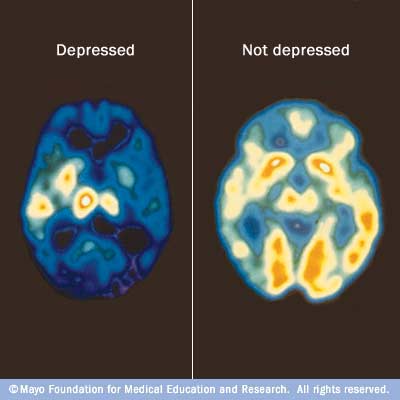
A PET scan performed at the Mayo Clinic compares brain activity in someone during a depressive episode and when not depressed.

Taking an anti-depressant is like the start of a new relationship. You need a few dates before you get to know it, how it treats you, what it brings out in you. My mishap with Celexa™ that had triggered a six hour-long panic attack, could be described as a really bad date. The kind where the guy turns up in low risers that show his ass crack, jibbers on about his investment plans in the UAE for an hour, then leaves you to pick up the check. But the first drug actually prescribed to me by a physician I had got to third base and moved in with by the end of the week.

The first thing I noticed when I began taking Wellbutrin was that I was better able to concentrate. On anything; a bird’s wing, a letter, a conversation. And so, I was able to work for the first time in months. It felt good to edit radio again. To do something I was good at and do it well. And to complete it! A total marvel.

With a renewed ability to concentrate came some clearer thinking, and this included some reflections about the nature of chemical happiness. A friend had warned me about what she’d referred to as “the soma factor”—of feeling like you’ve joined a cult of  people whose smiles you know are chemically enhanced. Since I knew a couple of people who lived with serious depression and were on medication for it, I didn’t have a negative view of those who turn to pharmacology to treat their condition. In fact, quite the opposite. (One close friend had terrified us all by going off his medication, announcing the start of a ‘vision quest’ and then disappearing into the desert for a week with no water). But even though I didn’t disapprove of anti-depressants and had seen the difference in people when they work, I still felt somewhere deep within me that I had ‘failed’ by turning to a drug. And I know that having been a practicing Buddhist for so many years compounded that feeling.

But this made no sense whatsoever. I had been ‘medicating’ myself with alcohol for months. I’d suffered blackouts, memory loss, serious losses of judgement. It had taken a toll on my body, left me fuzzy-headed and even more depressed. But somehow that was more acceptable than taking a pill that had a proven track record of helping people feel better. Bizarre.

Even my dad had tried to talk me out of going on medication. “It’s a crutch,” he’d said conclusively. “You’re smarter than that.” As if it were possible to somehow outwit depression like Wile. E. Coyote, always coming up with some devilish new scheme, and always thinking this is the day he’ll catch Roadrunner!

Eight days after the first dose of Wellbutrin I wrote:

I don’t have that stabbing pain in my chest any more. It’s amazing. It’s just gone. What happened to it? I’m still sad, but it doesn’t feel like the sadness is all there is.

There was also the suggestion in my dad’s remark, that only the dimmer-witted take medication for depression. The rest, I don’t know, write depressing poetry and put their head in the oven like Sylvia Plath. (Come to think of it I do write depressing poetry, just not the kind that’s won a Pulitzer.)

The odd thing is that the opposite was true. Going on anti-depressants to help me to manage depression was one of the smarter things I’ve ever done. And one of the most hopeful. It gave me the breathing space I needed to come to terms with things I hadn’t. It helped me to ‘move on’.

Nariman Mehta, inventor of Buproprion marketed as Wellbutrin™

But then there’s that thing where you feel a bit like a walking ad for big pharma. I’m quite aware that I’ve mentioned the word ‘Wellbutrin’ over a dozen times in my recent posts. And true, I’m not keen to be one of their poster children. (Plus, I know one person who took it and had acute anxiety and another who had no reaction at all.)

What finally persuaded me to try an anti-depressant was some of the recent research in neuroplasticity, basically the brain’s ability to change. This research is challenging the notion that the brain stops changing after childhood, and suggests that ones experiences can actually effect the brain’s anatomy and physiology. A person with depression tends to repeat negative thought and behaviour patterns, and these neural pathways can become entrenched. Long-term depression can carve out some pretty mean streets that result in dead ends. As the brain becomes habitualized to this road map, it can lose its ability to find its way out of the bad neighbourhoods. In his book The Noonday Demon: An Atlas of Depression, Solomon writes that there is growing opinion that even if one’s depression was triggered by circumstance, it can lead to organic (and far more intractable) depression if left untreated. This all really spoke to me. I wrote the following during a depressive episode, which I believe was my mind noticing these negative neural pathways I was unwittingly creating.

As I turned the key in the door tonight, a thought hit me. I am becoming habituated to feelings of loss. Loss is coming to define not just particular events and periods in my life, but my attitude to life itself.

And then there is the whole debate about ‘natural’ vs. ‘chemical’. I know people who would rather spend hundreds of dollars on some obscure Tasmanian root, with little more than internet rumours to its name, than take a pill that’s been successfully helping people to manage their depression for over thirty years. They say things like, “But I don’t want to take a ‘drug’ because it’s not natural”. I’m sure I don’t know what natural is. The drug has to interact with your own body chemistry to work. Buproprion (the active ingredient in Wellbutrin) acts as a reuptake inhibitor for the neurotransmitters norephonephrine and dopamine, leading to an increase in adrenergic and dompaminergic neurotransmission. And I don’t think it gets more natural than that! But all joking aside, waking up every day feeling disappointed to still be alive–is that natural?

The hard truth is that all that time you spend walking around in a fog, your relationships deteriorating, your confidence and self-esteem withering, your bank account dwindling because you can’t focus on work–you don’t get that time back. It’s gone for good. Studies have shown that most people who suffer from depression never seek the help they need. The world is full of fake smiles. People grin through their anger, laugh through their tears. I’ve faked my share. Today my smile may be chemically enhanced, but at least it’s the real thing 🙂

Posted in An invisible wound: a story of depression | Tagged , , | Leave a comment

An experiment with self-medication (don’t try this at home)

December, 2010

“You nasty little fucker!!!”

I was in a sleepy country lane, in the bucolic village of Bir in Himachal Pradesh where I had come for a weekend of Buddhist teachings, screaming at a Pomeranian. It was the morning of the second day, and I was walking the mile from my guest house to the meditation centre. Five feet below, a fluffy white lap dog was grinning like the cat who got the cream, except the ‘cream’ was my ankle which was rapidly turning blue. I was particularly peeved as I had said “Good morning,” to it with my best British manners.

It had cunningly waited until I passed, then jumped me from behind and ploughed its yappy ankle-loving teeth into my sinews. I stood staring at it with absolute hatred feeling totally ridiculous. I called a vet friend who suggested I get a rabies shot. But it was very expensive and I was far from anywhere that could administer it. Anyway, it was a pet not a street dog, and I was pretty sure it wasn’t rabid. Just a little bastard. (You can tell the Buddhism thing was really working).

I limped into the village and found my way to a clinic. By this time I was bleeding profusely from what looked like a vampire bite. The place appeared to be deserted so I was relieved to find a pretty young Tibetan girl dabbing an antiseptic on a man’s head wound. She looked annoyed to see me.
“I was bitten by a dog,” I said. “Can you help me? I need to clean it up.”
Her lips tightened as she consulted her watch.
“We’re closing,” she said.
“Um. Well, I can do it myself if you can give me some Betadine and some soap.”
She hesitated. I thought of throwing in a few hundred rupees. Maybe she doesn’t actually work here, I thought.
“Do you work here?” I asked.
“Yes, I do,” she said. “But I’m leaving.”
It was then that I noticed she was wearing a fancy chupa, a traditional Tibetan dress. Clearly, she had plans. And then I remembered that it was December 10th, International Human Rights Day, and the anniversary of the Dalai Lama’s Nobel Peace Prize back in 1989. Tibetans always celebrated this day with traditional food and music. I’d attended quite a number of these gatherings in the past.

I managed to persuade her to give me the soap and Betadine and I went into the toilet and washed the wound. My vet friend had told me I should clean it for 20 mins to get all the gunk out, which seemed a very long time. Ten minutes later, the girl appeared.
“Aren’t you finished yet?” she asked.
“Can you give me five more minutes?”
“We’re closing,” she said flatly.
She was a Pomeranian in a chupa.
“You know, you’re in the wrong profession,” I found myself saying. “You’re a really bad nurse.”
“That’s a really mean thing to say.”
The expression on her face showed that my remark had hit the target.
It was supposed to be. It was actually the first time in my life I can remember wanting to hurt someone, and doing so deliberately.

I had been walking the edge for a few days. I was only at the teachings because a friend had insisted, thinking that listening to a Tibetan lama talk for a couple of days about the mind would lift my spirits. I felt out of place, out of touch. The people around me looked happy, normal, comfortable with themselves. I felt like an ingrown toenail. Someone introduced me to a guy, thinking we might hook up. I had nothing to say to him. He left the table as quickly as possible, mumbling something about having to charge his phone. Standing in line to get into the gompa after lunch, an old friend came up to me, someone I had known in LA.
“I heard what happened,” she said in a confidential tone, speaking about the break up of my marriage, which I had been the one to instigate. “You must be having the time of your life. I envy you.”
“It’s not like that,” I replied, but couldn’t say much more, words taking archeological time to form.
She looked disappointed and moved away from me awkwardly.
I shuffled inside, studiously avoiding eye contact, and sat all the way in the back so I would be ready to leave. I don’t remember much of what the lama said. I was more taken by the number of middle-aged women who seemed have crushes on him. There was quite a bit of twittering about a beautiful Asian-Canadian ‘consort’.

At some point I knew I had to get out of there. There was a giant black boulder heading my way, no matter where I went. As it bore down on me, it gradually blacked out everything else around it. Looking back, I don’t know how I managed to get back to my guest house, pack my things, and arrange the taxi to come and pick me up and take me back to Dharamsala. I had found the last guest house in town. It was actually somebody’s bedroom. Obviously a young man, judging from all the posters of Bollywood starlets on the walls. The night before I had been thinking of different ways to kill myself while scanning the dusty plastic flowers and faded birthday cards stuffed into shelves on the Formica entertainment center. It was not a particularly emotional thought. It was more about the logistics. Judging angles, mass and velocities, the sharpness of a blade, the height of a building against the speed of falling objects, and wishing I’d paid more attention in physics class.

While I waited for the driver outside a shepherdess walked past the house with the dog that had bitten me. It was on the roof barking hysterically. She picked up some stones as she went by and threw a couple its way, missing by yards and sending it almost apoplectic. I tried not to will her to land one. I made the journey curled up in the back seat, watching my world becoming shrink-wrapped once again while the taxi driver prattled merrily on about his cousin’s wedding and the rising cost of gasoline. It was the third serious implosion since the depression had first hit back in August. There had been stretches of functionality in between. Painful functionality, but functionality at least. I wondered how long this one would last.

Back in my apartment, I turned on the heater and lay on my couch staring into its neutral halogen eyes. And then the anxiety kicked in. My heart was racing, perspiration began to pour off me. I began trembling as a mindless panic caught hold of me. The terror was real, but there was nothing threatening me.  I wasn’t in a war zone, or facing off a charging rhino. I was lying on a couch in my apartment. But the panic was unstoppable. I felt like I was being repeatedly thrown out of a plane without a parachute at 15,000 feet. It lasted for about eight hours. I fell to sleep around six in the morning and woke up at eight, my stomach in a fist. My first thought was. “I’m going to get that stuff.”

‘That stuff’ was Celexa. I’d heard some good things about it. At least two people I knew were on it and doing well. And you could get it over the counter in India. I Googled it, feeling proud of myself for being sensible and cautious. It had a good rep. Few side effects and lots of positive feedback. It was a serotonin-re-uptake inhibitor, and that sounded good. Seratonin was good, right? I took a taxi down to Baba Medical in lower Dharamsala and bought a couple of strips. I took one right away.

TWO DAYS LATER

A friend was in town and we had arranged to meet for coffee. He was an ex-nurse (the kind born for the job), a gay Buddhist six foot Australian generous-hearted beauty of a man. I adored him. He listened to me patiently while I babbled on about how I could feel this drug working on me. How everything seemed different already. What a beautiful day it was, how tasty the cappuccino was, how I was going to write about my depression now that I had a handle on it, how I wanted to help the world. How good I felt.
“Rebecca,” he said. And I could tell from his tone that he was about to say something I didn’t want to hear. “I know you don’t want to hear this, but I think you may be having a reaction to this drug.”
“No, no, no. No. No,” I said a few too many times. “I’ve looked it up! It’s really safe. I’m just maybe adjusting to it is all.”
“Maybe,” he said. “But there’s an edge about you that’s worrying me.”
I felt misunderstood. Like he didn’t want me to be happy or something.
“Look,” he said, seeing my crestfallen face. “I’m going into retreat tonight, but I’ll keep my phone on. Call me any time, ok?”
I agreed, humouring him and knowing I wouldn’t need to.

TEN HOURS LATER: TWENTY MINUTES PAST MIDNIGHT

“Daniel.”
“Yes, Rebecca.”
“You said I could call any time.”
“Yes.”
“I’m not doing so good.”
“What’s happening?”
“I’m having a panic attack. It’s been going on for two hours.”
“It will pass. Don’t take any more Celexin.”
“No, I won’t.”
“Don’t worry. It will pass.”
“Okay. I’m sorry to disturb your retreat.”
“It’s fine. You can call any time.”
“Thanks.”

click

Five hours later my heart was no longer beating like a chased criminal. The depression sunk back into my bones as if it had missed me. An arch enemy pouring tea across a fathom of enmity. But the anxiety had been so horrible, that I almost didn’t mind its return in those first few hours. I Googled Celexa again and looked up ‘rare side effects’. ‘Panic disorder’ was one of them. So was ‘extreme sense of well being’. Why didn’t I get that one? Two things had helped me through that night. Daniel and the memory of having taken amphetamines in my misspent youth, and understanding how a chemical needs to run its course in your system. I texted him. You’re golden. Thank you. He texted back. Any time. I poured some cornflakes into a bowl, but I couldn’t seem to add the milk. I sank exhausted and sobbing onto the kitchen floor, my arms wrapped around my chest, trying to hold myself.

Posted in An invisible wound: a story of depression | Tagged , , , | 2 Comments

the WELLBUTRIN diaries: 2 hours later

A continuation from
Wellbutrin…moving on

June 16th 2010

“I wave to myself from a country lane.
A soldier returning from war.”

It was Summer in Los Angeles and I was staying at a friend’s place while they were away. It was all very civilized compared to my life in India. Twenty-four hour hot running water, machines that clean your clothes, traffic that moved about sensibly, and a lot less yammering. The house had a sub-zero fridge, an insouciant marmalade cat that was twice the size of the freshly laundered Maltese…and a pool.

I had already been there a week, but the thought hadn’t crossed my mind to take a swim. I spent most of my time in bed, taking hot baths, getting smashed or staring at the TV without understanding it.

After returning from the doctor, I lay on the sunbed, trying to read. An hour later, I was baked and the clear blue pool began to look inviting. I stepped tentatively into the water. (During that time I did most everything tentatively–doing up a button, picking up a shopping basket, turning a door handle — as if rabid dogs were going to leap out at me and tear my face off.)

The cold water startled me. And I noted that I had actually ‘felt’ the coldness, had experienced the skin on my body tighten, my breath shorten a little. For almost a year my senses had been numbed. I had eaten as a functional conformity, had hardly noticed whether I was hot or cold. “Expect it to take a couple of weeks before you see any effect,” Dr. Mishra had said. I had known when he said that that I would feel it much sooner than that, being one of those people (and I suspect there are quite a few of us); ultra-sensitive to chemical changes, who are like canaries in the coal mine when it comes to this sort of thing. But I wasn’t prepared for quite how soon. This is what I wrote at the time.

A bougainvillea flower was floating on the water. It twirled above its soft pink reflection caught in a jet stream with the sun splashing around it through the wind-rustled leaves of an avocado tree. And I had a thought that, as it was occurring, I realized I hadn’t had for a very long time. It was the simplest of thoughts but it might as well have been transmitted from another galaxy. The thought was, ‘How beautiful.’

How beautiful. It was the inaugural address of my recovery.

I can feel the drug coursing through my bloodstream, my skin is tingling, there is a slight metallic taste in my mouth, there is a crack of an opening….

I watched in absolute amazement as my perspective began to widen….the way I had watched in horror at it closing in. How is it possible that I’m feeling the effects of the Wellbutrin so early?* Is it placebo? I quickly concluded that I didn’t care.

I dipped under the water and swam the short length to the deep end. A minute of blue pumping liquidy silence and I burst out, gasping for breath (a year of cheap vodka and cigarettes had taken its toll). I held onto the edge wiping the water from my eyes, feeling the muscles around my mouth threatening to shift into a smile.

Right under my nose, a moth was drowning. As was second nature to me (having been rescuing insects since I could remember; a spider from the bath, an ant from an incoming chair leg) I lifted it out of the pool. I knew I couldn’t put it on the stone while it was so wet because its wings had stuck together and there was a good chance I would damage them. I would have to wait until it dried off a bit.

As I watched this little grey flutterer twitch and wriggle in my hand a few things dawned on me. For one, I realized that I had noticed the moth. I had hardly been aware of bugs in distress, even though they must have been there, getting sucked down a shower drain or glued to a honey jar. They had been there. I just hadn’t noticed them. Like so much else, I thought.

And the very few times in the past year when I had lifted a soggy spider from my sink or moved a slug from a roadway, the act had been completely mechanical. There was no emotional reality to the experience. Like so much else, I thought. But this time my attention lingered. I didn’t just automatically leapfrog over it. I watched that moth struggle to right itself, clean its wings, and fly off towards the sun like it was the last creature on earth. Or the first. And I felt something. An action had connected with a feeling. I felt kinship with this tiny life, as if its fate and mine were bound by blood and oath on that Los Angeles June afternoon.

The cause of my depression was beyond me. But I was determined that the architecture of it would not be. I had been like a person strapped to a bed in an abandoned house. I had been waiting for a time when I could untie myself and begin to explore its rooms, its foundation, its supports, its walkways, its taste in furniture. But there is not much time to explore, because the house begins to evaporate the moment you leave that bed, and then gradually disappears into a brooding enigmatic fog.

The house of miseries was becoming ever-fainter as I stood in its driveway. It was refusing to be seen. It took a legion of effort to try to focus my mind on its ever more formless shape. And then, before I knew it, I was being propelled away from its lonely timbers in a gilted sleigh driven by Dasher, Vixen, and their new colleagues; Buproprion, and his sisters of mercy, Hydroxy-buproprian and Hydro-buproprian. “Wait! Wait!” I called to them. “I need to study the architecture!” But they couldn’t hear me above the din of the sleigh bells.

After a stoned hour or two of gazing at the clouds and drinking orange juice like it was a sacrament, I called a friend who’d had his own battles with depression, and told him what was happening.  He listened calmly and advised me to “watch the euphoria thing”. I was reminded of when I had experimented with an over-the-counter anti-depressant in India (well, it was over-the-counter in India), and had been sure I was on the mend until I shot into a night long anxiety attack less than 48 hours later.

By evening, things had calmed down. I was no longer a swirling mass of atoms eyeballing world-systems in the coffee grounds on the edge of a Scotchbrite.

I watched television (and was able to concentrate long enough to actually enjoy it). A reality show where a bunch of people with OCD live together in a big house. (Got me on a roll. ‘Homicidal Nymphos’ where one guy moves in with 15 women. Bret cowered in the basement, dazed and confused, clutching a condom and an axe.) I went to bed at a normal hour. Eleven instead of eight. It didn’t cross my mind to have a drink. And I ended the day with a tiny but unmistakable pinch of curiosity about the next.

NEXT UP: Natural Misery vs. Chemical Happiness

*On Wikipedia I found that: The active ingredient of Wellbutrin is Bupropion that is metabolized to hydroxybupropion by an iso-enzyme called CYP2B6. Alcohol causes an increase of CYP2B6 in the liver, and persons with a history of alcohol use have been shown to metabolize bupropion faster. I wondered if this could be part of the explanation of why I responded to it so quickly since I was drinking quite heavily at the time.

Posted in An invisible wound: a story of depression | Tagged , , , | 2 Comments

Footsteps of spiders

Before you even said a word,
This news had a sound,
An audible discomfort
The footsteps of spiders.

Tired, so tired of all this losing,
If I’m still not ready to let it go,
I’ll settle for watching it leave
without a chase…

Posted in epoche | Leave a comment

The man in the catamaran

I took this photo in Kerala. Every time I look at it I feel something different about it. Yesterday, when I felt lonely, it was an image of loneliness. At other times, it’s an image of a fisherman quite happily going about his business. Many things are like the man in the catamaran. Our minds will always spin the story that’s closest to home.

The man in the catamaran
is lost in a teacup
a breathing mast
a beating sail.

The man in the catamaran
is a genius on a plank of wood
hands spinning out his net
every move a masterpiece

The man in the catamaran
is a desperate sketch
a wisdom out of step with time
with thankless mouths to feed.

The man in the catamaran
is a floating poet, a drifting sage
reading squalls in a fish’s eye
time in a wave.

The man in the catamaran
licks his salt from the wind
has no one to answer to
no one to blame.

The man in the catamaran is
lonely as an asteroid
content as a friar
noble as marble
dull as backache
free as a bar fight

deep as the sea from where he came…..

Posted in epoche, Rose Apple Island | Tagged , , , | Leave a comment

In absentia: confessions of a depressed Buddhist

…soon other emotions follow happiness into oblivion; sadness as you had known it, the sadness that seemed to have led you here; your sense of humor; your belief in and capacity for love. Your mind is leached until you seem dim-witted even to yourself…..You lose the capacity to trust anyone, to be touched, to grieve. Eventually, you are simply absent from yourself.” Andrew Solomon, The Noonday Demon: An Atlas of Depression

There is nothing in particular that makes my story worth writing. I write about it because I don’t know what else to do with it. I had used the word ‘depressed’ before to describe being down in the dumps, a bout of melancholia, a touch of the blues. I will never do so again.

In August 2009 I entered a period of depression, the kind without inverted commas. It lasted for two years. At first I didn’t understand what was wrong with me. Depressed people were other people. People who couldn’t handle stuff life throws at them. They weren’t me. I’m the one who embraces life, chews up problems and spits them out. I can face it all because I’m a believer. This was true. It was also charmingly mistaken.

“It is not pleasant to experience decay, to find yourself exposed to the ravages of an almost daily rain, and to know that you are turning into something feeble, that more and more of you will blow off with the first strong wind, making you less and less.”

Andrew Solomon, The Noonday Demon

Most people suffering from depression (and its sadistic twin, anxiety) learn early on to stop trying to describe it. “Depression, truth be told,” writes Daphne Merkin, “is both boring and threatening as a subject of conversation.” Depression defies all conventional terms so that you become like someone with a rare tropical disease, isolated by ignorance and peculiarity of circumstance. As ordinary words are inadequate to describe what you are experiencing, you grope for adjectives and metaphors that inevitably sound like exaggeration. It’s a blood-sucking orgre that no one but you can see. And it feels infantalizing to try to convince anyone that its there. “Sure, sure. I believe you,” you sense them thinking.

“The psychological pain was agonizing, but there was no way of proving it, no bleeding wounds to point to. How much simpler it would be all around if you could put your mind in a cast, like a broken ankle, and elicit murmurings of sympathy from other people instead of skepticism (“You can’t really be feeling as bad as all that”) and in some cases outright hostility (“Maybe if you stopped thinking about yourself so much . . . ”).”

Daphne Merkin

Daphne Merkin writes, ‘…intractable depression creates a planet all its own, largely impermeable to influence from others except as shadow presences, urging you to come out and rejoin the world, take in a movie, go out for a bite, cheer up.’ Every depressed person learns one thing at least: to be an actor. To wear, to use Merkin’s phrase, ‘the mask of all-rightness’. Without it, you can’t function, because although you have fallen off the edge of the world, the world still insists on interacting with you. Even if it just wants you to pay its bills.

“Grief is depression in proportion to circumstance, depression is grief out of proportion to circumstance,” writes Andrew Solomon in his gem of a book, The Noonday Demon. Grief, I thought was getting close to the feeling. An aching, gnawing ever-present pain. It makes little sense, to those outside it or to those inside, who experience it nonetheless. That was one of the first things that struck me about depression. Its uselessness. Depression replaces the very molecules of your existence. Replaces the oxygen in the air and the atoms beneath your feet. It is all-pervading. There is no room for insight.

I stumbled upon Andrew Solomon while I was desperately searching the internet for clues as to what was happening to me. I found a video of a talk that he gave at his alma mater, Yale University. He was both impish and scholarly. Tin Tin in worsted. He was articulate, warm, open, with a crisp knowing sense of humour. Most of all, he spoke from personal experience. I watched the video twice back to back. It was like he’d been camping out in my head. I had found my first friend in the darkness. It was more important to me that he knew the nature of the darkness than the fact that he had found his way out. I was coming to understand that there is nothing lonelier than an experience that cannot be shared.

I felt I needed professional help, but I was in India, and had no idea where to get it. Watching this video was how I diagnosed myself. I realized from listening to Solomon that I had got off lightly. I had moderate depression that only very occasionally had stepped over the line into ‘severe’. I learned there were people much more debilitated by this illness than myself. People with enormous courage and compassion.

When depression first hits, you spend a lot of time stumbling around looking for a light switch. Anything that might make you feel better. Taking piano lessons, sex, intoxicants, walks in the woods, Banoffee pie, candlelit massages, hypnosis, rescuing a dog from the pound. It can be anything. After painstakingly and repeatedly running your palm over the floor and ceiling and every wall feeling in vain for the switch that you imagine must be there, it begins to dawn on you that if you’re planning to live you’re going to have to learn to see in the dark.

Depression was the mental equivalent of the time I got a root canal and the anaesthetic didn’t work. I tried doing tonglen, the Buddhist practice of mentally receiving the suffering of others and giving one’s own happiness. It was a practice I had been long familiar with and had always helped to put things in perspective. But this time it had the opposite effect. The mental torment went off the scale. The experience was absolutely agonizing. It was my first Buddhist shock. I was face to face with something I couldn’t think my way out of.

I began researching Buddhism and depression online. I suppose I expected to find some helpful insights from fellow practitioners. What I mostly found were pious lectures on the self-cherishing mind and self-obsession. The contributors commonly presupposed some level of control over one’s mental state. Not only were the comments unhelpful (and occasionally downright hostile) but they were remarkably ill-informed. How did these people feel qualified to write on a subject they clearly knew so little about? Simply because they were Buddhists? I was angry, partly because I was starting to feel protective. Depressives had become ‘my people’.

Telling a depressed person that they are self-obsessed is rather like shouting to a drowning person that they don’t know how to swim. For a person with depression their depression is the only thing going on. It is what makes it so debilitating. It’s influence is total. It’s not as if you can just place your mind on something else. Depression is that something else. It becomes and defines everything.

There is no self-obsession=depression formula. There are millions of rabidly self-obsessed people walking around feeling quite fine, thank you. And I have come to notice that those who do suffer from depression are often creatures with Olympian hearts, who value kindness and compassion more than most. To have such a heart compacted into an all-consuming mass of despair, unable to act as a resource even in the simplest most straightforward way, is a horror compounded.

I had been a fairly active Buddhist, and I liked to think, mentally pretty stable. My friends used to joke that I was on my way to becoming a nun. I used to wrinkle my brow a little at the emotional turmoils of others. Just take it into the path, I would intone. Now I could no more take it into the path than I could dredge up a sunken galleon with my bare hands. Meditation was not only painful but impossible. When I tried to bring to mind any aspect of the Dharma, my mind could not take it in. Intellectually I knew that my depression, like everything else, was impermanent, but I couldn’t internalize that notion to any effect. Seeing it all as a fruition of my past karma also had zero impact. It is more clear to me now why. It has something to do with the temporal amnesia that depression can create. Once again it’s Andrew Solomon who puts it best.

When you are depressed, the past and the future are absorbed entirely by the present, as in the world of a three-year-old. You can neither remember feeling better nor imagine that you will feel better. Being upset, even profoundly upset, is a temporal experience, whereas depression is atemporal. Depression means that you have no point of view.” (from Anatomy of Melancholy)

When I couldn’t do my practice, and when doing tonglen felt as good as stabbing my eyes out with an icepick, I felt not only depressed but a bad Buddhist. I had been practicing Buddhism for sixteen years. If I couldn’t apply it now, what had been the point of all those hours spent working with my mind? I felt I had learned nothing. I had assumed that no Tibetan lama would have any idea what I was going through, so I was pleasantly surprised when I came across the transcription of a lecture by a Tibetan teacher named Traleg Rinpoche. His words had the ring of experience to them.

Everything that we experience is normally experienced self-indulgently, from an egoistic or narcissistic point of view. But a constructive form of depression takes away the brashness, the security and the illusory forms of self-confidence that we have so that we have to always re-evaluate and check ourselves. Instead of thinking, ‘I know what is going on, I know where things are at,’ with such confidence, we are constantly forced to be more observant and to question our assumptions, attitudes and behaviour, in terms of our interactions with others and with the world at large. That is what has to be there if we are to make progress on the spiritual path.”

This is a far cry from the depression as self-obsession mantra. Traleg Rinpoche’s talk also revealed that he was aware of the difference between mild, moderate and severe depression, and that they can’t all be treated the same way. “All the old beliefs, attitudes and ways of dealing with things have not worked. One has to re-evaluate, say and do things differently, experience things differently”, he said. This, I was finding to be true. Nothing known was helping. I was a Bronze Age woman trying to format a hard drive.

I felt guilty that Shantideva’s wisdom couldn’t touch this. That I didn’t want to talk to my lamas. My new guru was a transgender writer and authority on Soviet art from New York. Here was the compassion and wisdom that seemed strangely absent from much of the Buddhist discourse on depression. There were parallels between us also. We were almost exactly the same age. His mother had died from ovarian cancer. And like me, his depression had hit after her death and the break-up of a long relationship.

It is the aloneness within us made manifest, and it destroys not only our connection to others but also the ability to be peacefully alone with oneself.” Andrew Solomon

There were some other Buddhist luminaries in the internet darkness. Susan Moon who had been a Zen Buddhist practitioner for over 20 years when she fell into deep depression wrote this.

“Buddhist teachings are about suffering and the end of suffering, and Zen Buddhism, in particular, emphasizes sitting still in the midst of your suffering and just letting go. I assumed that my meditation practice would steady me. What could be more comforting than 40 minutes in the peaceful, familiar zendo, with the slant of sun across the cedar floorboards, and the sweet smell of tatami matting? But it didn’t help. This is what I want to say: At times it made things worse. The demons in my mind took advantage of the opportunity. They weren’t real demons, but they didn’t care whether they were real or not; they tormented me anyway.”

I related to much of this. My practice that had once been a source of strength, was now a source of torment. And this piled on another shame. I began to see the world more pessimistically but also, I thought, more accurately. One of the biggest problems in treating depression, says Solomon, is when depressed people view their illness as insight. But he also acknowledges that the existential observations of depressed people are often true. We are ultimately alone. We are all going to die. There isn’t an inherent meaning in life. As Traleg Rinpoche put it: When we are depressed, we may actually be able to see through the falsity and deceptive nature of the samsaric world.  ‘In depression’, says Solomon, ‘the meaninglessness of every enterprise and every emotion, the meaninglessness of life itself, becomes self-evident.’

Solomon mentions a study that was done in which a group of depressed and a group of non-depressed people were asked to play a video game. After an hour, they were asked how many little monsters they thought they’d killed. The depressed group were accurate to about 10%. The non-depressed group thought they had killed between 15 and 20 times more little monsters than they actually had. I realized that I had always exaggerated the number of little monsters I’d killed. (There is a whole school of thought called ‘depressive realism‘ for those who are interested.)

People began to divulge their miseries to me. It was like I was ‘marked’ and they could smell it. Bearing witness to the suffering of others offered a temporary reprieve, but that feeling subsided quickly, and when I was alone (which depressed people often are) the depression was all there was. It had become my natural state. My default setting. I wanted to get out and help people, to do good, to do anything that would lift my mind from this abyss. But this takes energy that I didn’t possess. “The opposite of depression is not happiness” writes Andrew Solomon, “but vitality.”

Just getting out of bed in the morning feels like a heroic act. You want to call in the Army Corps of Engineers to help you take out the trash. And it all seems so silly. “While you’re in it you know and recognize that it’s ridiculous, and you experience it as ridiculous,” said Andrew Solomon, describing the Herculean effort he needed to invoke just to take a shower. People are naturally puzzled. They ask perfectly reasonable questions like, “You’re sad so you can’t get to the post office?” I found myself acting out. Turning to alcohol to try to numb the pain, but more often than not ending up in a wreck of tears before passing out (it was only when I was drunk that I cried). “I understand that it’s tough. I just wish you were handling it with more grace and maturity,” said a good friend after one particularly tearful night. So did I.

I began to feel ashamed by my own existence. Suicide stopped seeming like an aberrant act, and was quietly re-filed as an option.

The main question that interests Solomon is not why depression hits some people and not others, not even what the causes are. He wants to know why some people navigate the experience better than others.

“A lot of it has to do with integration. There are some people who go through depression and as soon as they’re feeling okay, they want to shove it aside, and not think about it, and not look at it, and not talk about it, and in the course of doing all that, ironically, they make themselves more vulnerable to its next ambush because they have dissociated themselves from it and therefore have no new coping mechanisms. And there are other people who have been depressed and who say , “Okay, I would never have chosen this, I would never have wanted this, but having had this experience, I’m determined to find some kind of meaning in it….It won’t prevent you from getting depressed ever again, but it will allow you to tolerate the fact that you do get depressed from time to time.

I recalled a friend telling me that one day I would look back and be grateful for this experience. I would have thought him mad, except that he had lost his only son in a car accident and knew what he was talking about. I had nodded, but at the time I couldn’t see ever being grateful for this. But today, I am.

After depression the world never quite looks the same. The spook of depression, even when you are feeling okay, lurks behind the doors of your head. But there are some things to be gained, once you have put enough space between you and the experience.

You lose conviction, but gain humility. You lose poise but gain honesty. You lose opinions but gain receptiveness. You lose strength but gain forbearance. You lose cleverness but gain tenderness. You lose judgement but gain mercy.

I am kinder now because of my episodes with depression. Kinder because I’m more willing to be with what is than with what I expect. And I’ve noticed that a number of people who Solomon interviewed report the same thing. One of them, a woman named Laura Anderson who had gone through severe suicidal depression writes:

“Depression has given me kindness and forgiveness where other people don’t know enough to extend it. I’m drawn towards people who might put off others with a wrong move or a misplaced barb or an overtly nonsensical judgment….. Once you’ve gone through it [depression] you get a greater understanding of the temporary absence of judgment that makes people behave so badly. You learn even perhaps to tolerate the evil in the world.”

And that is the kind of Buddhist I want to be.

NOTE: You can download the first chapter of Andrew Solomon’s book, The Noonday Demon here.

Going for help

Posted in An invisible wound: a story of depression | Tagged , | 10 Comments

the WELLBUTRIN diaries: moving on


Time doesn’t heal. Time is a hospital ward. Space is what heals. Healing begins as mysteriously as the depression. When depression is there it is total. There is space for nothing else. Healing begins with a crack….for me that crack was a Parma Violet pill called Wellbutrin

June 16th 2010, Wellbutrin Inauguration Day

I went to see Dr. Mishra. He was Indian, and even better, his practice was on Los Feliz Blvd, and I loved driving those long palm-lined East LA avenues. If I had written a character sketch of my perfect doctor and scripted the perfect consultation this would have been it. He was also very cute. Young, burnished, with a face both child-like and noble. He kept it simple. Was kind, precise and insightful. Most importantly, he trusted me. In all my lostness, my bump-into-the-furnitureness, my foot-in-mouthness, he trusted me to know what I needed. I would buy a boat and name it Dr. Sadhana Mishra.

He asked me some questions, treating the personal and the impersonal as one.
“How is your appetite?”
“Are you sleeping okay?”
“What was your last experience with loss?”

We didn’t talk very long, perhaps only 15 minutes. I remember saying that I was struggling to get through the day, that I couldn’t work, couldn’t concentrate or focus for more than a few minutes at a time. That I just needed some help to get back on track. He knew that I wasn’t telling him the half of it. He knew I had tried on my own. He knew I was ready to blow. Dr. Sadhana Mishra. A name that could stop wars. End famine. Raise the dead….

As he wrote the prescription (and the angels in my stomach were holding their breath) he casually asked if  I’d considered seeing a therapist. I noted that he wasn’t suggesting it. Just putting the question. I said, no, not really, without feeling the need to explain why. “Well, it seems to me that you left, but you haven’t moved on.”
The words floated out of his mouth and painted themselves in gold filigree on the wall behind him. You left but you haven’t moved on.

“You’re going to have to figure out why, whether you do it with a therapist…” You left but you haven’t moved on… “…with your friends, on your own…” ..left but haven’t moved on…”I think you’re going to have to understand that somehow.” …haven’t moved on

He wasn’t a mental health specialist. He was just a GP. But he had nailed it. He wrote the prescription and charged $60 for the visit. The receptionist checked with him about the price before she took my money. When we parted I couldn’t help telling him, “You’re very kind.” I would rescue a kitten and name it Dr. Sadhana Mishra.

An elderly woman in a creased plum-coloured hat was standing next to me, signing the register in a world slowed down to a fraction of the speed of this one. It struck me that she actually lived in a different time. She incrementally lifted a tissue out of its box and picked up a pen like a forensics expert trying not to disturb the fingerprints.
“I’m becoming a monk,” she said and winked at me. “Do you understand me?”
“What was that?” said the moon-faced Polish receptionist who hadn’t noticed her before.
“Monk. She’s talking about the TV show,” I replied, and the old woman smiled at me, eyes glinting from her decelerated world, then shuffled the ten or so feet to her seat, which I was the only one in the room to understand was to her a serious mile.

I went across the street to the Albertsons pharmacy to pick up the prescription. I didn’t even know what the doctor had prescribed me. I had to ask the pharmacist.
“Velbuu-trin”, she said in a thick Russian accent. “Are you sure zis prescreeption es right?”
“Yes, I’m going back to India. Three months with a three month repeat.
“I’m going to ‘ave to check on zat. Just a momont.”
She made a call.
I sat in the cold plastic chair next to that pharmacy like a queen at her coronation, the word ‘Vellbuu-trin’ an incantation circling my head.
It was a vote of faith in life itself sitting at that Albertsons pharmacy that afternoon. It wasn’t just the day I accepted that I’d survived. It was the day I decided to live.
“Okay, eet’s been approved.”
Russian was my favourite accent.
The check out clerk grinned as I ripped off the tab of the organic blueberry juice and swallowed my first pill.
“Thirsty were we?”
“Yeah.” I handed her a couple of bucks. “Very.”

Note: One study carried out by the University of Michigan concludes that of people suffering from depression. only about half solicit help of any kind from a priest or spiritual guide, friend or relative. Only about half of those find their way to a doctor who can address the medical aspect of their depression. Of those, only half actually receive treatment. Of the ones who get treatment, only half get effective treatment and only half of them get effective treatment for an appropriate length of time. I was one of the lucky ones.

And this is what happened next…

Posted in An invisible wound: a story of depression | Tagged , , , | 5 Comments

The Ganga Chronicles

“You canno forsch life inku enggi shay you wan jus fom guh powah of your fillings.”
German Baba struggled to form the words around his toothbrush that had been busily working its way around his mouth for the past ten minutes. He spat an exclamation mark of white foam into the river. It twirled a few times before floating dutifully downstream, bobbing on the wake of a passing motorboat.
“Excuse me?”
He turned to to Jude for the first time and gave her the look of a schoolteacher to an inattentive student. The toothbrush now dangled across the fingers of his upturned left hand like a ritual implement. Only his pinkie curling ever so lightly around the handle kept it from falling into the river. She suddenly envied the toothbrush. An ordinary thing, handled like a marvel.
“You cannot force life into any shape you want just from the power of your feelings,” he repeated, with a hint of impatience.
He tucked the toothbrush into his dhoti and he ran his hands through his long wire-grey hair, starting from his forehead, striped with orange dye. But hadn’t he done that, she thought? Hadn’t he forced his life from schnitzel and suits into daal and loincloth? From efficiency and logic into timelessness and mystery, simply from wanting it badly enough? But she didn’t feel like arguing today.
“No, I guess not,” she conceded.
“What’s wrong?” he asked her, suddenly more gentle.
“I’m tired of being misunderstood,” she moaned.
“Aaaaah.” German Baba laughed. “Are you worth understanding?”
Jude felt mildly insulted, but knew it wasn’t intentional.
“Sometimes,” she replied, truthfully.
There was a long pause. A characteristic of intercouse in India, where there is never any urgency to fill a silence.
“Do you think it was wrong, Heinrich?”
German Baba turned and faced downstream.
Another long pause….
“What do you think, my dear?” he said quietly. “What do you think.”

German Baba had been born Heinrich Pettinger. He had been an average student at school and at college, where he earned a BA in economics and later a Masters in Business Studies. He had worked for fifteen years at the Heslinki Insurance Company, offering “reliable, informed and trusted advice” to his clients. Now he had few possessions, no insurance and no pants.

He took out a pipe from somewhere in his magic dhoti, that artfully concealed an apothecary of items. He lit it with a lighter that read I Want You beneath a half-erased heart. Heinrich took in a long draw off the pipe, cupping his right hand over the bowl. He closed his eyes and tilted his head back slightly, and then exhaled a stream of smoke in the direction of a passing egret. Jude felt like Alice in Wonderland, waiting for the verdict of the hookah-puffing caterpillar. “Who are you?” She half-expected him to ask.

“Do you love him?” he said.
The question surprised her.
“Do you believe in love?”
“As much as I believe in nebulas or indigestion. Look! The buffalo have come for afternoon tea.”
About a hundred water buffalo lumbered single file towards the west bank, and sank into the river like a serene mass suicide.
“I do love him. But I’m afraid,” she said.
The reflection of the buffalo turned the water around them the color of a fresh bruise.
“I wrote a story. It’s my first one.”
“What’s the title?”
“The Ganga Prince. It’s about Atisha.”
“If it’s about the Ganga, then I would like to listen.”
“They’re all about the Ganga. In one way or another.”

Posted in epoche, Kashi | Tagged , , , , , , , | Leave a comment

Chain-smoking guru

I went downstream – to imagine
How things could have been different
I went upstream – and worried
How things might change

But then your grandfather’s words
Rippled underneath….
“The boat is the middle. Stay on the boat.”

From Water Coming, Water Going by Jude Duncan

“I only care about money,” announced chain-smoking guru lighting up a Gold Flake with a 10 rupee lighter. “For my girls orphanage,” he clarified, head titled a little back, Arabica eyes following the smoke as it escaped his momentous nostrils. Jude eyed a glass bookcase cum altar stuffed with mystic knic knacs and rupee notes, mostly 50s ad 100s. He sat cross-legged on a pile of silk cushions like Pavarotti in pajamas, sucking away at his cigarette. Waiting. She added a couple of hundred to the pile. He didn’t seem impressed but also didn’t complain, so she figured it had been more or less the right amount.

They were sitting in a shrine room, that looked more like a seventies stoner pad. It was filled with deities, posters of deities, wall-hangings of deities, and draped in luxurious fabrics and tassled floor cushions in between engraved brass incense holders and cheap tin ashtrays. Next door, a smaller room looking out onto a narrow alley, was filled with the oddest-looking machine, like a candy making appliance from Charlie and the Chocolate Factory. It was making a hell of a racket too, clanging cymbals and banging drums with levers and bolts and ball-joints. It was, she later learned, an automatic puja machine, churning out rhythms for the faithful to cure their piles, get their sons straight ‘A’s and return their wandering husbands.

Chain-smoking guru, the most respected astrologer in Varansi as Jude had been told, made her swear not to tell anyone what he was about to impart. Which was fine with her, since it wasn’t that intriguing. A few accuracies about her past were hard to explain, but most of it was groping and vague. She forgot the bulk of what he’d told her within half and hour, except the words with which he prefaced almost everything. Your heart is empty and alone. Her questions seemed to rankle him and put him off his stride so that he would have to begin again with, Your heart is empty and alone! in a melodramatic baritone. No need to rub it in, she thought. After half an hour of spinning possible futures out of a far from certain present, she’d heard enough. She was already bored with the future, and the past was written. He sensed her interest fading.
“It would help if I could touch your breasts,” he said. “It will give me inspiration.”

At the end of the session, she found Atisha waiting for her outside, hands in pockets, leaning against a wall.
“Where to now Judy ji?”
She took one look back at the puja machine, clanking and dinging away to the distant elusive ears of the divine.
“Let’s get back on the boat.”

Posted in Kashi, Moving on.... | Tagged , , , , , , , , , , , | Leave a comment

River Turner

Where does understanding go,
when it goes?

Are you sure it ever existed?

I can’t change the course of the Ganga
But if I could
I would drink it dry

And spit it out in another direction…

Posted in epoche | Leave a comment