It is understandable to me how some people see it as being by design. All part of some grand and grandiose plan for mankind. Conspiracy theorists, they’re labeled. They must, of course, be wrong in a very big way. They must be seriously unhinged. Whatever they are, it seems to be important that they are not at all like us–the hinged.
I’ve always had a wide window of tolerance for the un-hinged. They don’t scare me one bit. Sometimes they make more sense than the sensible and I’ve heard notes of truth struck even in the mad ramblings of obvious lunatics (and here, I don’t refer only to politicians). It seems to me it used to be easier to distinguish between the hinged and the unhinged. It’s getting harder and harder to tell the difference, isn’t it? In fact, I’m beginning to wonder if I’ve got a lot of things not only a wee bit wrong, but completely ass-backwards. Obvious truths seem, well, less obvious than they used to. It’s like the Caterpillar in Alice in Wonderland is now in charge of reality. “Whoooooo are yoooooooo???” This is fine on a personal level (what some would call ‘spiritual’) and even on an intra-personal one. But on a societal level it gets really, really weird. It’s like quantum physics is now strolling down the local high street bold as brass. Welcome to the upside down.
I look around me at what the world has become in a little under two years. Two revolutions of this bright marble around the sun and our way of life is becoming increasingly unrecognizable to me. I don’t know if it is by design or simply human nature. It is perhaps more likely to be an intersection of the two – a kind of crisis opportunism. History teaches us that this doesn’t bode well.
Like farmers who must learn to observe the signs of a storm, to read the wind in falling leaves, to detect the scent of earth that signals coming rain, there are those of us who read the patterns and signs of change in the fields of human behaviour with the same level of attention. But it should be obvious by now, to anyone with even just one squinty eye on the horizon that some very bad weather is on its way.
Navigating the pandemic itself has been hard enough. The virus has destroyed millions of lives and disrupted millions of others. It has not only killed, it has also bereaved and disabled. Naturally, we have done what we can to protect ourselves. Some might argue we went too far. The more radical steps that societies have taken to protect themselves from this threat have caused as yet untold losses. We may never know the extent of these, even in relatively quantifiable metrics such as physical and mental health, education and jobs. There is a loss much, much harder to quantify but one which is felt just as keenly – that is the loss of the Future. The Death of Dreams.
We now seem to be in a place where the future is a dark veil – too heavy for any of us to lift. No one makes plans any more. We are trapped in a turgid dystopian present. There is now no doubt in my mind that either by design or opportunism, a concentration of mutually aligned powers are attempting to take over our lives in ways that have already become untenable to enough of us that can actually make a difference.
When even one single person says “no” to a wrong with the full spirit of intention, it becomes more than a word – it becomes a verb that can rally to action, to agit as the French say, to agitate. When enough people say “no” with the full spirit of intention, the effect of this collective agitation becomes more than this still – it becomes a prophecy fulfilled.
I can’t speak for all our motivations, but for myself I do it always with you in mind — the Next — because you do not deserve the sad, timid, grey-haired world we are in danger of leaving behind us. You do not deserve to have liberty and democracy written out of your will just because we were too distracted or self-centred or complacent or blind or just too damn comfortable to do what we should have to preserve it. We acted like inheritors when we should have been guardians.
Our grandparents have carried the burden of freedom for too long now. It’s our turn – this will be the revolution of the middle-aged, inspired by the warriors of old, with the watchful eyes of the young and unborn as our talismans. Because the sacrifices we’ve been sold to keep each other safe from the virus is not the one that is calling us in our hearts.
The sacrifices presented to us from the brittle mouths of politicians and corporate agency managers threaten to squeeze us into smaller and smaller spaces where personal agency becomes so truncated as to be rendered meaningless. The only measure of freedom in the space left to us is as a consumer. It comes down to the freedom to choose the brands, colours and styles of the stuff with which we fill our living space and decorate our bodies. Like our other ‘freedoms’ such as the freedom of expression, freedom of the press, and the freedom to vote, it pretends to a level of choice that in reality is unavailable. Life has become like a game where every choice you make leads to the same result but if you don’t play it you can’t survive. In politics, the margin of difference between parties is exaggerated beyond all actuality by voices that call out “traitor” to those who refuse to buy into the sham and “conspiracy theorist” to those who suggest that the game exists at all.
We are still in the process of handing over the wheel to people who do not have our interests at heart. The measures of control that are being sold to us in the name of public health may make us feel safer from the virus, but the damage to individuals and to society at large will be far, far deadlier. It will lead us to an ever darker, dystopian more heartless world. Social austerity measures like health passports may be packaged in morale boosting mottos that smack of civic duty, but we – the farmers of the Future, know that they come from a place of No Soul. Either by design or opportunism, it is clear to me know after almost two years that what we are seeing is nothing less than the hijacking of the Future by networks of interests led by soulless narcissists who think they have the right and the ability to run the show, when they have neither.
The real sacrifice, the one we are being called to bear from the voices of the next generation, will demand a lot more courage and honesty than we might be willing for. I am not ashamed to say that I myself am very, very afraid. But I am even more afraid of what will happen if we let the Liars, Narcissists and Manipulators win. I don’t want to go to my grave ashamed that I lived through this time and did nothing except shout at the television. That I didn’t say my little “no.” Whether I fail or not is almost irrelevant to me. What is required to go to my grave at peace is only a meaningful effort. Meaningful in the sense that it comes from the heart. It may or may not make a difference out there, but it makes a difference in here.
Make no mistake about it. You have been deceived. This is not a political fight. It is not a struggle between the Right and the Left or between the individual and the collective. It is a struggle between those who seek freedom and those who seek to control. Right wing dictatorships and left-wing dictatorships are being challenged alike in this global struggle against authoritarianism. We need to counter it uniquely as individuals as well as collectively in whatever group structures support the resistance so long as they respect the Golden Rule. If those structures are not to be found, we must create new ones.
Last night I sat up late and shared a bottle of wine with a stranger. Something about the encounter made me feel like I was 18 again. We discovered that we had an unusual amount of commonalities between us. Details of our personal lives overlapped in remarkable ways. She even had a faulty light fixture in the entrance way of her house just like me. It was like meeting myself in a parallel universe. We talked excitedly about our common love of traveling, of exploring other lands and cultures. We spoke of our youth with fondness and appreciation, of a world that now seems less like another time than another planet. We had both journeyed to the near east while still in our teens, and with our parents blessing. I left for a whole year with my boyfriend who was four years older. (For the record, I’d be reluctant to let you go now if you were mine. Or if I did it would be under strict guidelines.) This was 1981, before the Internet, before laptops and mobile phones. We communicated by letter through the Poste Restante, an international mailing system. Each letter took two weeks to arrive if we were lucky. Some letters we never received because we had already moved on, by boat, train of plane to another country. I think I spoke to my mother once in that whole year. I remember busting over with excitement about all my experiences and telling her (with the remarkable certitude of youth) how I planned to do this for the rest of my life. I remember her saying to me, “Enjoy it now.”
We slept in building sites, rose with the sun and walked crazy miles with heavy metal-framed backpacks eating nothing but halva and cheese and sandwiches. We played backgammon in tiny curtain-doored cafes in countless middle of nowheres across Greece, Turkey, Cyprus, Israel and Egypt. We broke bread with strangers every day, we listened to them complain about their neighbours across the border that seemed to dress and eat and speak a lot like them. We learned that old disputes get ground into the bones of each new generation and replayed like old records, but that although we prefer to talk about our differences people are mostly the same. I didn’t know at the time that thoughts like these would be considered a kind of political heresy in only a few decades. It was a year of learning and adventure. Our futures spanned out before us like peacock tails, into fractal horizons encoded with iridescent possibilities. What does the future feel like to you, I wonder?
At the beginning of the pandemic, in Spring of 2020, I was like everyone else. Can you cast your mind back there? Can you recall the sense of camaraderie, of facing something down together? The first lockdown was treated as something of an adventure for those of us who could afford to embark on it. Gardens bloomed like never before, people rediscovered lost talents or found new ones. We used humour to ease the loneliness and uncertainty, and the challenges felt tolerable, even enlivening. We watched – some with wonder and others perhaps with a touch of unease – how quickly the natural world moved back into the gaps that humans left as we retreated back into our caves, how the footfall of humans was replaced by paws and hoofs, how the cessation of our frenetic comings and goings created pools of tranquility. This was the best part. Perhaps some of us thought it was all there was too it and we would all bounce back after a season knowing how to cook flan or play Moonlight Sonata on the piano or cultivate an orchid for the first time in our lives. We checked up on one another, we asked “How are you?” We provided services for free. We offered to help. How far away that all seems now. And how I miss it. That kinship. That optimism. It was the shining best of us.
The change in the dynamics of social behaviour during this pandemic has been dramatic and will likely fascinate social historians for decades to come. We’ve gone from checking in with one another to checking up on one another. Requisitioned for the panopticon, we watch and monitor each other for signs of non-compliance. With what, we’re not exactly sure, but it has something to do with being on the ‘right’ side with being a ‘good’ person. This view is never questioned and is reinforced constantly by all the major information networks. Righteous indignation towards those who see things differently has become the hallmark of what it means to be a good citizen.
How did we get from there to here? From mutual support to mutual withdrawal, from conviviality to suspicion, from common ground to an aching chasm. Bonding to division. I am not sure how history will record this period, but I suspect we will not receive a glowing report. If you were my child, we would talk about it together. We’d find things to laugh about and perhaps to also cry. We’d create our own conspiracy, our own tiny theory of things. We’d find a way to say “no” together. Instead I find myself writing this blog like a letter to a Poste Restante of the Future. The future YES that has been sewn together from the wriggling awkwardness of all those little NOs.
All I can do is to be a witness; to tell you the story as and how I saw and lived it. Me and some of my friends. Like all good stories, it involves some darkness, and it is certainly a warning of sorts. But it is also a peek into the possible. If it describes the building of a prison, it does so from the point of view of the inmates. Not the ones who make deals with the guards for extra portions of gruel or rearrange the furniture in their cells, but the ones who keep their wits sharpened and spirits lifted with plans for escape. It is the shaking off of shackles of dualism. The empty dictates of black and white thinking. It is a story of non-duality, of Indra’s Net made manifest in the socio-political sphere. It is the rising of the best of us again, individually and united.
We started with the common sense that “something ain’t right”, but we now have something that could be called a map–scruffy and wildly inaccurate no doubt, but it provides clues and markers; a notch in a tree trunk here, a ring of toadstools there, for a possible way through, to pierce the dark veil of the Future that hangs like a sombre hopeless fog over our heads, and let in a pin prick of light. It is not much but it is perhaps enough to see one step in front. And this might all we need to feel our way to the Truth. And in the face of the Big Lie, it might give us just enough courage to say our little “no”.
“When you mix politics and science, you get politics.” John M. Barry
When stories become deeply divisive it is a good time to ask some deeper questions. So here’s one: what is up with Ivermectin? Why has a decades old Nobel prize winning drug become a flashpoint in political divisions around pandemic policy, and who has most to gain or lose from its rise or fall in the Covid medical landscape?
Like in the parable of the blind men and the elephant who became convinced that the elephant was in fact a tree if they only felt its legs, a snake if they felt only its trunk, or a rope if they felt only its tail, Ivermectin is a completely different character depending on what part of the story you approach it from. It is a hero for anti-vaccine activists and a bête noire for those who rail against them. For thousands of doctors and researchers it is an effective workhorse in the fight against the pandemic, while for international medical agencies, politicians, Big Tech and most of the media, it is persona non grata. Ivermectin is a saint for the patients it has helped to cure. An outright nuisance for Big Pharma. The question is, in this story, who are the blind and who are the sighted? And is it even possible to see beyond the parts to the whole elephant?
If absolute truths are becoming harder to find in this world, it surely must be possible to wrangle a closer proximate out of the evidence than in the emotional octane bully pits on social media platforms and in what passes for debate in much of the mainstream media. For those who would rather simplify the Ivermectin debate to a tug of war between the political right and left, things become true or false depending on who is saying it is so and who is saying it is not. It is less important what is said than who is saying it. If you don’t like the politics of the person saying it then it must be false. This is truth as advocacy, not truth as reality. It reduces all debate to posturing. Evidence, if considered at all, is picked over for morsels that feed a preset agenda.
The results of a single study are treated as an adequate basis for evidence. The negative bias around Ivermectin in the press is now so extreme that to say anything about it other than to denounce this “horse drug” is to risk becoming marked with the rather tired out label of “right wing conspiracy theorist”. This is a balance that needs to be addressed, not by responding to hatchet jobs with uncritical “miracle drug” advocacy, but by making a sincere attempt to see a bit more of the elephant in the room.
This story from the LA Times is fairly typical of the tone around the subject. The author clearly intends for the reader to conclude that Ivermectin as a Covid treatment should be tossed onto the rubbish heap of medical theories on the basis of a single medical trial. What he fails to mention, however, is that the Together COVID-19 Trial from which he quotes was funded by the Bill and Melinda Gates Foundation. With its high level of interest and financial investment in Covid 19 vaccine companies, this would seem like a serious conflict of interest. In withholding such information, journalists are denying their readers the right to make up their own minds–to be exposed to more than just the leg or tail of the elephant and to decide for themselves what kind of animal they’re dealing with.
If we shift our focus from the United States to the rest of the world, the debate around Ivermectin as a Covid treatment becomes a very different one. It involves doctors, scientists, researchers and public health professionals, many of whom swing not the right, but to the left. It is also, at times, a battleground between stakeholders; Big Pharma and powerful health agencies on the one hand and doctors and patients on the other, often in the world’s poorest countries.
At its best, the debate around the role of Ivermectin in the pandemic goes to the heart of questions around the ethics of medical commerce, the right of doctors to treat their patients as they see fit, and the political and financial power dynamics in the global pandemic response.
What we discover when we take the time to ask the right questions is that the Ivermectin story in the time of Covid is not so much a conflict between the political left and right, but a conflict between interests that are driving the response mechanisms to the crisis. This conflict has been exacerbated by a dearth of investment and research in Covid therapeutics that actually treat the illness and the single minded focus on vaccines as the sole path to safety. In the United States, these responses have found their cheerleaders–either accidentally or intentionally–within two distinct political camps that assert arguments around “good” vs. “bad” science (or even science and anti-science) and civil responsibility vs. individual rights. This has resulted in people reduced to caricatures; of the sane, reasonable and compassionate people versus the insane, unreasonable and selfish. This has all given the impression that the different views in how we should respond to the pandemic are fundamentally political in nature, but are they? Could it be that there are other forces at work, with other interests, who might actually be quietly profiting from these divisions?
WHAT IS IVERMECTIN?
Ivermectin (also sold under the names Stromectol and Mectizan) is a drug that was developed by the American pharmaceutical giant Merck. It was first used as an anti-parasitic in veterinary medicine, but has been used for almost fifty years to treat a number of conditions in humans, primarily water-borne parasitic illnesses. Ivermectin is on the WHO’s authoritative List of Essential Medicines. It it has a long safety record, and is described in the scientific literature as “astonishingly safe for human use”. The drug was found to have extraordinary efficacy against river blindness (onchocherciasis), a nightmarish disease caused by the larvae of a parasite carried by blackflies that has maimed millions of people in the developing world. Ivermectin has been so successful in helping to eradicate river blindness that its discoverers won the Nobel Prize for medicine in 2015. From 1987, former Merck CEO, Roy Vargelos, was inspired to donate billions of doses of the drug for free in collaboration with the World Health Organization.
WHAT HAS IVERMECTIN GOT TO DO WITH COVID-19?
In June 2020, Ivermectin was shown to have potent anti-viral properties against SARS-COV-2 in the lab. Scientists called for more studies to explore the potential to repurpose this widely available drug that already had approval from all major health bodies to treat Covid19. In December, intrigued by the in vitro study, scientists noted that certain African countries had a low frequency of cases and deaths from the SARS-CoV-2 COVID-19 compared to others. When they delved deeper, they found that Covid patients in countries where Ivermectin had been used as part of the WHO-sponsored African Programme for Onchocerciasis Control (APOC), had a significantly lower chance of dying than in African countries that had not been part of the APOC protocol. The researchers suggested that a mass public health preventive campaign against COVID-19 may have “inadvertently” taken place, and again called for additional studies.
The additional studies came thick and fast. To date, there have been 104 of them examining the action of Ivermectin as either a preventative or treatment for Covid-19. Of these studies, 64 have been peer-reviewed and 60 have been control studies–that is studies that compare treatment with control groups, the gold standard of scientific research. Not all of these studies found efficacy for Ivermectin against Covid, but a significant number of them did.
The Front Line COVID-19 Critical Care Alliance (FLCCC) led by Professor Paul E. Marik was founded in early 2020 with the mission of providing a continuous review of the emerging science and clinical data on treatment protocols for COVID-19. The group conducted a meta-analysis of Ivermectin interventions in the American Journal of Therapeutics the results of which were peer-reviewed and published in April 2021. The analysis included 18 randomized controlled treatment trials, controlled prophylaxis trials, and distribution campaigns that had been conducted up until January.
The researchers found that Ivermectin was effective “in all phases of Covid”, that treatment led to “statistically significant reductions in mortality, time to clinical recovery, and time to viral clearance” as well as significantly reducing the risk of contracting the virus. In their conclusions they suggest that Ivermectin “may prove to be a global solution to the pandemic.” Another meta-analysis of the evidence was published in June 2020 out of the UK. Bryant-Lawrie et al. concluded with “moderate certainty” that “large reductions in COVID-19 deaths are possible using Ivermectin”. Moderate certainty might not sound so convincing, but as clinical care physician Dr. Pierre Kory of the FLCCC points out, corticosteroids are also graded only with “moderate certainty” in their efficacy against the coronavirus even though they are currently the standard of care for Covid patients.
At the end of June this year, another meta-analysis by Roman et al. published in Oxford University Press for the Infections Diseases Society of America found against efficacy of Ivermectin in treatment of either early or late stage Covid. This was followed by an Open letter signed by 40 physicians detailing errors and flaws in the Roman et al. meta-analysis, as well as conflict-of-interest concerns and requesting a retraction.
In the first week of July 2021, Andrew Hill, a senior research fellow at Liverpool University doing research on Ivermectin for Unitaid, had a preprint of his own meta-analysis published in the Oxford Academic Open Forum Infectious Disease Journal. His analyses of the evidence showed that Ivermectin reduced deaths from Covid-19 as well as hospitalizations and significantly improved medical outcomes. The Youtube presentation of his results was removed and re-uploaded and removed again like a game of whackamole.
Critics continue to point to lack of quality peer-reviewed double blind control studies of Covid-treatment and Ivermectin, and questions over research quality and meta-analyses conclusions continue to dog those who have become convinced of its critical role in the war against the virus.
IVERMECTIN IN PUBLIC HEALTH DISTRIBUTION CAMPAIGNS
Some of the most compelling evidence for Ivermectin as a useful Covid treatment comes not from randomized control trials but from mass public health campaigns, particularly those that have been conducted in India, Mexico and South America. The campaign in Chiapas, Mexico, that rolled out in July 2021 appeared to have drastically reduced more serious forms of the illness.
On June 10, the Spanish-speaking media began reporting on the success that Peru was having in controlling the virus using Ivermectin. At that time, Mexico was in the middle of its worst peak with records breaking daily, and interest in Ivermectin rose dramatically. On June 20, the pan-American WHO (OPS/OMS) issued a statement strongly opposing the use of Ivermectin to treat Covid. Nevertheless, Mexican health authorities decided to move ahead with with a distribution protocol for out patients that included Ivermectin.
Perhaps one of the reasons that Mexican health authorities chose to ignore the WHO advisory was their experience with the awful disabling impact of the parasitic disease onchocherciasis, known as river blindness. In 2015, the same year that the developers of Ivermectin won the Nobel Prize, the WHO declared this disease to have been completely eradicated in Mexico. One of the states hardest hit by river blindness had been Chiapas, which was where the Covid Ivermectin campaign was carried out. Many Mexicans in Chiapas must have had friends and relatives who had been affected by river blindness and probably felt a level of trust towards the drug that had cured it.
Relatively small doses of Ivermectin were distributed as part of a multi-drug treatment protocol for Covid positive patients suffering mild to moderate symptoms. The aim was to reduce hospitalization since the hospitals were completely overwhelmed by critical Covid cases. The campaign was substantial. In one month alone, 83,000 medical kits were distributed. The program was found to offer protection against the disease between 50 and 76%. By the end of the program Covid deaths in Chiapas had reduced dramatically while the deaths in the rest of the country had risen. A Peruvian study published January 2021 had similar findings. Ivermectin was also shown to reduce viral load, and hence the transmissibility of the disease.
Along with successfully treating Covid patients with mild to moderate symptoms, Ivermectin was also discovered to help prevent people from contracting Covid in the first place. Uttar Pradesh was the first state in India to introduce a large-scale prophylactic as well as therapeutic use of Ivermectin. It began in early summer 2020 in Agra, where Ivermectin was given to all emergency health workers in the district. None of them developed Covid-19 despite being in regular contact with Covid positive patients. Based on the findings from Agra, the state government sanctioned the use of Ivermectin as a prophylactic for all the contacts of Covid patients and later extended its use to therapeutic doses for treatment. Whatever the cause, death and infection rates in UP plummeted compared to other Indian states. Between September and October, the All India Institutes of Medical Sciences (AIIMS) ran a study that found that only two doses of Ivermectin resulted in a 73% reduction in Covid-19 infection among their healthcare workers.
SO MERCK MUST BE HAPPY ABOUT THIS, RIGHT? WRONG
Despite the growing evidence of Ivermectin’s usefulness in the pandemic, or perhaps because of it, Merck took pains to distance themselves from their own Nobel prize-winning “wonder drug”.
In February 2021, Merck put out a strong statement on Ivermectin use during the Covid-19 pandemic. Claiming that their scientists “continue to carefully examine the findings of all available and emerging studies of Ivermectin for the treatment of COVID-19 for evidence of efficacy and safety” they concluded that they had found “no meaningful evidence for clinical activity or clinical efficacy in patients with COVID-19 disease”. They concluded that: “We do not believe that the data available support the safety and efficacy of Ivermectin beyond the doses and populations indicated in the regulatory agency-approved prescribing information.”
Even though since this date, dozens of studies and real-world distribution programs have resulted in data that suggests otherwise, Merck has remained intransigent in their position.
Curiously, the only Ivermectin/Covid study published in JAMA, arguably the most prestigious medical journal in the world, concluded that the drug was ineffective against patients with mild to moderate to symptoms. This was the March 2021 López-Medina study out of Columbia. Because of its prestigious appearance in JAMA, this study was naturally given widespread media coverage. But one detail stands out. At the bottom of any published study the researchers must mention any conflicts of interest. And this study had them in spades.
The lead researcher in the study, Dr López-Medina, reported receiving grants from Sanofi Pasteur, GlaxoSmithKline, and Janssen as well as personal fees from Sanofi Pasteur during the conduct of the study. Another key researcher reported receiving grants from Janssen and personal fees from Merck Sharp & Dohme and Gilead Sciences. All of these actors have something to gain from a study that disproves the effectiveness of Ivermectin.
Janssen (owned by Johnson & Johnson) is, of course, the developer of one of the top vaccines against SARS-COV-2. Merck, has vested interests in side-lining Ivermectin in order to promote their new therapeutic, Molnupiravir, which we will learn more about later. Gilead Sciences is responsible for Remdesivir which (remarkably since even the WHO says it doesn’t work) is the only Covid drug with FDA approval. Sanofi and GlaxoSmithKline are currently in collaboration to develop a whole new generation of multi-valent mRNA vaccines for COVID-19. How the fact that the Columbia study was funded by the very same entities that had some serious stakes in keeping Ivermectin out of the picture somehow slipped the attention of the journalists at the New York Times is anyone’s guess.
Even more perplexing was that in spite of the mounting evidence that Ivermectin was a potentially powerful tool in combating the pandemic, in spite of its long safety record, its widespread availability and affordability, none of the world’s major medical bodies – neither the Food & Drug Administration (FDA), World Health Organization (WHO), European Medicines Agency (EMA), nor the National institute of Health (NIH – authorize even its emergency use as part of Covid treatment protocol. Not even for patients fighting for their lives in the ICU.
In January 2021, the US National Institute of Health shifted their position on Ivermectin. They stopped short of recommending for its use but ceased to recommend against it stating “there are insufficient data to recommend either for or against the use of Ivermectin for the treatment of COVID-19. Results from adequately powered, well-designed, and well-conducted clinical trials are needed to provide more specific, evidence-based guidance.” The UK’s COVID-19 Therapeutics Advisory Panel—an independent panel of experts that recommends what treatments should be proposed for testing through the various UK platform trials—expressed the same opinion. The response was always, “more trials, more trials, more trials”.
In richer countries the media became increasingly anti-Ivermectin, associating it with the right-wing fringe. Meanwhile, doctors and health care professionals in the developing world were claiming Ivermectin as possibly the best available drug at preventing and treating the disease. It was like two parallel universes.
Even the most ardent critics of Ivermectin—at least the honest ones—do not claim that Ivermectin doesn’t work against Covid, only that the evidence is methodologically limited. But here’s the Catch 22. To build a strong body of evidence for any intervention requires double blind controlled studies but these are expensive and require substantial resources and organization to run. Medical agencies such as the WHO are perfectly set up to fund such clinical trials. Indeed, WHO set up their own Solidarity Trials for the very purpose of exploring potential Covid treatments.
WHO has granted Ivermectin use only within controlled trials and yet bizarrely refuses to include Ivermectin in the clinical trials that the agency itself conducts.
For many scientists and researchers reviewing the evidence and for doctors working on the front line of the disease, the situation was incomprehensible. Even if Ivermectin wasn’t as efficacious against Covid as some of the studies indicated, they argued, any efficacy was better than nothing. Since there were literally no drugs approved to treat Covid apart from the ineffective and whoppingly expensive Remdesivir, what was the harm in including Ivermectin in treatment protocols when lives were at stake? Dr. Tess Lawrie, the lead researcher on the UK Ivermectin meta-analysis, who consults for the WHO and NHS to support clinical practice guidelines, went as far as to make a plea on Youtube for the public to inform themselves about Ivermectin.
“Our evidence shows that Ivermectin is effective, safe and very cheap. We should be using it for both prevention and treatment of Covid. However, governments and health organizations are ignoring the evidence – and there’s a mountain of it – and I think this is because they are heavily invested in novel treatments. So I’m asking you please, take responsibility for your health, educate yourselves and inform your friends and family and most of all speak to your doctors. Help us spread the word, help us save lives. Thank you.”
WHY WOULD DRUG COMPANIES NOT WANT IVERMECTIN TO GET APPROVAL AS A TREATMENT FOR COVID-19?
Dr. Lawrie hints at the answer to this question in her video appeal when she says that health organizations are “heavily invested in novel treatments.” The small percentage of biopharmaceutical firms involved in the search for COVID-19 treatments (as opposed to vaccine development) raises the question of whether such firms may have insufficient incentives to redirect innovation efforts to respond to the pandemic. There are even less incentives to explore the potential use of repurposed therapeutics—that is, drugs already circulating in the healthcare market with tested safety records.
Firstly, getting funding and interest for trials for pre-existing drugs is not as easy as for novel ones. Discovering and developing new molecules has more cachet than re-purposing a common generic, but the main reason for the challenge in funding studies is that discovering new uses for older drugs is simply not as profitable. New drug molecules can be patented, meaning that companies can control the sale and receive all profits from their creation. Once patents expire, other companies are allowed to manufacture and sell the same generic drug, which drives down the price. Ivermectin was launched in 1981 and Merck’s patent on it expired in 1996, though it was extended for different periods in various countries. Today, generic forms of Ivermectin are widely commercially available.
Simply put, Ivermectin is not going to make anyone rich. A single dose of the drug is $2.64 compared to $520 for a single dose Remdesivir. It costs more to put Ivermectin into tables than it does to produce the drug itself.
Tocilizumab, one of only three WHO recommended drugs so far for the treatment of Covid is produced by the Swiss company Roche. Even though this drug—sold under the name Actemra —has actually been on the market since 2009, Roche has kept the price so high that it remains out of reach for most, with price tags per dose (600mg) set at $491. This could help to explain why most of us have never even heard of it. (The other two WHO recommended drugs for treatment of Covid19 are sarilumab, sold as Kevzara manufactured by Sanofli and the corticosteroid dexamethasone).
It is important to note that currently all the WHO recommended Covid treatment drugs are only for patients with severe and critical conditions. There are norecommended drugs for patients who have mild to moderate symptoms, although this is poised to change.As the world shifts from pandemic to endemic, this is the gap in the market that drug companies, who are finally turning their attention from vaccines to therapeutics, are eager to fill—with anything except Ivermectin, that is. And this is where the story really starts.
MOVE OVER IVERMECTIN, MAKE WAY FOR MOLNUPIRAVIR
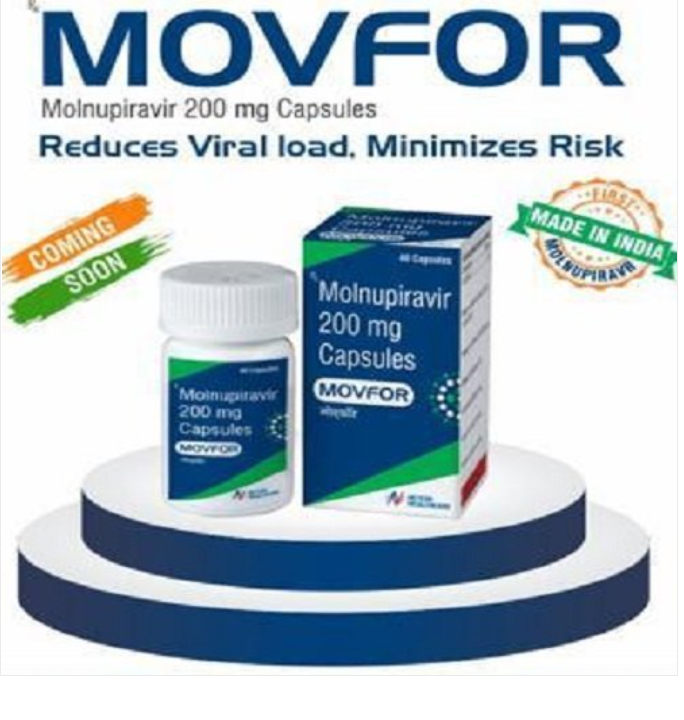
Although Ivermectin has not received official approval from the world’s major medical bodies, it has been part of the Covid treatment protocol in many regions of the world since early in the pandemic. In January 2021, Merck scrapped its plans to develop vaccines against SARS-COV-2 to concentrate exclusively on therapeutics. The result of their efforts is Molnupiravir. This is the drug that is poised to corner the market for therapeutics against mild cases of the disease.
EIDD-2801, as Molnupiravir was formerly known, was developed at Emory University by Ridgeback Therapeutics before the pandemic for use against Ebola and influenza. After a study revealed that the drug blocked transmission of SARS-COV-2 in ferrets, Merck acquired exclusive worldwide rights to develop the drug and related molecules in March 2021, in collaboration with Ridgeback which is responsible for funding and conducting the Phase 1 and 2 trials.
The following month, in April, on the other side of the world in India where one of the world’s largest populations was battling against the second wave, the use of Ivermectin was formalized at the national level by All Institute of India Medical Science (AIIMS) and the Indian Council of Medical Research (ICMR). All the evidence from the country’s own research studies and distribution programs had confirmed Ivermectin as an important part of any Covid 19 treatment protocol. There is no vaccine hesitancy in India—people are falling over themselves to get the vaccines—and as such Ivermectin has never been a political football in the way it has in the US. It is simply seen as a drug that has shown effectiveness in preventing and treating Covid.
That same month, Merk announced that it had entered into “non-exclusive voluntary licensing agreements” with five major Indian drug manufacturers for the novel drug Molnupiravir. The statement by Merk CEO, Kenneth Frazier, was curiously lacking in any mention of the curative properties of their new drug, focusing solely on its promised accessibility.
“The scale of human suffering in India at this moment is devastating, and it is clear that more must be done to help alleviate it. These agreements, toward which we have been working as we have been studying molnupiravir, will help to accelerate access to molnupiravir in India and around the world,” said Kenneth C. Frazier, chairman and CEO, Merck. “We remain committed to aiding in the global response that will bring relief to the people of India and, ultimately, bring an end to the pandemic.”
The truth is that Mr. Frazier couldn’t very well talk about efficacy because at that time Molnupiravir was still “investigational” and in Phase 3 trials, the results of which had not yet been published. In spite of this, Merk was already engaged in signing licensing contracts and anticipating emergency authorization for its use by Indian authorities.
On June 9th, Merck’s aspirations to capture the Indian Covid patient market were given a further boost when the Union Health Ministry and Family Welfare’s directorate general of health services abruptly ceased their recommendation of the use of Ivermectin in Covid treatment.
On that very same day of June 9, the U.S. government committed to purchasing approximately 1.7 million courses of Molnupiravir at a price tag of 1.2 billion dollars. Once again Merk’s statement was lacking in any mention of the drug’s effectiveness against the disease it was developed to fight. The entire focus, once again, was on access as expressed by Rob Davis, the company’s president. “In addition to this agreement with the U.S. government, we are actively engaged in numerous efforts to make molnupiravir available globally to fulfill Merck’s commitment to widespread access.” Merck expects to have more than 10 million courses of therapy available by the end of 2021. And all of this while the drug is still being evaluated in clinical trials run by the very drug company that developed it.
BIG TECH & LEGACY MEDIA’S ROLE IN THE IVERMECTIN STORY
Either willingly or unconsciously the media and Big Tech have been doing Big Pharma, and particularly Merck, a huge favour by helping to smear Ivermectin’s reputation by aligning it with the loony fringe. It wasn’t that long ago that Ivermectin was touted by the mainstream media as the drug to watch with potential to be a game changer in the treatment of SARS-COV-2. And yet, in the name of protecting the public from misinformation during the Covid pandemic, the media and Big Tech have treated Ivermectin like woo woo at best and a public enemy at worst. Even the alternative press are getting in on the act. I have a Medium account but I cannot post this story there. Those who write about Ivermectin outside of the orthodox narrative have their accounts suspended as happened to Joyce Kamen, an Ohio-based writer and filmmaker.
Posts are routinely removed from platforms like Facebook, Youtube and Twitter. Doctors who talk about Ivermectin have their accounts banned. Ivermectin might be the first drug in history to have been de-platformed.
By their own admission, Youtube is basing its content rules on guidelines from the Centre for Disease Control (CDC) and are still running from a May 2020 playbook. This means that not only are they are woefully behind on science that has evolved in leaps and bounds since that date, but they are aligning their censors with a medical body that has consistently refused any meaningful engagement in the research of treatment options for Covid 19 patients.
The only drug that the CDC have approved to treat Covid—Remdesivir—is a product of their own collaboration with the Army Medical Research Institute of Infectious Diseases. The WHO advise against Remdesivir as a Covid therapeutic claiming that it has “little or no effect on hospitalized patients with Covid-19.”
Those who like to cite issues with the data on Ivermectin would do well to look at the alarming paucity of evidence for the only FDA/CDC approved drug for Covid, Remsdesivir. They would be left scratching their heads as to how on earth this drug got emergency use authorization as early as May 2020 and full FDA approval for hospitalized patients by October 2020.
In their list of banned content, Youtube includes any posts that recommend the use of Ivermectin for the prevention or treatment of Covid-19. This comes right beneath a ban on Covid cure claims involving prayer or ritual. The content managers claim that these topics are being disallowed because they “pose a serious risk of egregious harm”.
A huge setback for Ivermectin proponents came in mid-July 2021, when a large study led by Dr Ahmed Elgazzar from Benha University in Egypt that had seemed to confirm what advocates of Ivermectin had been saying all along was withdrawn over accusations of plagiarism and concerns about discrepancies in the data. At the time, the Elgazzar study was only one of 62 studies that had shown Ivermectin efficacy, but the problem was that it had been so substantial and the results so promising that its retraction called into question the accuracy of the meta-analyses that had included it in their findings. The Guardian could hardly contain its glee and lost no time in further politicizing the situation. “The efficacy of a drug being promoted by right wing figures worldwide for treating Covid-19 is in serious doubt after a major study suggesting the treatment is effective against the virus was withdrawn due to “ethical concerns” was their opener.
NEW IVERMECTIN TRIALS MIGHT SETTLE THE DEBATE
Journalists can only report on what the medical science discovers. Fortunately, there are currently large trials of Ivermectin underway that hopefully help us all to better understand the potential role of Ivermectin in the fight to end the grip of this disease. Oxford University has already recruited several thousand volunteers for a large-scale clinical trial to study Covid and Ivermectin that they describe as “a well-known medicine with a good safety profile”. The US government has spent $155 million on ACTIV-6 a US study of repurposed medications for treatment of Covid 19 that includes Ivermectin.
It is increasingly being recognized, although at a bewilderingly slow rate, that antivirals must be developed as we move into the endemic phase of the disease. At a White House briefing last winter, Anthony Fauci, chief of the US National Institute of Allergy and Infectious Diseases had this to say. “The bottom line of what we need to do looking forward, and the clear need is this, is the development of potent antivirals directly acting on SARS-CoV-2. Antivirals would revolutionize the fight against SARS-CoV-2, since they block viruses from replicating and can stop people from getting very sick or dying.”
Naturally, Merck would prefer that Molnupiravir—not Ivermectin—become the go-to Covid anti-viral in the future phases of the disease. Many doctors will continue to prescribe Ivermectin off-label, but one can already see Ivermectin losing medical legitimacy as it already has in India. The Peruvian press has been touting this drug for the past several weeks and now the European press has come on board. It is fast nearing approval in Australia.
Molnupiravir may prove to be worth the investment, but as it moves into the spotlight an uncomfortable question remains: did Merck have a hand in the canceling of a safe, cheap, life-saving drug in order to profit from the suffering of millions?
And if the answer is yes, it is not technically criminal. After all, Merck’s loyalties are to its shareholders not to patients. And the drug it’s replacing is one of its own creation. But it’s a long way from the company that handed out free doses of treatment to billions to protect them from disease.
When former Merck CEO Roy Vagelos who was responsible for the free distribution of billions of doses of Ivermectin to combat river blindness was asked, “What would be an incredible moment of your career at Merck?” he answered, “When we eradicated a disease.”
I doubt the executives at Merck say anything quite so noble today.
We cannot expect giant profit driven companies to play nice or fair, but we have a right to expect a better standard of practice from our media. Just as the media has contributed to the unfair de-platforming of Ivermectin, it has the power to restore it through more responsible journalism. New York Times best-selling author in Michael Capuzzo, in May 2021, called upon his fellow journalists to “open their minds to legitimate, unreported doctors and therapies and write about all sides of the Ivermectin story” calling it “a historic opportunity,” adding, “Journalists may be the ones to save the world.” This last part is a little grandiose, but if that’s what it takes to get a clearer view of the truth, let them get their superhero suits out, flick open their laptops and get down to business.
“Most of us knew in our bones that things with the world weren’t right, long before it became a crisis.” ― Pernell Plath Meier, In Our Bones
August 13, 2021
Grief. That is the feeling, right there. As the old world slips quietly into the softly airbrushed shadows, we look for signs of something – anything – that keep us believing that we are not already lost and helpless in the softly crying dark. An old world we moaned and groaned about. But one we’ll miss, more than we can know. And miss moaning and groaning about too.
At least I have this blog. And, for now, I can witness the events about and within this oh so slippery, almost intangible time. At least as long as very few people read it. Popularity is problematic these days, well, it is when you say the kinds of things I’m going to say.
I realize now as my fingers hit the type, that this has been in me long and urging to be let out of the house like a cooped up cat. I must admit the sin of cowardice. It is only in seeing the bravery of others with so much more to lose than I, putting their careers, their reputations, their livelihoods, their families on the line. I have none of these things, and yet I’m still afraid. I’m afraid right now as I type the word a.f.r.a.i.d. What I am afraid of, exactly, is only beginning to become clear to me. I am not afraid of the Coronavirus. I already had that. I caught it last winter in Tanzania (another story for another time), but I’m afraid of a virus of another kind. The virus that is being unleashed on our world. The virus of MASS FEAR.
It is not so much even the fear itself that troubles me, but its variants. The mutations of fear that seek out those vectors where good and decent people willingly give up on all that really matters in exchange for a kind of similitude of security. One that never comes through with its promise of safety, one that offers at best temporary rest stops, and then rolls out another minefield ahead of you. You are handed a map, but the map makes no sense. It contains routes that claims to be escapes but which actually only keep us in some eternally trapped nowhere like Escher staircases. If you make a misstep, you are rebuked, mocked or scorned, until you are not sure what you are more afraid of – getting blown up or getting shamed – and step by step, you lose your way, until you have forgotten altogether what it was like to walk your own path, to trust your own map.
Abdication of personal responsibility is only one of several of fear’s variants. Learned helplessness and reduced capacity for personal agency is another. As is reduced capacity for critical or creative thought. Another, more sinister, is the breakdown of social trust and the alienation of the perceived source of threat – the ‘othering’. The hypernormalisation of preposterous realities. The cowardice that nods and says “yes” when the only right answer is “no”. The anomie. We will get to all these in my coming posts.
I’m writing this with you in mind – the young. This may sound a bit rich. I mean I never even had children. To be honest, I’ve often looked upon you lot as grubby annoying little things that have to be kept from bumping into furniture for the first five years of your lives. But lately – and this is one strange thing in a series of strange things that I will recount here over the coming weeks – you’ve been catching my eye and looking at me – like really looking, and saying “hello” and waving, even from across parking lots. More than once I’ve turned around to see if it was someone else they meant to greet, but no. It was me. Even the littlest of you, and the littler still, you just look at me in this lovely friendly open easy way, and often smile. And damn, I feel smitten by you and sense the quiet stirrings of hope, and the grief I feel, suddenly it is yours. It’s all for you. Mother or not. Because I should have stopped it, or at least tried to. But I was too busy believing that it would somehow work it’s way out. And in truth, I didn’t see it coming so fast. I thought ‘that’ future would remain locked up in the collective imagination, at least for another 100 years or so. I wouldn’t be walking through it in the snack aisle of the supermarket in 2019. Objects in the mirror are closer than they appear. So it seems was dystopia.
Did I really believe that some magical band of change warriors would do the dirty work for me? Politics was never my bag – or so I told myself. I focused my attentions elsewhere – on wrongs committed in far flung lands – because I found your problems too irksome, too close for comfort. You have a right to be angry with me, with us – the old, to put it bluntly. But I’m here to try to tell you how it happened. At least from where I’m sitting. To be a witness to history is the only thing I have left. I already failed in the ‘stop the authoritarian takeover department’. Sorry about that. I will, at the very least, try to leave you a good story. Perhaps so you don’t hate all of us. Perhaps so you don’t make the same mistakes. Perhaps because if I don’t speak up, I worry I might really lose my mind. I think I already lost the friends I was going to lose. I grieve those friendships too, those promised moments of empathy. I’m too nostalgic, that’s my problem. One of them anyway. I thought the world was a holy mess until 2019. Then I realized that wow, it really wasn’t so bad. At least we still had more than one narrative. At least we could argue about stuff, at least we had opposing voices. No more.
At least now I know I’m not lost alone. Not like last week, when I thought there were like five of us. Now I realize we’re in the millions. And this is not nothing. Solidarity is not to be underestimated. I wish we could get together in a barn somewhere and shout and scream and hug and feel safe for the first time in a while. Safe to say what we really think. Safe enough to not even need to – to know it on a friendly glance. Yes, me too. I also say no. Just. Like. You.
This could be enough for now. I mean, I started all wrong. I had this grand plan. I wrote so eloquently during the lockdown about what I saw happening to us – the creeping anomie. I can’t find any of it now. But I tell you, it was heart-wrenching stuff. Clever too. I quoted Durkheim. It’s too late now. And anyway you already know how the lockdown fucked you up. You were on the front line of it. You and your grandparents. The rest of us – the self-centred middle – well, we didn’t exactly shine, did we? We can’t say that this was “our finest hour”. We should have had your back. We should have done better to keep you safe. Now we vaccinate you to protect ourselves, knowing full well – just as you do – that its not you who this virus goes after. It’s us. What did Neil Oliver say? Using the young like “a human shield” – that about covers it. I feel ashamed to be part of this human experiment.
And here I am about to talk about freedom. Freedom. A word about as abused as ‘love’. A word that somehow, somewhere, along this twisted gas lit street of next-door history, has taken on the mouth breathing drawl of some “right wing fetish” (thank you again Neil Oliver, bright voice in the wilderness).
We are told that we are to blame, the curious questioning ones. The ones who say, “Hold on one darn minute. Can’t we at least talk about this?” But the narrative is moving too fast. Forever changing the goal posts. No, we can’t talk about it, because to talk about it would require that someone was making sense. There is no sense here. Only. Fear. Shame. Blame.
We are told that we don’t care. But actually we have a different problem – we care too much. It has not gone unnoticed that the supposed compassionate ones, never speak on anyone’s behalf. They only speak against – never for. When you care, you speak for. We care too much to just watch, like another episode of whatever generic Netflix series we have our eye on, as the world goes slowly madder, as those we had respected, even loved, gradually lose their capacity for rational thought. As the fear – the real virus – invades the very cells of their hearts, and hardens them against us. It is not the regulations themselves that change us but the way we treat one another when we enact them.
But our caring alone does not absolve us. So this must be my absolution. I’m not responsible for the rest of them. Each of us, in our own way, must step into the harsh light of truth, and admit we were just too fucking preoccupied to make sure it never got this far.
But this is enough, for now. My young friends. You must be wondering where your future went. I will try to explain it but please bear with me. I am no expert. The only thing I can truly claim is that I lived through it.
It was my first visit to India and I was staying in a hotel in New Delhi’s East of Kailash—a neighbourhood that always makes me think of the sunrise face of Tibet’s holiest mountain with which it has nothing in common. It is north and yes, a little east, of its more affluent neighbor, Greater Kailash on the outer ring road, that is home to some of the city’s most well-to-do denizens. Around eight in the morning, there came the soft plop! of a copy of the English-language newspaper TheHindustan Times being dropped outside my door, a sound I’ve come to associate with staying here and which I always find soothingly reassuring.
I made myself some coffee with one of those miniscule packets of Nescafé and scanned the front page. I was still groggy from jet lag, and it took me a few seconds to fully realize that I didn’t understand half of what I was reading. FIR against ASI staffer for cheating NRI and another, HC orders CBI inquiry into illegal mining across UP. What on earth were they on about?I kept re-reading the headlines as if their meaning would emerge from the letters like some magical code. I scanned the stories, naively imagining that the abbreviations would be expanded upon somewhere in the column, but this was almost never the case. The operating assumption seemed to be that the readers already knew what all these acronyms stood for. In keeping with my ‘things I will never do but it’s fun to think about’ list, I made a mental note that one of my future projects would be to furnish visiting tourists with an acronym phrase book upon arrival at the airport.
Indians love all forms of abbreviation. They use them liberally, even in casual conversation. To an outsider, this can give the impression, despite the prevalence of English, that they are communicating in some sort of code. A Punjabi acquaintance of mine used to delight in making up acronymic nicknames for people, particularly those he didn’t like. He called one person an OSW (Over Smart Wannabee) and another WOS (Waste of Space). There are some acronyms that are a must know for anyone operating in India. For starters, even getting around the place requires acronym-intelligence since quite a number of neighbourhoods in Delhi are abbreviated. Greater Kailash is GK1 and GK2 while Connaught Place, the city centre, is CP. It’s helpful to know some government departments such as the MEA (Ministry of External Affairs), the MHA (Ministry of Home Affairs) and government agencies such as the IAS (Indian Administrative Service) or political parties, such as the BJP (Bharatiya Janata Party). The Communist Party of India is abbreviated to CPI, not to be confused with the CPI(M), Communist Party of India (Marxist). Government of India is often reduced to GOI, while states with two word names are compressed into two letters, such as HP for Himachal Pradesh or AP for Andhra Pradesh. Chief Ministers of a state (the equivalent of an American governor) are almost always referred to as CM.
The popular usage of acronyms might have something to do with the habit of abbreviating long Indian names, especially the multi-syllabic forms from the south. Avul Pakir Jainulabdeen Abdul Kalam, India’s 11th President, was understandably shortened to A. P. J. Kalam. The famous writer, Rasipuram Krishnaswami Iyer Narayanaswami, is better known as R. K. Narayan. But the main reason for such widespread use of abbreviations is the multilingual nature of India. It is worth remembering that although it is listed as an official language, English is still only spoken by a minority. The 2001 Census recorded 30 languages spoken by more than a million native speakers and 122 that are spoken by more than 10,000. So abbreviations are indeed a kind of code, used to condense meaning into a few letters, and they are also much easier for many Indians to pronounce. The majority of the people who read them don’t necessarily know what the letters stand for, but they know what they represent, and that is what matters. The average reader may not actually know, for example, that FIR stands for ‘First Information Report’, but he does know that this is the relevant document he should ask to file if he wants to report a crime to the SP—Superintendent of Police.
Other helpful acronyms are BCCI (Board of Cricket Control in India) and IPL (Indian Premier League). Since cricket is a national obsession, these acronyms can help you to avoid the places where games are being held so you don’t have to spend the better part of the day in traffic. If you travel by train or national airlines you will need to know your PNR (Passenger Name Record) number. If you ever dare to weigh in on the topic of India-Pakistan relations, you can impress your company by slipping the abbreviation LOC into the conversation. This stands for Line of Control, the militarized boundary between Pakistan-controlled Kashmir and the Indian-controlled state of Jammu & Kashmir. This should not be confused with the LAC (Line of Actual Control), which is the political boundary between India and China.
Many banks are reduced to letter combinations such as ICICI (or icky icky as I took to calling it), HDFC and SBI for State Bank of India. There is a whole barrage of acronyms specifying the residential and ethnic status of Indians. PIO is Person of Indian Origin. OCI stands for Overseas Citizen of India, while NRI means Non-Resident Indian—an Indian citizen who has emigrated to another country for six months or more. RNRI is a Returned Non Resident Indian, meaning an NRI who has moved back home. Certain acronyms in this grouping poke fun at the oft-complicated status of the globetrotting modern Indian such as ABCD, used to denote American Born Confused Desi (‘Desi’ meaning a native of the subcontinent), while others such as ABCDEFGHIJ—American Born Confused Desi Emigrated From Gujarat, House In Jersey—are a self-effacing jibe at India’s love affair with acronyms itself. But since the mid-2000s, with India’s economical and cultural rise on the world stage, the word ‘confused’ is now often replaced by ‘confident’.
I began to find this habit of reducing everything to its least possible letters rather charming. And by the time I was able to understand fifty percent of headlines like BJP leader seeks SIT probe into purchase of penguins by BMC I began to feel a little encouraged. But I am still very much a beginner. Last time I was in Kolkata, I glanced at a copy of the Indian Express that someone had left in the hotel lobby. One of the headlines read LU out with merit list for LLB, LLM. I knew nothing for certain about that headline except that it meant that I was back in India. Or perhaps I should say, Independent Nation Declared in August.
I needed Massive Attack tonight ~ Oh how well you know me The perfect song at the perfect time Between lovers there’s so much why No need to explain it to my Spotify.
You know things about me, even I don’t know Anticipate my every need in my ever changing same old feed (Did you even think how to buy me something That made my shoulders look so good?)
When Facebook knows my every mood It makes me wonder if our love is just a sham. What good are you if you can’t see me for Who I really really am? I shut you out like a mad disease Youtube’s my friend in times like these. It shows me all the reasons why I’m alone in this once in a lifetime rain And reminds me to not try to explain – I prefer the friends who don’t complain.
When it’s hard to rise and I need someone to run Interference on my side Twitter is my morning wake up tribe The chorus of “I understand” No effort to make on who I am So at peace in these distant loving hands.
And then for the times I want to be seen for who I really am There’s always Instagram.
It’s so good, so so good To be so so so understood. No matter what I say about you on social media At the end of the evening I come to you because I can hide in you, abide in you because You know me so so well.
It’s that angle of the year When you walk open to the wind Like a taking-off crane Not bolt fast against it Like the door of some deserted church
You find a light-soaked tree And as you curl around behind it Your body gets quietly smaller Curling back in time It’s that tree cave from the 70s Where your dirt knees folded in unknown prayer Next to the music box The broken ballerina you’d replaced with a leaf Swan Lake notes swirling up and up and up into the Great Green Relief.
Stop pushing the Future Like the last grains of white powder – the last stack of chips – the last debt that you owed – the last oath that you promised – the last deal that you closed – the last seed that you sowed.
Stop pushing the Future The Spring doesn’t come any quicker…
Let it rest in your palm With the will not to harm And you’ll be amazed You’ll be amazed.
Stop – pushing the Future Like you haven’t died a thousand times over – haven’t loved like a Poet – haven’t bound like a Ring – haven’t fought like a Mother – haven’t lost like a King.
Stop pushing the Future The blossom doesn’t bloom any quicker…
Let it rest in your palm With the will not to harm And you’ll be amazed You’ll be amazed.







 subincontinentia