Apocalypse life

room

My guest house room in Varanasi, overlooking Mother Ganga

What to do with this love that moves
like immaculate conception?

I will gaze into the sun without blinking
Forge broadswords from abandonment
Battle plans from moonlight

I am without seed, or home,
Without God or country, spouse or paycheck

My seeds are my deeds, my home where I tread
God sleeps in my arms

My flag flies the colours of the Four Winds

Wedded to lost hope and the songs of seashells
Paid in the crumbled dust of buried scrolls

I have taken the Night Watch
Turning my collar against the cold
I wait…

For those who have lost the fear to live
The end of the world is a full-time job

Posted in epoche, Rose Apple Island | Tagged , , , , , , , , , , , | Leave a comment

!ncomprehensible !ndia: yet another piece of the code

magicIt first hit me as I threw a Snickers wrapper into a rubbish bin in the city of Mysore. The bin was shaped and painted like a snowman, which in the 40 degree heat made me feel even hotter than I was already. On the next block was a penguin bin. On the next one, a rabbit.

It was one of those moments where everything falls into place. The three-wheeled taxis; the car horns that squeeze as many sounds into one honk as possible; the signs on the backs of trucks that actually say BLOW HORN; the back up tunes of trucks that play everything from The Funky Chicken to Auld Lang Syne (my favourite being the disco version of the entire first half of the theme from Love Story; the one where Ali MacGraw makes a miraculous recovery and becomes a Bollywood film star); the driving that’s more like bumper cars, where road signs, traffic lights, and lanes, are treated like the suggestions of someone’s twit of an uncle; accidents that are always the other person’s fault. The sign on the back window of the car in front that reads: Are you ready to die for me?

ready to dieAll this combined with the habit of sticking anything shiny onto anything that moves; cars, cows, babies, and finishing it off with a swathe of tinsel; the endless search for the light up thing that can flash in more combinations than the last light up thing; the gleeful use of pneumatic drills way past bedtime. And let’s not forget the plumbing that’s put together like the person got bored in the middle and went off to play a video game. Yup, it was clear as New Delhi’s bright orange 108 foot high monkey god, Hanuman. India is run by nine-year-old boys.

Posted in Rose Apple Island | Tagged , , , , , , , , , | 1 Comment

Rakesh and the seventh stone

river trashIn the arms of Mother Ganga,
To sleep the sleep of the stainless once more.’

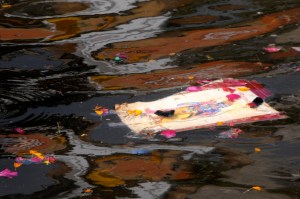
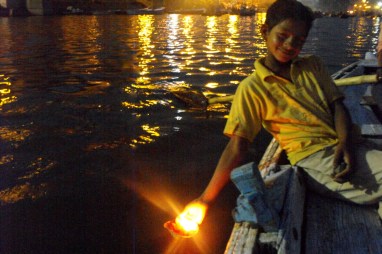
 Rakesh grew weary of fishing for customers, his line coming up empty each time. It was getting dark now, and the lights along the ghats were beginning to glimmer as the winter sun dimmed. Rakesh rowed his boat towards the eastern bank, as he always did this time of the evening, right after the Ganga Aarti ceremony at Dashashwamedh Ghat. He pulled his black woolen scarf more tightly around his head as the fog began to thicken, settling on the water like a last breath. By the time he had reached the middle, the fog was so thick he could see no more than a couple of yards all ahead. The water around his boat shone a slippery black, but just by his left oar, a small area the size of his sneaker glowed with a vivid white radiance. At first glance he thought it must be a flower candle, one of dozens set on the Ganga after sunset by pilgrims and tourists (and some a mixture of both). Rakesh loved to watch them, after those who lit them had made their wishes and moved on, bobbing on the river’s undulating skin, a mirror universe of fallen stars.

But it wasn’t a flower candle. It was not a reflection on the surface even. It was something emanating from below. Rakesh leaned over the side, straining his eyes to try to understand what he was seeing. What could it be? When he ran his fingers across the surface the light parted into ripples. When he withdrew his hand the light merged again at the same spot. He shivered a little and thought about home, of warming his hands at the kitchen fire where Ma was waiting for his return. But how could he leave without finding out what it was? He took off his clothes fast, and dived in.

stoneRakesh had bathed in the Ganga over a thousand times, but when he opened his eyes under the water, it occurred to him that he had never done so before. There was nothing before him but a murky blackness, and a sudden breathless panic gripped his chest. He was about to return to the surface, when he saw it. Shimmering just below him. He mustered up some courage and swam down towards it. His hands make contact with the riverbed, soft with sediment, and then, something smooth and round and cool slipped into his palm, as if propelled by its own motion. He shot back up, bursting through the water with a huge exhale and clambered over the side of the boat. He sat and stared at the thing in his hands. It felt like marble, was the shape of a ripe fig, and the size of a two rupee coin. And the colour….not white exactly, but as if all colour had blended into it. The light it gave off was so strong, that when he closed his small hand around it, his fingers became outlined with the red glow of his blood. Rakesh got dressed, wrapped the stone carefully into his headscarf, and hurried home.

As soon as he entered the house, Ma’s scolding was upon him, but he didn’t mind. He made fast work of his sabji and rice; Ma in her shrill hurried voice telling about the call from his elder brother, and the hardships of driving produce trucks across the Punjab to New Delhi. She spoke, as she always did, of how much she missed his father, who had found moksha at the cremation ground just two months back after a long illness, and how much harder everyone had to work now that he was gone. Rakesh was only twelve, but had been taking tourists on the Ganga for two full years. The whole world came to Varanasi, it seemed. Many Indians still called it Benares, after the British who couldn’t pronounce all four syllables correctly. But Rakesh preferred the older name; the one his grandfather always used. Kashi, the ‘luminous city’. The Japanese came in droves to Varanasi but were the worst tippers. Americans were scarce, but tipped the best. But the best money to be made was from the South Indians who came in hordes during the holy months to bathe away their sins.
wishMa sent him to bed early without any TV as a punishment for being late, but it was exactly what he wanted. He waited and waited, until he could make out the soft kitten purr that was the sound of his mother’s sleep. Only then did he dare to take out the bundled scarf from his jacket pocket and unwrap it under the blanket. It shone like a full moon against the black wool. Moments of light, like miniature lightening strikes, danced across the surface. He closed his fingers around it, watching his blood light up between his fingers. He sensed a pulse run up his arm and fill his chest with a gently exhilarating power. He wrapped it up again and returned it to his jacket pocket. When he woke up the next morning Rakesh felt as if the world was waiting at his feet.

He took the stone to work with him the next morning, and kept it in his pocket. He didn’t look at it once, he didn’t dare, in case someone saw it; a customer or worse, one of the other boatmen. They were all older than him, and would surely take it from him. But he felt it, pulsing from inside his pocket. He caught five customers that day, which was four more than usual. It’s bringing me luck, this stone, he thought.

That night, Ma was cursing when he returned, but not at him. The electricity was out again, and she couldn’t get the kerosene lamp to stay lit. She said she’d been trying for ten minutes.
“Look. It lights but goes out right away.”
“Let me try,” said Rakesh. He struck a match and held it against the wick. It bloomed into flame and lit up Ma’s gentle smile as he replaced the glass shade.
“It hasn’t gone out,” she said in amazement.

Rakesh took out the money he’d earned that day and placed it in front of her.
“You’re a lucky one,” she laughed. “I’ll make you special sabji for dinner, with extra aloo, the way you like.”
She called him ten minutes later to help her light the fire.
“So funny,” she said. “With me it refuses to stay lit.”
oarThe days and nights passed, and they all brought good things his way. He caught many customers, who treated him kindly and tipped well. He held the notes to his forehead in gratitude to the gods, and in the evening time, he crossed the Ganga, moored his boat on the eastern bank, and walked the half mile to his village, where he proudly offered the money to Ma, who hugged him tightly and put extra aloo in his dinner. But she started to rely on him to light the lamps and the fire because whenever she tried to do these things, the flames just sputtered for a moment and then went out.

After seven days, Rakesh had earned more than he usually did in a whole month.
“We’re not getting any customers these days,” his fellow boatmen complained. “This shrimp is catching them all.”
When he caught himself in the mirror, he liked what he saw. He flipped up his jacket collar and smoothed down his curly black hair with his right palm. On Saturday, he hurried home early to help Ma with the fire. It seemed to him that she was very tired these days. He found her lying on her mat, a cold sweat on her forehead. He took out the seven one hundred rupee notes he had made that day and pressed them into her hand.
“Fortune is shining on you,” she said, her eyes dull with fatigue.

When Ma was asleep, Rakesh pulled out the stone from his jacket pocket, as he had become accustomed to doing every night, and crawled under the blanket to gaze at it. His dark eyes filled with delight in its luminous beauty. Ever since he had found the stone he had felt special and large, not ordinary and small. But his feelings were mixed. He didn’t seem able to share his good fortune. He was constantly anxious that someone might discover it and take it from him. A large portion of his earnings went to a series of doctors, who came to the house, took Ma’s pulse and listened to her heart, prescribed small pills and wrote large bills. None of them seemed to know what was wrong with her.

boat sunAs usual Rakesh got up two hours before dawn and rowed across the river to Meer Ghat, where he sat on the boat waiting for the tourists to trickle sleepily out of their guesthouses so they could experience sunrise on India’s most sacred river. He gazed into the calm water, his mind filled with turmoil. He tried to recite the long Hanuman mantra that his father had taught him for when he found himself in trouble, but he could recall less than half. The stone felt like it was burning a hole in his pocket with this secret that burned in his heart. Offerings of marigolds and books filled with purifying mantras in red ink floated past. I must seek the advice of Guru ji, he thought at last. Guru ji was the family guru. He meditated all the time in a small khaddi tent on the eastern bank near Ram Nagar, the dilapidated fort and home to the last King of Kashi until his death a few years back.

“Acha, a mani stone, said Guru ji, turning the stone over in his delicate hands. “These are very rare. How did you come by it?”
Rakesh told him the story.
“Acha, but this is stolen property.”
“I didn’t steal it,” retorted Rakesh indignantly. “I found it.”
“Found it, did you? Ha! Do you have any idea what to do with it?”
Rakesh admitted that he did not.
“A thousand years is just the beginning. You must go into the forest this full moon from the south side. There you will meet the ones who know.”
It was five days until the next full moon, and they passed slowly. Ma became weaker, and Rakesh stopped working the boats to look after her. He lit all the lamps and fires in the house and cooked for the both of them. The night of the full moon, after dinner, he made up an excuse to leave the house. Ma nodded weakly.

At the tree line on the southern edge, Rakesh hesitated to go further. An even older name for Varanasi, his grandfather had told him, was Ananda Bund, Joyful Forest. But he always avoided this place, home to all his village fears. Robbers who slit your throat for five rupees, lonely spirits who pick your heart clean, and fat-fingered flesh-eating demons. The trees shut out the moonlight, and Rakesh turned on the flashlight on his mobile phone. Guru ji hadn’t told him how deep in to go, so he kept on walking. After a few minutes, he heard something that sounded like a baby’s cough. A short soft hagggghk! that came from up ahead.

He continued to the edge of a small clearing filled with moonlight. What he saw there made him dip behind the trunk of a tree in fright. Seven cobras the length of rowing oars were gathered in a circle. Black and shiny as wet buffalo. The one nearest to him made the hagggghk sound and spat a glowing object onto the earth where five others already lay. It was a stone exactly like his. Rakesh felt a stab of pain in his chest. He’d believed his stone to be one of a kind, something meant only for him. But here were six of them, all the same, all radiating with the same inner fire.

As if it had sensed his agitation, the cobra froze upright and rotated its head in his direction. Its eyes were orange as cremation.
“Come out from there,” it hissed.
Rakesh stepped to the side of the tree trunk but didn’t move forward. He pulled the stone from his pocket and held it out in the middle of his palm.
“Ah yessssss. So young,” said the snake.
The others nodded their heads slightly as if in agreement.
“He hasssss the sssssseventh sssssstone,” said the orange-eyed snake, though his mouth didn’t move at all while he spoke, and the other snakes all hissed in unison, so loudly that Rakesh had to cover his ears.
“Sssssso young,” said one.

Then each snake took up a stone into its mouth and slithered in the direction of the river. All except one, that dipped its head and brushed Rakesh’s trouser legs as it passed.
Rakesh kept his distance, but didn’t lose sight of them, the stones giving off enough light to for him to follow easily. When they reached the water’s edge, the cobras reared up as if preparing to strike, and the stones in their mouths seemed to shine more brightly. There was a sound like the dipping of an oar, and a woman emerged from the river and moved to the shore as if carried on a tide.

She was dressed in a long white sari. Her thick black hair trailed behind her and disappeared into the water, dripping with water droplets shiny as jewels. Her eyes were slightly downward cast, her nose sloped gently, a silver ring nested in one nostril. Her lips were wet and the palest of pinks like the clouds of Kashi moments before dawn. She stretched out her arms and cupped her hands, whereupon each cobra lowered its head and placed its stone gently inside. When all six stones were in her hands, the woman turned ever so slightly in the direction of Rakesh. He couldn’t seem to look at her for more than a second at a time. The stone began to get hot in his hand until he could barely hold onto it any longer. The orange-eyed snake nodded, and he knew what he had to do. He made a few shaky steps forward and awkwardly placed his stone along with the rest. As he did so, an enormous wave of relief washed over him and he almost fell to the ground.

“Go home,” said the woman, resting her gaze upon him with eyes deep as Arabian wells. “Your mother is feeling better now. She has lit the lamps, and she is waiting.”

Posted in Kashi, Moving on.... | Tagged , , , , , , , , , , , , , , , | 4 Comments

Fire on the water, Christmas on the Ganga

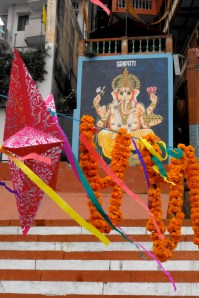
ganpatiRakesh found some tape from somewhere, and we set about decorating the boat. We hung coloured streamers and strings of marigolds from wire stretched across bamboo poles, finished off with a pink and silver paper star.

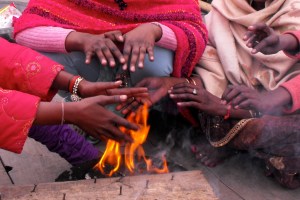
Huddled in our coats and scarfs, we ploughed through the chilly fog to Assi Ghat. There we picked up eight oven-baked pizzas and set off again downstream, stopping for a few minutes to collect the chocolate cake that we’d ordered from the German Bakery. Sunita, her mother and two sisters, warmed their hands over the fire that Sunil had built. I love fires on boats. They give off a kind of magical danger. A large boat filled with Asian Buddhists trundled past, surrounded by four smaller boats, floating shops brimming with trinkets and souvenirs like the pilot fish that clean the sharks.

hands fireWe moored up while Sunita’s and her family went to visit some relatives. Nothing stays a secret for long in Varanasi, and word had got out along the ghats that there was something very precious on our boat–chocolate. Soon we were surrounded by little kids shouting, “Chocolate madam! Chocolate madam!” and occasionally, “Madam, chocolate!”  I cut up the rest of the cake and placed a piece into each tiny hand.
“Merry Christmas!” they shouted as one, when we pulled out into the river again. “Merry Christmas!” we shouted back. Merry Christmas indeed.

Posted in Kashi, Rose Apple Island | Tagged , , , , , , , , , , , | Leave a comment

At the end of the world we are all Delhites

xmas

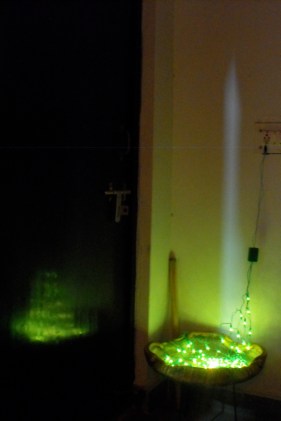
My xmas lights in a bird bath because trees are hard to come by….


The end of the world is nigh and it’s starting in New Delhi. How do I know this? I have incontrovertible evidence. I paid 250 INR for Christmas lights – a shocking price even by ‘Second Coming’ standards. I rode in an auto rickshaw, one smog-ridden breath away from total anarchy, resisted only by the flimsiest memory of civility. My balaclavad driver (or was it a head injury?) honked and screamed with apparent total hatred for his fellow man.

There were little children hold tiny signs reading, ‘Asthma is my birthright’ and the man chanting tonight’s Tuesday puja has to interrupt his conversation with God, to stop and cough every minute, for which I pray, God pardons him.

These days, evening in Delhi falls under a dying, not a setting, sun. Everything about this city is apocalyptic. Which is perhaps why it’s hard to leave it, even though you hate it with a hatred that makes you boil and scream like a denizen. Vegetable wallahs on their morning rounds, shout “The end of the world is nigh!” in Hindi. I’m designing travel brochures that read: Come to New Delhi. Repent for your sins.

For the past three nights, someone has been letting off fireworks from the roof of a nearby apartment building that sounds decidedly not life-enhancing. More like the heralding of the Antichrist. Thunderbolts erupt from unknown sources, inter-smacked with low-flying airline traffic, and no one thinks it’s strange, but me.

Today was the first foggy day of the year, but it was hard to distinguish the fog from the fumes that have engulfed my neighbourhood in the past couple of days. An inordinate amount of construction that a number of us suspect to be illegal (since much of it happens at late hours) sounds like the Devils Workshop through woofers. Pneumatic drills and explosions of dubious origin ring through the night, while the citizen’s dreams, their only escape, are fractured and disturbed.

privilege

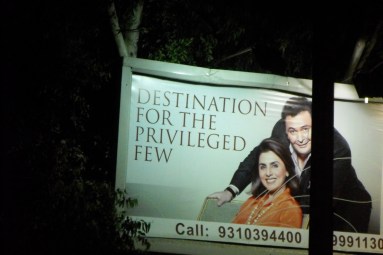
Billboard in New Delhi doesn’t mince words

Outside my local convenience store is a cement mixer the size of a humpbacked whale. It has almost completely blocked the entrance to the shop. All of the shop owner’s goods are covered with a thick layer of cement dust, including himself and his mother. And all of this they take with incredibly good grace, even though late night construction is illegal without a permit. They just assume the building owner has paid off the local police. There is even a saying that’s got around for the poor blighters who try to complain to the MCD (Municipal Corporation of Delhi) – a spin on ‘the buck stops here’. It goes: ‘The complaint stops here, but keep passing the buck (under the table)’.

Because I have little better to do, and the end of the world is upon us anyway, I visited the MCD complaints board website: the Elephant’s Graveyard of  building complaints. You imagine these poor blighters actually believing there is a living breathing soul who checks this webpage and/or gives a damn.

Your necessary action is requested again and again

I invite your kind attention to copy of my letter dated 16/11/2009…

I have complaining so many times before but they reacting like a deaf and taking a lightly of this matter and construction is in a full swing going on…

I have complained again & again about illegal construction…

Sir,
There are large scale violations by the builder mafia in constructions of buildings...

Whether it’s the building mafia or Western-consumerist colonialism; someone must be to blame. So we keep screaming at one another at intersections, because the small infractions seem manageable. Something that a shout across tarmac might be able to fix. At least, at an intersection we can look one another in the eye. While the good citizens of New Delhi keep writing to their municipal authorities, because they have to keep believing that someone out there actually cares.

This sign off from one of the countless letters to the Municipal Corporation of Delhi, is the clue to it all. That, at the end of the world, we are all Delhites.

Warm Regard,
Suffered people

Oh, and merry Christmas one and all….

Posted in epoche, Rose Apple Island | Tagged , , , , , , , , , , | 3 Comments

The quick and easy way to learn Hindi

The following is an excerpt from the Quick and Easy Way to Learn Hindi
by PT. Aditya Nand. Do let me know if you find it useful.

Man:         Where is Daisy?
Woman:    I don’t know
Man:        You’re her mum and you don’t know?
Woman:    You mean I should keep on guarding her?
Man:        But you must not set her free
Woman:    Should I keep her in a cage?
Man:        Will you let flirt around then?
Woman:    What has bitten you today?
Man:        Snake has bitten me
Woman:    It looks like that
Man:        I’ll strangle her today
Woman:    But why?
Man:        She has brought me blame

Woman:    Blame? How?
Man:        She has conceived
Woman:    Who told you?
Man:        My doctor friend
Woman:    And how could he know?
Man:        She had gone to him
Woman:    For what?
Man:        For medicine for getting abortion
Woman:    No matter
Man:        My reputation is at stake and no harm?
Woman:    Everything will come round. Don’t worry at trifles.
Man:        All this is trifle?
Woman:    Yes, in these days.

Posted in epoche, Rose Apple Island | Tagged , , , , , , | Leave a comment

This explains everything…

Photo: Wen Yan King

Why some people love India…
Because when you’re on your way to a meeting, the taxi driver stops at a temple half way up a hill, parks two inches from a thousand foot drop, disappears for ten minutes, and upon his return, cheerfully explains that he had to offer a cup of milk to the god Shiva.

Why some people hate India…
Because when you’re on your way to a meeting, the taxi driver stops at a temple half way up a hill, parks two inches from a thousand foot drop, disappears for ten minutes, and upon his return, cheerfully explains that he had to offer a cup of milk to the god Shiva.

Posted in epoche, Rose Apple Island | Tagged , , , , , , , , | Leave a comment

Shopping in India: where change must come from within

It took me a while to find the right coffee mug. You know, the one that feels right and has handles made for humans over six. Now, which to choose? The teddy bear holding a rose and champagne bottle or the Dalmation smoking a pipe? I settle on the Dalmation and place it on the counter.
“180 rupees,” says the store-keeper.
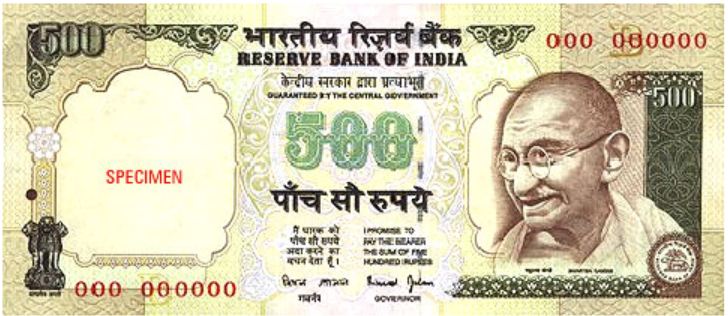
I run a quick-search of my wallet, then with an inward sigh, I offer across a 500 rupee note. He eyeballs me furtively.
“You don’t have… change?”
“Sorry, I don’t.”
My words bounce off the musty walls with an echo of sinister laughter.
No change?! No change?!
The pause that follows sucks all the air out of the room. I see his right hand slide under the counter while my neck muscles tighten. On the wall behind, a strip of multi-coloured lights begin to flash and play the theme to Hawaii Five-O. Somehow I manage to shake myself free from its hypnotic effect and make a dash for it. But the shop door swings closed before I can reach it, and bolts automatically three times. Bdang! Bdang! Bdang! A black cord telephone rings once. The shopkeeper lifts the receiver to his ear, keeping me locked in his dispassionate gaze.
“We have one. Yes….yes….don’t worry. She’s not going anywhere.”

don’t leave home with one

Okay, so maybe I exaggerate. What actually happens is this….
“You don’t have change?”
“Sorry, no change.”
“Raju!”
A boy aged between 10 and 12 appears from nowhere. The store-keeper hands him the 500 rupee note with directions in Hindi that I translate as follows:
“This foreigner has come to our country without the correct change. Run to Chandigarh and fetch the amount of 20 rupees from one of the merchants. May the god be with you.”

I figure I have quite a bit of time to kill since Chandigarh is in the Punjab, so I mozy on back to the coffee mug section, pondering the vast mystery that rivals the search for dark matter in the universe. Where is all the change?

I mull it down to three possibilities:

1. The machine that prints the smaller denominations broke down and no one knows how to fix it.
2. The machine that prints the smaller denominations broke down and nobody cares.
3. The estimated INR 70,00000 crore of India’s ‘black money’ in Swiss bank accounts is all made up of 10, 20 and 50 rupee notes.

Today, I’m in a moderately-sized hill station town in Himachal Pradesh, but just a few days before I’d been in the country’s sprawling capital–New Delhi. The Gaddi hill people are known for their endurance, but I’m skeptical that little Raju is up to his mission for another reason. You see, I’d had a very similar exchange with a sweet-faced cashier in a gourmet (see’ overpriced’) Delhi grocery. Let’s pick it up where she was looking at me apologetically, and saying, “Ma’am, I’m very sorry, but we don’t have change.”
Why wasn’t I moving? Why wasn’t I saying, “Okay, never mind then,” like I had nine hundred and eighty-two times before, and sensibly returning my HobNobs back to the shelf next to the seashell chocolates? All I knew was: I just couldn’t bear it any longer.
“But why don’t you have change? You’re running a business.”
Blank look.
“Where people buy things.”
Another blank look.
“With money!”
I realize I’m stretching.
“But we have no change, ma’am. And the bank is closed.”
Oh no. She mentioned the bank! Stop it now, Rebecca. Turn back while there’s still time!
“But the bank was open this morning, right?”
“Yes, ma’am.”
Foolish woman. Pray desist before it’s too late.
“So, why didn’t you get change then?”
“I think this is a question for the manager. Shall I call him?”
This dark-eyed maiden has proven a worthy adversary. The customer behind me is slapping her left palm with the end of her baguette in a menacing fashion. With the little sense I have left I accept defeat and put back the HobNobs.

So now in the village ‘Coffee Mug & Everything’ shop, I wish little Raju god-speed and count my blessings that I hadn’t tried to pay with a 1,000 rupee note, (which no doubt would have required an overnight train to Mumbai). For those who come after me, I say, asking questions like where is the change? will only serve to addle the brain and hold up queues. Instead, I suggest you turn your attention to issues of lesser complexity. Ones that will keep you under the radar of local authorities and not annoy your Indian friends; that will break down cultural barriers and bring smiles of recognition to all parties. I offer as one humble example the following globally acceptable conundrum: should I have chosen the champagne carrying bear mug, after all?

NOTE: Thanks, Caroline, for the title idea!

Posted in epoche, Rose Apple Island | Tagged , , , , , , , , , , | 4 Comments

Bodhgaya: don’t need a full moon for crazy

Even a full moon looks dusty in Bodhgaya. Beneath it’s grubby glow, a group of high-spirited Indian youths hijack a merry-go-round in a fair that’s closed for the night. One of them mounts a plastic baby goat while the others push him round and round, squealing with delight.

A small boy wears the cardboard box of an electric heater as a hat and stares into an open fire through a jagged peephole.

A man crawls along the road, his limbs twisted into a permanent gymnastic trick, and is barely missed by the wheels of an auto rickshaw. A trio of Indians are jamming on the street. One was playing a large skin drum, another was blowing a conch, while his friend was performing a kind of nihilistic Indian rap.

I will steal the smile from your face…only sorrow will exist, no joy, no happiness, no laughter…..”

The conch player noticed me standing there, and staggered over to tell me that he was stoned on hash and had “never experienced love”. Would I like to play the conch with him? Much as I was tempted to blow a grubby seashell with a sex-starved wasted Indian stranger, I thanked him and told him I was retiring for the night.

I was making my way back to the Chinese monastery where I was staying in my usual brisk don’t-mess-with-me fashion–head down, scarf across nose, hands firmly in pockets. I had almost made it, when there came a hearty “Hello!” and I knew it was aimed at me in the way that you do. A young dark-skinned beggar was walking towards me. Well, walking is the wrong word. Manoeuvuring would be better. He was handicapped in such a way that he could only move in a crouch, with his knees up around his ears. He had his right hand outstretched towards me, but not in a begging way. He wanted to shake my hand. I took it, a bit confused.
“Don’t you remember me?”
“Er…”
“Dharamsala…I know you. I’m Ahmey.”
“Oh, right. Hi.”
He did look familiar. After the relentless surreality of Bodhgaya,  I was only mildly amazed to be recognized by a beggar 800 miles away.
“How are you sister?”
“Well, to be honest, Ahmey, I’m very tired.”
“You’re tired, sister?”
“Yes, Ahmey. I am.”
Ahmey looks up at me from his frog crouch with an enormous grin.
“Shall I give you a massage?”

I hurry into the courtyard of the Chinese temple, past a robed monk standing over the fire from a giant wok, chanting in a monotone and ringing a hand bell like the dinner call for the dead.

In Bodhgaya, you don’t need a full moon for crazy…..

Posted in Navel of the World, Rose Apple Island | Tagged , , , , , , , , , , | Leave a comment

Double-sided drum

This morning my bicycle rickshaw passed a goat dressed in a turquoise sweater. “Perfectly natural,” said Alice, “since it is rather chilly.”

These days, a damp, bone-chilling fog fills Bodhgaya in the early hours, burns off for a few hours in the afternoon, and returns around dinner time. We’re now in the middle of the Nyingma monlam. A monlam is a massive days-long Tibetan prayer festival. In Tibet, there was only one a year, dominated by followers of the Gelug school (fair enough since they started it). But in exile, each school now sponsors its own, bringing it’s own unique flavour to the proceedings. In Bodhgaya the monlams have taken on the  feeling of a Buddhist Woodstock.

The Kagyu Monlam is eco-friendly and super-organized, largely due to the huge number of Asians that are devotees of the Karmapa, the spiritual head of the largest Kagyu sub-school. It even has its own logo that’s printed on badges, bags and tee-shirts, and usherettes in nifty uniforms. The Gelug monlam, dominated by the monks from the three uber-monasteries of Gaden, Drepung and Sera, was a model of efficiency–over in two days flat. But the Nyingma monlam is the daddy of them all.

Photo: Wen Yan King

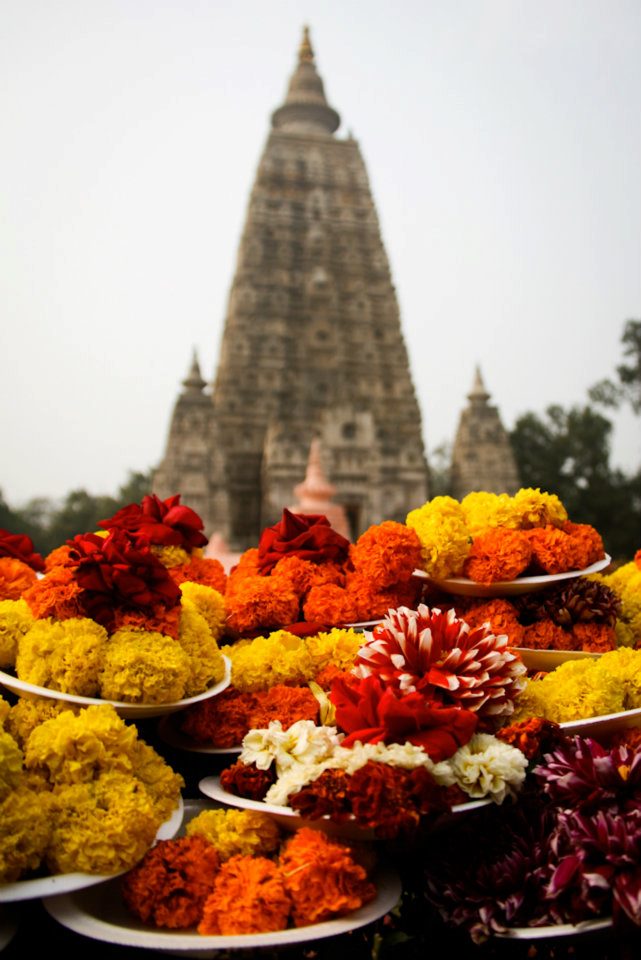
The oldest school of Tibetan Buddhism, it brings together large numbers of yogis who look like they’ve descended from the earth’s remotist outposts. Long matted hair, cross-legged in grubby robes, they mutter over ritual items fashioned from human bone among the dwarf village of stone shrines. The shrines are bedecked with orange and yellow marigolds, some in intricate patterns like mandalas. The air is laden with the sounds of soft hand clapping, mantras, hand bells and a constant swoosh swoosh swoosh of sandals on stone, as hundreds of people circumambulate the temple. At least four different Hindi film songs are blaring from different parts of town. There’s a strong smell of incense and rose petals.

I sit behind the temple of the Unwinking Gaze over-looking a round stone table about 12 feet in diameter decorated with a mandala made out of carefully placed plastic cups and marigolds, with an outer ring of ruby rose petals. Around this dozens of monks and old women perform full length prostrations on wooden boards using what look like oven mitts to protect their hands from splinters. They seem to have limitless energy and I never see one of them stop for more than a moment to wipe their brow.

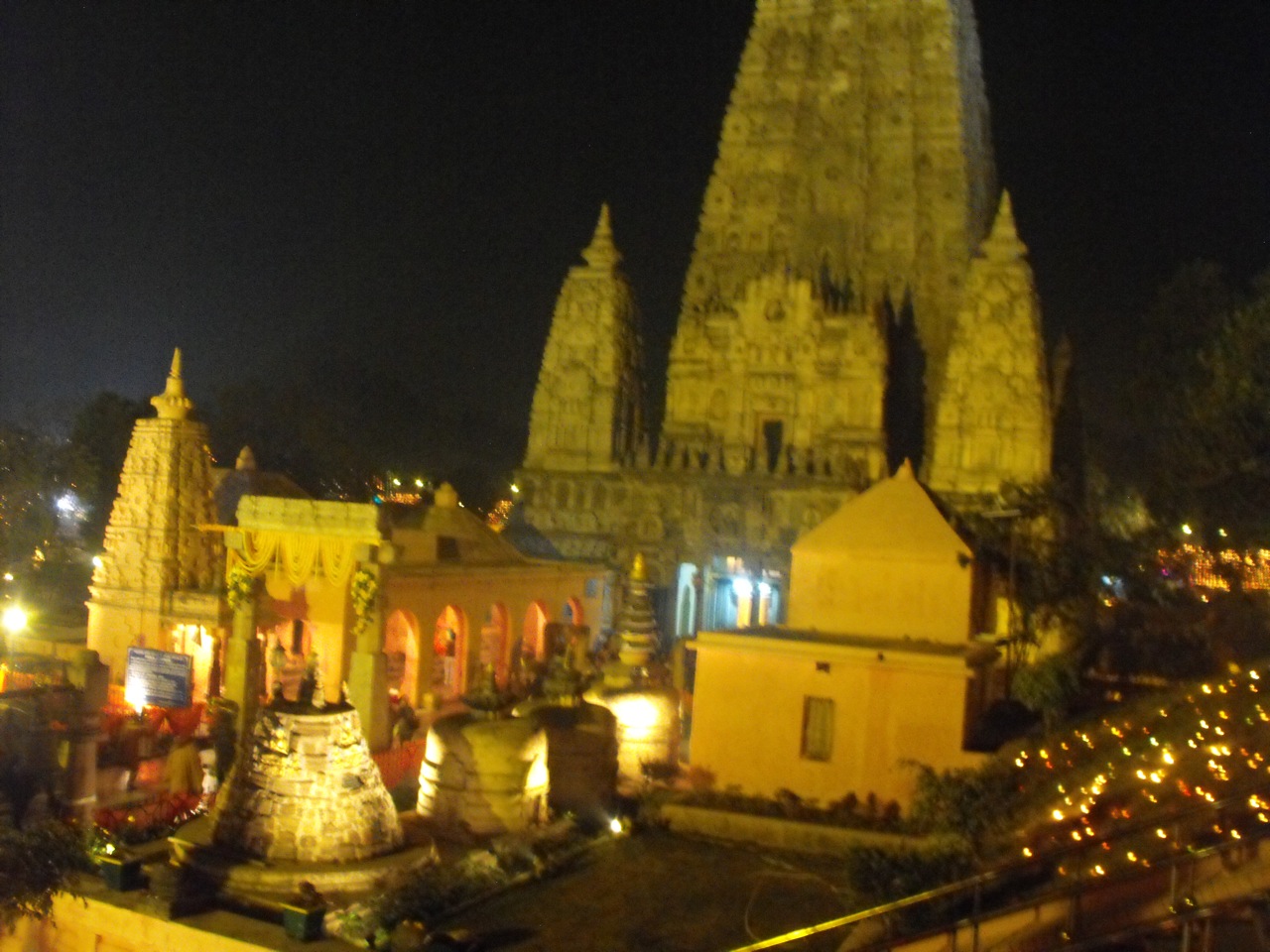
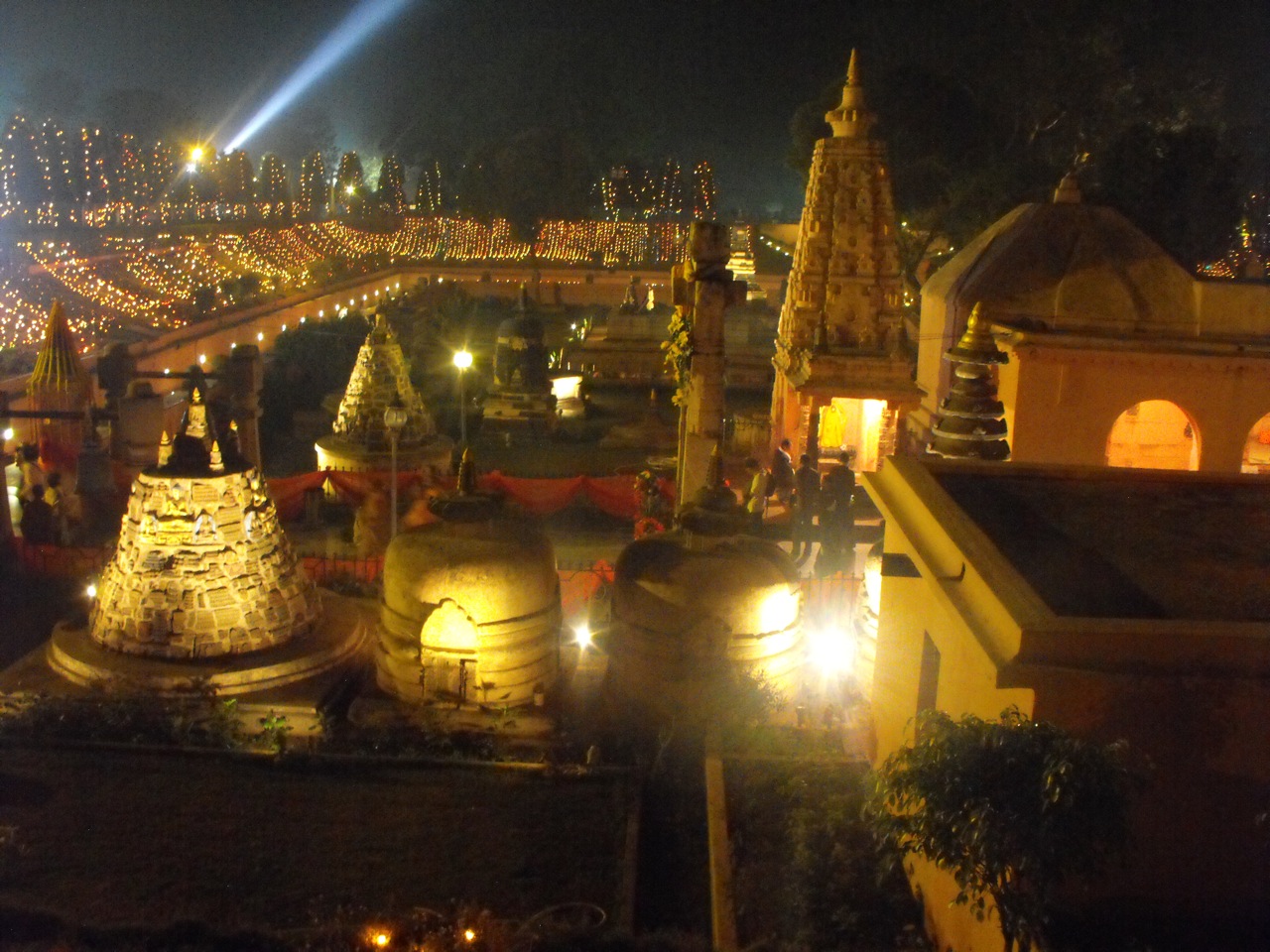
Every opportunity to lay a string of lights had been seized brought to illuminating fruition. Candles are everywhere, as are thousands of tiny water and flower offerings in glass and metal bowls. The Mahabodhi temple is lit by two huge spotlights, shooting up into the sky, like an ancient dormant spacecraft. Indian groundskeepers are engaged in the precarious job of climbing up 15 feet of wall unaided by ladders, and placing necklaces of marigolds around the necks of all the statues surrounding the temple. And everything is playing out through a layer of fog that certainly doesn’t hurt the mystical ambiance.

Photo: Wen Yan King

The Nyingma Monlam officially ends in the afternoon, when large numbers of (mostly young) maroon-clad monks burst into the streets and leap into auto rickshaws, 12 at a time. (I saw one plucky little auto rickshaw with 14 monks hanging on the outside and 12 inside). But in the evenings, the temple grounds are still filled with tireless monks performing full body prostrations on wooden boards, and the white-eyed dread-locked yogis. In front of me a monk plays an enormous damaru, a double-sided drum that represents the co-existence of conventional and ultimately reality, with both sides struck simultaneously by two tiny balls on the end of strings.

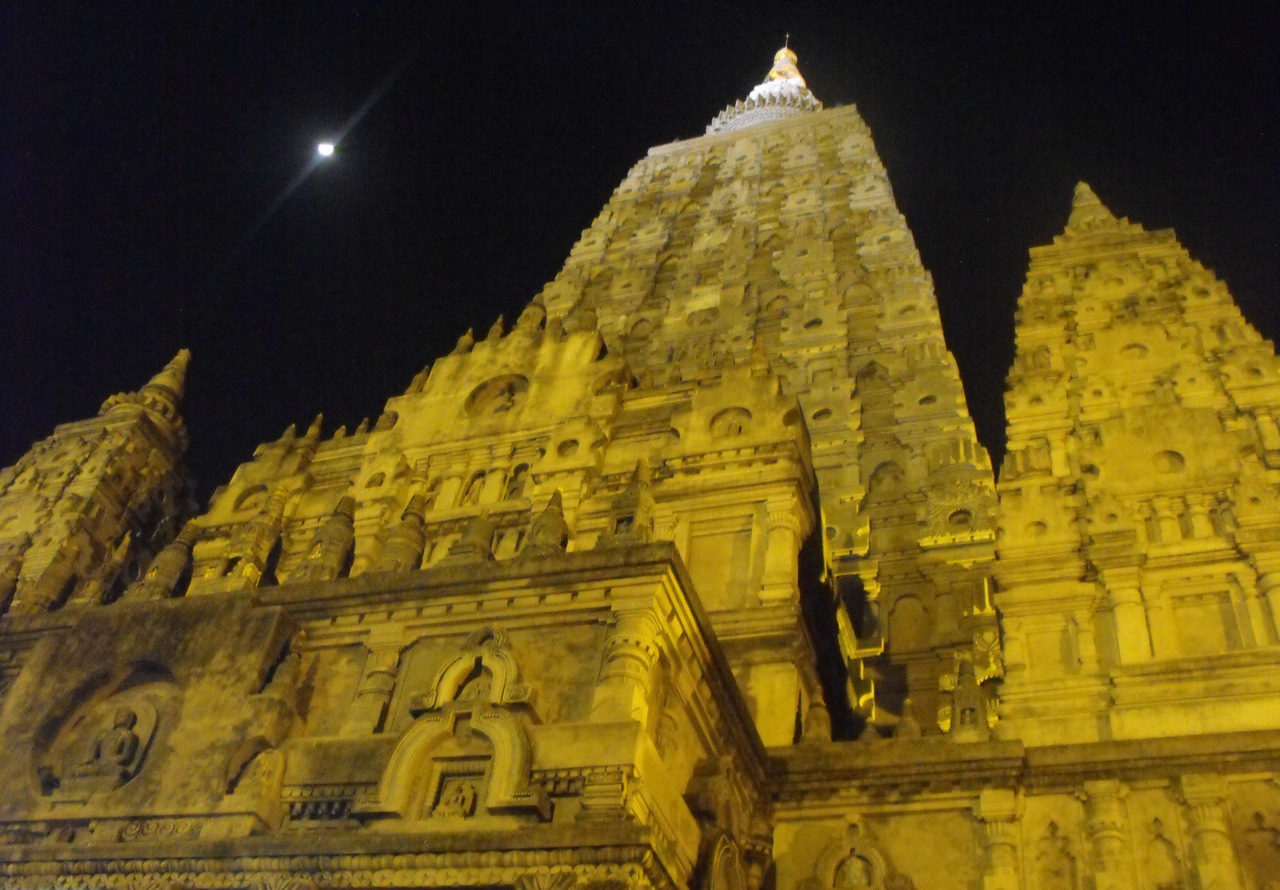
The 150 foot tall Mahabodhi stupa rises above us all, etched in stone reliefs like pieces of a puzzle from an alien civilization. In my travel-weary gaze, I imagine that the entire structure is on the verge of re-arranging itself like some antediluvian Rubik’s Cube, to send a space-time-continnuum-ripping beam to its distant creators somewhere deep in the belly of the lonely night sky.

My reverie is disturbed by the nudge of an aged Tibetan monk in a woolly hat. He peers at me, eyes twinkling. I sense the promise of some about-to-be-imparted wisdom. “Can I leave my backpack with you?” he says. “I need to go and check my email.”

Posted in Moving on...., Rose Apple Island | Tagged , , , , , , , , , , , , , , | Leave a comment