“Anything else, madam?”
“I’ll have….erm, chocolate ice cream.”
“Sorry, madam, chocolate ice cream finished.”
“Okay. Then I’ll have….vanilla.”
“Oh, sorry. Vanilla also finished.”
“Hmmm. Alright. Do you have toffee ice cream?”
“No, madam.”
There was only one more flavour on the menu. Strawberry. The next question, it would naturally seem, was ‘Do you have any strawberry ice cream?’ But I was starting to understand that I was not in a world where my natural reason applied. I had an epiphany which informed many of my interactions in India from that point on.
“Do you have any ice cream?”
“No, madam. We do not.”
I left without dessert, but with another piece of the code.
The waiter brought her a second mango juice.
“Oh, that’s okay thanks. I only wanted one.”
“If you sit ten minutes more you can have this one too.”
“You mean, I can’t drink it now?”
“Just ten minutes more.”
“So, I can drink it now, but I would need to stay here for ten minutes after I drink it?”
“Sit now, then after ten minutes drinking.”
She didn’t really want to sit another ten minutes before or after the juice, which she also didn’t want. She was ready to leave, but she couldn’t. Because it was starting to get interesting.
“How about I sit for five minutes, then drink the juice, then sit five more minutes. Would that be okay?”
He thought for a moment, glanced over at the manager standing at the counter, then turned back, looked at her very precisely, and gave a flash of white smile.
“You can stay as long as you like, madam. Enjoy your juice.”
Twice I’ve tried to write about Varanasi. The first time my notebook mysteriously disappeared from my hotel room in Pahar Ganj, New Delhi. The next time, I dropped it in the Ganges. Varanasi is like that. Resists anything that tries to hold on. The burning ghats are always burning, whether you see them or not.
The first time I was there was in the winter of 2010. It was cold, with a damp fog that hung over the Ganga like a flattened ghost. I was permanently wrapped in a white woolen shawl. I wasn’t into talking much at the time. And I wasn’t interested in ticking off the local sights. I didn’t even have a camera. My boatman, Sunil, seemed to sense my mood, and he rowed in silence. I had asked him to take me on the river, and that’s what he did. We went first to Assi Ghat. I don’t remember why, exactly, perhaps a bookshop I had heard of. When we moored the boat, a puja began clanging away from a nearby temple. Pujas are the soundtrack of Varanasi.
“This city is constantly at prayer,” I said, half to myself.
“Yes, madam,” said my boatman. “We never let God sleep. In fact, we don’t even let him take a nap.”
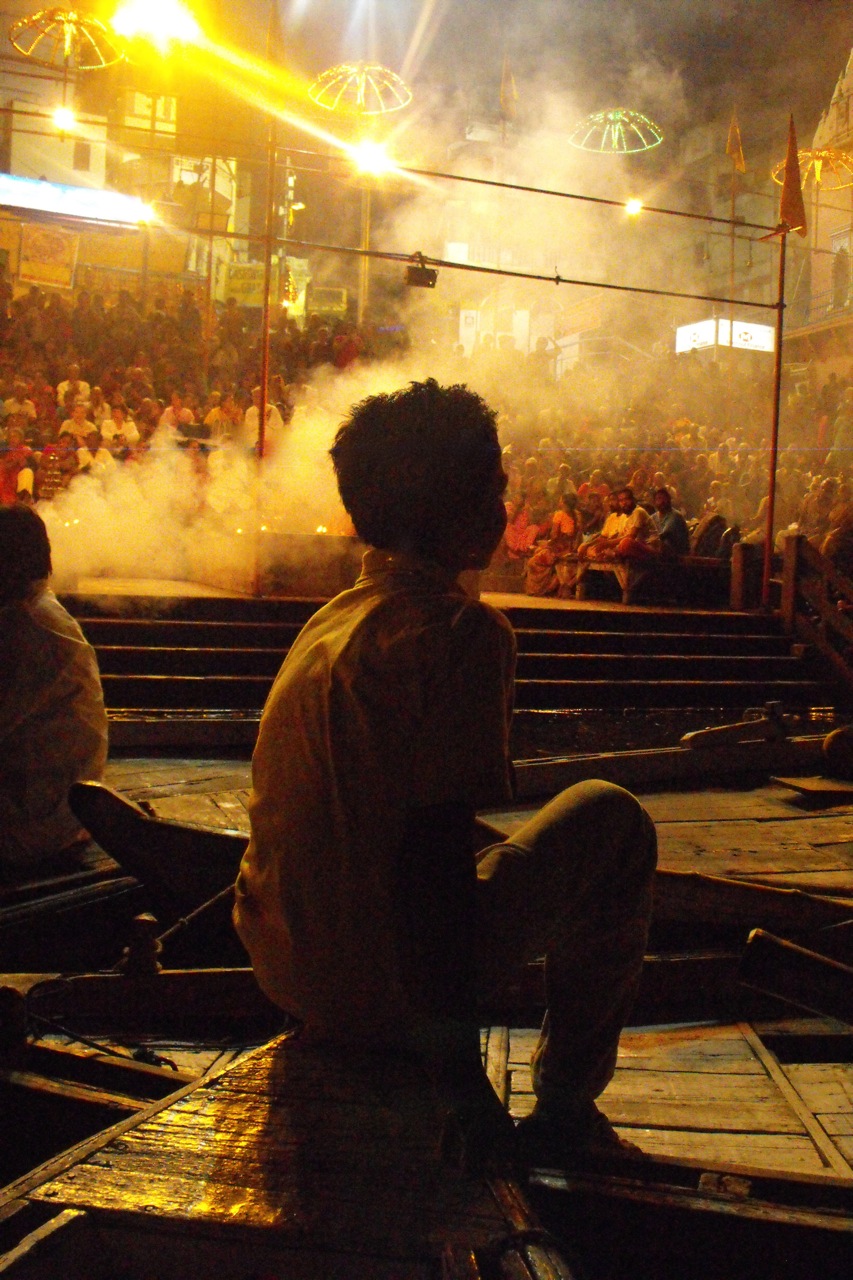
It was such a charming remark, and it brought my attention to him properly for the first time. His name, I found out, was Sunil. After some hours, when the sun had set, we ended up at the burning ghats. We stayed bobbing a few hundred yards from the bank, further out than the other tourist boats. I’m sure he was used to foreigners wanting to get up close, but this was close enough for me. Not for any fear of death, but out of respect for the living.
I stared into the pyres, that people say have kept burning for millennia. The way the river carries sound, the crackling of wood and bone mixed with the soft lapping of water against the hull. I stared into those fires, like a soul transfixed. And I envied them. The burning ones. Being so nobly and mindfully sent on their way from this world.
“We have a saying around here,” said Sunil.
“Burning is learning. Cremation is education.”
He lit a cigarette and offered it to me.
We were friends after that.
The first Indian wedding that I was actually invited to, perfectly fit my friend’s description. A ‘Big Fat Punjabi Wedding’. He was an uncle of the bride but he felt uncomfortable the whole evening, embarrassed by the lavishness and vast expense. I, on the other hand, was having a grand time.
The wedding ground was like the size of a football pitch and was decorated in so much pink, that all the photos look, well, pink. Even the faces. There were two jumbo screens so the 500 plus guests didn’t have to miss any of the action. There was a full bar with the best brands in wine and spirits. The food tent contained tables laid out with various dishes from every state in India, which were repeated on the opposite side of the tent. That’s right. Dishes from every state in India. Twice. Then if that wasn’t enough there was also an table for Italian, Chinese, a salad fountain, a gelato stand, and a giant snack sculpture, made largely of imported cheese that nobody touched except a 5 year old boy who plundered the cheddar squares throughout the evening.
Later the bridge and groom, looking like bejeweled royalty, posed for photos on the stage. Yes, stage.
I was happily sucking down my third Mojito and digging into a food plate from Andhra Pradesh, when Amar’s wife, a child rights activist, rushed up to me with a look that did not bode well for my plans for dessert. She asked me to take a photo of the kids holding up the lanterns outside the wedding ground, lighting the way for the groom’s arrival on his traditional white horse. At the time I took it, I was sure the photo wouldn’t come out. His face was so dark and the lantern so bright and my camera skills so naff. But it did. This little boy was one of about half a dozen who had stood holding these heavy lanterns for hours, perfectly invisible it seemed to any of the guests.
Don’t want to bum anyone out but there’s a darker side to the shocking pink of Indian weddings.
The metro spat me out at an obscure badly lit stop on the red line named Tiz Hazari. It’s named after one of the largest district courts in Asia. The Tiz Hazari Court complex boasts 400 courtrooms and a staggering 50,000 visitors a day.
I’d been told on the phone by Vikas Travels that the bus to Jodhpur left from behind it (or “backside” as they say, which still makes me giggle), so I made my way around the imposing colony of buildings, passed rows of 4 by 4 feet stalls, each with a single wooden bench opposite a desk and chair, above which hung signs that read things like ‘PV Singh. Advocate.’
On exiting the “backside” gate of the court grounds, I found myself in a murky puddled street cluttered with bicycle rickshaws and a few dingy storefronts selling mostly kaney (chewing tobacco), gum and cigarettes. I didn’t have an address, just a rough location the agent had given me – “backside courthouse”. I called the number and had one of those baffling conversations that you begin to get used to in India after a while.
“I’m at the backside of the courthouse. Where are you?”
“Come office.”
“Yes, but where is office?”
“Backside courthouse.”
“Yes, I’m backside courthouse. Do I go left or right?”
“Do you have ticket?”
“Yes, I have ticket.”
consults with someone, then comes back on the phone.
“Office. Office!
“Yes, but where are you exactly?”
click
I was standing outside a petrol station mulling over whether to go left or right. A black sedan churned up a spray of mud onto my trouser legs. I went right. After a few yards, I spotted the Vikas Travels sign on the opposite side of a crossroads, where a bus was being loaded with luggage. Things were looking up. ‘Office’ was a bit of a stretch. Beneath the sign, an open storefront and formica lift-up counter, behind which two men were noisily conducting business. They looked surprised to see me. I confirmed my ticket and took in my surroundings.
It was a street cum freight yard illuminated only by an intermittent bare bulb. I’d got there early on purpose as I didn’t know the area and wanted to be sure of the pick up point before my bus arrived. I’d imagined relaxing with a book and a cappuccino while I waited. There was nowhere to sit, the light was too dim to read by anyway, and there wasn’t a café or restaurant in sight. The bus being loaded in front of me had most of its rear windows blown out. The body was scarred with dents and scrapes. I remembered what the nice-sounding manager of my hotel in Jodhpur had said after asking me which travel agent I’d booked with.
“Rajastani tourism is notorious. I would strongly advise you, take the government Volvo bus instead.”
“But Vikas Travels say their buses are deluxe.”
“Madam,” he’d replied with an audible sigh. “They can say whatever they want.”
All around me, men in dark balaclavas and headscarves were pushing or pulling wooden carts through the streets, stacking up boxes and bulky burlap parcels. At first, they were too busy to notice me. But after the bus pulled out of the yard, fifty or so men stopped what they were doing, turned towards me – and stared. It was like I’d disturbed a colony of meerkats. Sex-starved meerkats!
Now, I’ve lived in India for five years. I’m used to attention. In Varanasi even septagenarian western women get propositioned. But this was different. Rationally, I knew I wasn’t in any immediate danger but my security felt precarious all the same. I looked down at the puddle by my feet, cursing my whiteness, sweaty hands clenched inside my pockets, my whole body crawling with that special vulnerability that only women can feel and only men can create.
I got on the phone and called a friend. “I’m not in a great location. Can you just talk to me for a while? I want to look busy.” He knew me well enough to get that I wasn’t being nervous for no reason and obliged by chatting about his ride on the metro. But the connection broke after only a few minutes. “Sorry” he texted, “went into a tunnel”.
There wasn’t a female in sight. I went to buy some chips, not because I was hungry, but just to move out of staring range. And there I saw one, behind the counter. A woman. She was brusque, squat-faced and short-tempered but to me she was a goddess. I wondered how much I’d have to pay her to come to Rajasthan with me. Returning to the bus, I found a place in the shadows, pulling my coat up around my ears, and trying not to make eye contact with anyone. In the dimness a pair of trousered legs stuck out from under a jumble of sacks a few inches away. “Oh my God,” I thought, “someone has died here and no one has even noticed!” I tried to untangle what I was actually seeing from my fears of the same. The torso was missing. The legs ended at the hips. A severed body? The escalation of my horror gave way to relief followed by a shadow of amusement when I comprehended that I was looking at the lower half of a manikin.
I called an Indian friend and tried to explain what was going on.
“I know it sounds stupid, but I’m having one of the most uncomfortable evenings of my life.”
“Where are you exactly?”
“Behind Tiz Hazare courthouse.”
“Just call me when you get on the bus.”
Clearly, there was something he wasn’t telling me.
“Wait. What? What’s going on?”
“If I tell you now it won’t help. Call me when you’re on the bus. Don’t worry, you’ll be fine. But don’t talk to anyone.”
Fifteen minutes later, my bus arrived. It looked quite a few notches down from deluxe but at least all the windows were in tact. I huddled into my seat next to the window. The seat adjustment lever didn’t work and the curtain was stuck and wouldn’t draw, but I didn’t care. Two or three women also boarded. I felt like kissing their feet. When we pulled out onto the main Delhi streets I called up my friend again.
“So?”
“The place you were…”
“Yeah?”
“It’s a well-known red light district. The only women who go there are prostitutes.” A mobile phone from the seat behind me began playing Santa Claus is Coming to Town.
“Get some sleep, Rebecca,” he said. “It’s going to be a long journey.”
Looking for a place to live in any city on a tight budget is usually tough, but doing it in Delhi can really kick the spit out of you with a steel-toed boot.
After a morning of peering into the dank and dripping concrete warrens that litter Delhi’s backstreets, I was a walking sigh. Shabbily constructed, rapidly decomposing, cramped, cold, grease-stained walls like archeological sites of dinners past, leases signed in desperate necessity or existential fatalism under the sullen light of fluorescent bulbs.
It was December and the current occupiers wore woolen hats and scarves in their living rooms. Christmas Day 2011 was colder in Delhi than in London. A grubby pollution-sucking Jack the Ripper fog sneaks into the bones, pricks the eyes and clenches the chest. Hurtling through this substance in an auto rickshaw at night, the driver bunched inside ear mufflers and headscarf, is like a journey in an apocalyptic cataract-lit dream.
Sharma, my broker, looked genuinely puzzled when I turned down the plywood bed and scratched plastic table set that came with the rent. “I’ve shown her all I have,” he complained to my Hindi speaking friend. “What does she want?” My progressive seasoned traveler image melted into fussy Memsahib throwback.
I didn’t think I was asking much. A window that looked out onto something other than a brick wall 3 feet from the glass, a window with glass IN it, a fan, a shower (not just a tap), and a decent landlord who would allow me to install an AC when the temperatures get above 39 degrees. I wasn’t even asking for a geyser (what Indians endearingly call water heaters).
When I found a place that met one or two of my requirements (accommodating landlord and….erm, maybe that was it) I signed the agreement (under the sullen light). I’d found an apartment around the corner that was under construction and planned to move there on March 1st. My temporary place was set to be demolished in a month, so my landlord was keen to rent it and get an unexpected installment as it’s hard to find tenants for such a short stay. I was there for 6 weeks in the end, during which time I got a head cold followed by a viral infection, fought off light deprivation induced depression, was evicted by the police and forced to leave the city (and then invited back), and (unknowingly) spent one of the most uncomfortable evenings of my life waiting for a bus at a well-known prostitute pickup point. But all this another time….
Because I have moved and it’s a miracle. Never mind all the things that have gone wrong or weren’t done right in the first place, or are bound to go wrong in the future. I have a balcony. I have windows with actual daylight that comes through them. I have a shower. Oh, and stowaways.
In my last place, I’d noticed a bunch of small cockroaches scurrying around, but didn’t think much about it, since there didn’t seem too many of them, plus I had just re-viewed Wall-E with its animated plucky cockroach character. When I set up the kitchen in my new place, there they were again. I knew there hadn’t been cockroaches when I first moved in. I’d checked. They must have stowed away in something during the move. But what? I spent yesterday evening on my hands and knees on the kitchen floor, catching them and throwing them onto the leaves of the neem tree that (gratefully) grows up to my balcony. I got pretty good at it too. But I couldn’t figure out where they were all coming from. I’d noticed that they liked to hide under the electric kettle, and recalled finding the odd roach floating in my hot chocolate. I inspected the base (the part that you attach the kettle to) and noticed 3 small slits on the underside. A tiny pair of feelers waved at me from one of them.
I took the base outside and began to shake it, and one by one, cockroaches galore fell out. I looked more closely at the electric kettle base. It looked almost identical to the cockroach traps you can buy in the US that let the cockroaches in but not out (don’t ask me how it works). They call them Cockroach Hotels (They can check out any time they like, but….”) It dawned on me that my electric kettle had been an actual cockroach hotel. I felt a small pang of regret that I’d shown them the door so unceremoniously. But I got over it.
Where are you exactly?”
“Mahabalipuram.”
“What?”
“Mahabalipuram.”
“I’ll never be able to say that.”
“Mahabalipuram!”
I was bellowing this down the phone when I realized this place really suits an exclamation point. Said loudly and with enough vavoom, it carries like a victory cry. Later, I learned that Mahabalibpuram—an appealing and intriguing little beach town just one hour drive south of Chennai in the East Indian state of Tamilnadu—is believed to be named for a 6th century Pallava king known as the ‘Mahabali’ or ‘great wrestler’ after his people’s favourite sport. Following his conquest, the Pallava dynasty ruled unchallenged in Southern India for four hundred years. “Mahabalipuram!” you can imagine his soldiers shout in triumph.
As early as the 4st century CE, Mahabalipuram was said to have been a vibrant port city. An 8th century text describes ships “bent to the point of breaking, laden as they were with wealth, big trunked elephants and gems of nine varieties in heaps”. A hub of the international spice trade, the town enjoyed regular visits from Roman, Persian and Chinese merchants, checking out the latest deals on big-trunked elephants no doubt.
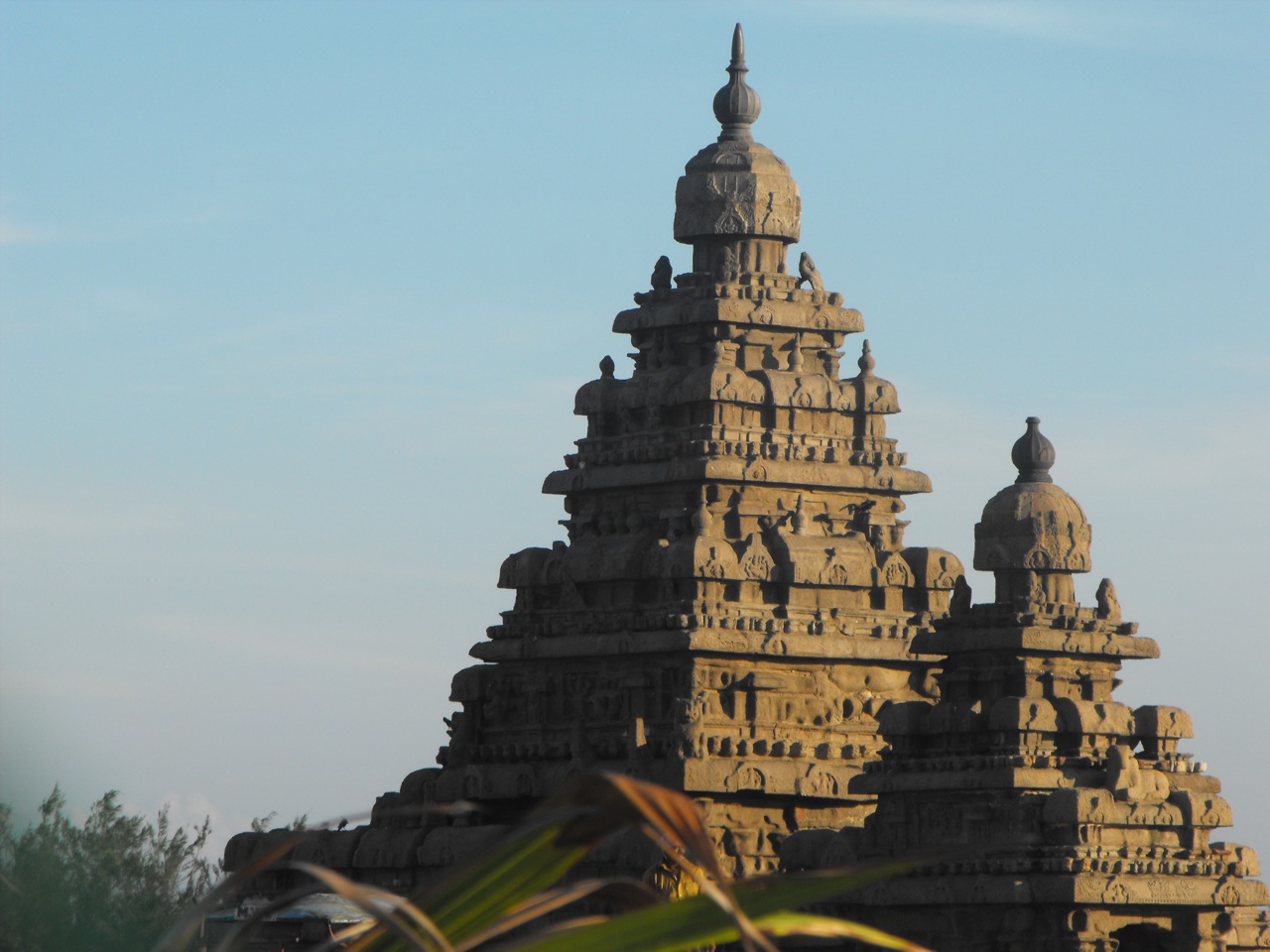
The beautiful and mysterious ‘Shore Temple’. There are legends of 6 more just like it under the sea….
These days no sailing ships stud the horizon, but Mahabalipuram! has a lot to offer the 21st century visitor, including some of the most exquisite stone reliefs India, rumors of ancient submarine temples, and one of the most hilarious opportunities to rack up your 15 minutes of fame.
“Do you want to be in a movie?”
I was with my friend Carey, sauntering down a street lined with Kashmiris offering lazily hopeful invitations into their stores of paisley silk shawls and the ubiquitous ‘baggy pants’ that Indians have decided is the height of haut couture for Westerners. The morning sun was dealing out another glorious cloudless day. The question came from a portly friendly-faced Indian man. Used to saying “No thanks” to almost every question put before us, “You want shawl? You want see inside my shop? You want guidebook/postcards/grass? we were temporarily lost for words.
colorful bags of rice in shop in Mahabaliupuram…
“What kind of movie?” I asked, imagining the worst.
“Action romance. We need foreign voices,” he said, like a man on a deadline.
I can’t remember if we were on our way to cappuccinos and chocolate croissants or back from cappuccinos and chocolate croissants. It had been a stressful few months in the cold smog and hustle of Dehli and in the gentler, cleaner and politer South we had fallen into an epicurean routine of walks on the beach, glasses of bootleg Bordeaux in rooftop restaurants (smuggled up in night trucks from Pondicherry where alcohol is tax free) and the (very) occasional visit to a cyber café.
“We’ll pay you 700 rupees each.”
$14 for a day’s work. We looked at each other and shrugged. Why not?
We were told to wait at a guesthouse while our guide assembled the rest of his foreigner quota. We were not the likeliest bunch and it was hard to imagine what other circumstances other than a shipwreck or plane crash would have brought us together. A tall whippet-thin Dutch entrepreneur of dubious wealth; a dread-locked German beauty with the fashion style of a prehistoric slave girl; a quiet first-time-in-India French guy in baggy pants; a Brit who had by his own admission had “chucked in everything–job, girlfriend, the works” to go and see the world (he’d just returned from the Andaman Islands) and us—an American writer and a Canadian computer engineer.
We were all ushered into a jeep and driven to Chennai, the French guy nervously chain-smoking joints the whole way. The studio building was rather shabby, but the recording rooms were state of the art. We were told to wait with no other instruction than not to smoke in the building. The trailer being cut in the adjacent studio sounded promising, with a melodramatic James Bond meets The Omen soundtrack.
A polite tired looking producer entered the hallway from the sound studio and told us that the name of the movie was a Cassanova. Well, actually it was Cassanovva, with two v’s, I guess to distinguish it on Google search from the one spelled properly. One thing I knew about South Indian cinema is that whereas the female stars are Vogue cover lovely, the male stars all pretty much look the same; chubby-cheeked and middle-aged with a generous moustache and a more than generous girth. (In fact, in South India, for men over “a certain age” the moustache is compulsory). This movie’s star, Mohahlal, was no exception. The poster shows him beckoning from the wheel of his sports car – moustache in especially inviting form – with the tag line “Come….fall in love!”
The trailer says it all.
The film was in Malayalam, that claims the largest number of letters of all Indian languages and seems to use them all at once with so many ‘l’s that it sounds almost liquid. Our job was to provide inane (and to us, unlikely) background chatter. For example, if the scene was set in a restaurant, we were told to talk about the menu. “I’m not sure if I want the salad or french fried. Do you think I’m getting fat?” If it was set in a hotel lobby we were instructed to talk about our rooms, “How’s your shower pressure? Mine’s awesome.” You get the idea.
Two men in the control room offered occasional pointers from behind a glass window to a big, energetic producer called Matthew who was consistently referred to as “fat boy” by the other two – without a hint of insult given or taken from either side. Carey gave a very believable performance as a BBC anchorman, and my star-turn was cooing over the male lead while he handed out ice cream to a group of adoring beauties. “You always know my favourite flavour, Casanovva.” Initially reserved, we soon warmed up and did our best work during a police tear gas scene where we stumbled around the room coughing and spluttering out things like, “Jenny, grab my hand!” and “I can’t see. I can’t seeeee!!”
We’d been told they’d have us back in Mahabalipuram by 7:30 that evening. Actually, it was midnight. The Dutch guy proudly negotiated an extra 200 rupees for each of us.
Don’t tell the guy with the moustache, but I would have done it for free.
Not that I’m in the habit of wishing anyone Happy Easter, let alone a belated one. It’s just that I have to share a text I received on Easter from an Indian acquaintance of mine. My phone, which I reluctantly bought after my loyal Nokia finally gave up the ghost, has a very limited space for text messages so I’m about to delete it, but I can’t without sharing it with you. But first, I’d like to take this opportunity to bitch about my phone. It’s called ‘Spice’ which I dislike with an intensity unbecoming to a Buddhist. It also switches itself off at a whim and plays crap Indian disco tunes whenever it gets bored. (Indian disco makes Saturday Night Fever seem like Mozart).
Nokia. Aged 7 RIP
Apparently, Spice got bored in the toilet at a roadside cafe between Agra and the ancient Mughal fort at Fatehpur Sikri. At first I thought the noise was coming from a speaker hidden in the plumbing, and toyed with the idea that the cafe manager had turned on the music to entertain me while I peed. But nope, it was my phone (which does have a great speaker system I must admit) pumping out ‘I wanna make love nah nah nah nah‘ at an excrutiating pitch (plus it’s an excrutiating song). I guess it was getting tired of all the history tours, kind of like having Paris Hilton on holiday in your handbag.
Also, some time just before the Global Buddhist Congregation, my call tone mysteriously switched from a pumping Maharastra fishing song about all the ways you can prepare fish (“You can fry it. You can boil it. You can bake it” etc, which my Indian friends thought highly amusing for a vegetarian), performed by what sounded like a hundred baritones going ‘Holi! Holi! Holi! Matchadee! Matchadee! Matchadee!‘ to a gentle song-prayer dedicated to the monkey god, Hanuman.
Initially peeved (I loved my fishing song), one of the GBC delegates informed me very sincerely that this was an auspicious sign as the lyrics of the Hanuman song spoke of being protected by higher powers. I needed all the higher powers I could get at the time.
Which brings me back to Easter and the text message. It went: HAPPY EASTER. GOD BLESS YOU AND MAY HIS SACRIFICE FOR YOU BECOME A REALITY.
This is a religious country and they take this stuff seriously. I didn’t want to tell her that most people aren’t meditating on God’s sacrifice at Easter. They usually just give each other chocolate eggs (if they’re lucky).
But Easter is about resurrection, isn’t it? And we all need a little cosmic renewal now and then.
There were 30,000 weddings on a single day in Delhi last week. Many of them, it seemed, took place right outside my apartment. Now, when I say ‘weddings’, I don’t mean a sedate spiritual affair where the couple tip toe around hot coals and have lovely, calm, gift-offering ceremonies. I mean the wedding reception where everyone gets drunk and plays unbelievably loud Indian pop music out of sub- standard speakers well into the night. “Got any Chris de Burgh?” I feel like screaming.
But there is no such thing as a slow dance in India. If I could do an audio transfer of what it sounds like in my bedroom right now, you’d probably ask one of two questions. How can you stand it? or Why don’t you go down and join them? The answer to the first question is, I sometimes wonder. I’ll address the second question with the following–an article in the Times of India that I’m expecting to read tomorrow morning.
AMERICAN WOMAN CRASHES WEDDING: ‘UNHAPPY’ COUPLE MAKE FORMAL COMPLAINT TO EMBASSY
An American woman invited herself to a wedding reception in Katwaria Sarai on Friday, locals reported. “She wasn’t hard to spot,” said Sanjay Das, a 28 year old fitness trainer, “she was pretty white.” The woman, who is yet to be named by police, apparently lives in the neighborhood. “She drank all the Kingfisher Ultra” complained Nitin, a cousin of the groom. “We’d reserved that for our VVIP guests.” But having a few drinks uninvited at the party wasn’t the problem. It was when she started dancing that the guests got peeved. “It was not good,” says Dipti, the unhappy bride. “She had no rhythm at all. It made me feel queasy just watching her.” Sandeep, her new hubby agrees. “At first I thought she was a nice lady. She even offered to take over from the DJ who had mysteriously disappeared. But then she began throwing pakoras at the music speakers. My grandmother had made those with her own hands from an old family recipe. We were completely bamboozled.” The unnamed woman was not available for comment. “We’re taking this case seriously” SP officer Jaswant Singh told TOI. “We have 5 million more weddings in the capital in the next month alone. We have to be vigilant about this kind of infiltration by foreigners.”
Chiranjeevi in his box-office hit, ‘Gharana Modugu’
For some reason best known to Airtel I get daily SMS updates about the South Indian film actor, Chiranjeevi, who you might know by his more popular name, ‘Megastar’. He went into politics a few years back, forming his own party, Praja Rajyam, in Andhra Pradesh and was elected to the State Assembly. I used to get updates about his political career, things like: Praja Rajyam’s launch in Tirupathi was largest gathering in India’s political history with over 30 lakh people attending (a doubtful claim) and His party won 18 MLA seats with 18% vote share until the Praja Rajyam merged with Congress in August.
Clearly, this was not as exciting a move as it sounded, since my updates abruptly changed from breathless messages about his political successes to things like Chiranjeevi’s favourite god is Hanuman and Chiranjeevi is 5 foot 9 inches tall.
Now it’s hard to presume to understand the yearnings and whimsies of someone who you only know through one sentence text messages from their PR agency, but I was getting the sneaking feeling that Megastar was getting disillusioned with political life. Occasionally, I would get tit bits about his promised ‘150th film’, that seemed to hint at a career still unfulfilled, even though 150 films is a lot by any standard (14 of them broke box office records and ran for over 100 days). He’s even starred in a film called ‘Chiranjeevi’.
Then I began getting these….
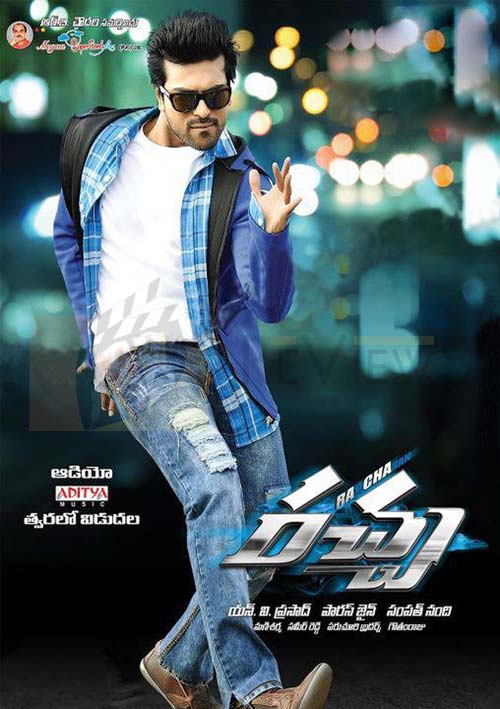
Chiranjeevi’s son, Ram Charan Teja, in the poster for the hit movie ‘Rachcha’
On March 25th: The remix of Vana vana Velluvaye from Chiru’s 1991 blockbuster, Gang Leader, is one of the highlights of Ram Charan Tejas’s upcoming film Rachcha.
Ram Charan is Chiranjeevi’s son. Rachcha was released by Megaa (yes, two ‘a’s) Super Good Films – I’m really not kidding – in India on April 5th. It broke the record for the best box office opening in the Teluga film industry.
On March 26th: Watching him onscreen was like watching myself all over again in a younger avatar. Charan has done an even better job of dancing in Rachcha.
Hmmm. Do I detect a touch of nostalgia for the buzz and excitement of the film industry after the drudgery and disappointment of national politics? I can imagine Chiranjeevi sitting in his private movie theater, stroking his moustache as his ‘younger avatar’ grinds and bumps to a remix of a song from one of the biggest films of his heyday. Did it, perhaps, take him back to his own blockbuster, Gharana Modugu, the first Teluga film to gross over 100 million rupees that shot him to mega-stardom in 1992?
And this on April 5th. Taking a cue from his contemporary’s book, the superstar Rajinikanth, our megastar is toying with the idea of doing a film in Kochadaiyan style.
Okay, putting aside that I have no idea what ‘Kochaidaiyan style’ is, (though I do like the way they slipped in ‘megastar’ to subtly up-stage the ‘superstar’ status of his ‘contemporary’) I’m really began thinking Chiru’s going to go back into film. I could feel it. He’s had it with politics. He wants to step into his megastar shoes again. He’s been fighting the desire to grab Sonia Gandhi by the hand and do THIS on the floor of the Rajya Sabha.
But then I thought, perhaps I’m reading too much into this?
Today I got the message: Chiranjeevei has reportedly approached Congress head Sonia Gandhi and sought permission to return to acting.
I think he might have heard me — somewhere in that mysterious mobile microwave interzone.
And then, this: Chiru recently obtained permission from his party bosses to act in films yet again.
(though this message I received on May 5th, got me a bit worried he might get carried away: Congress leaders have advised Chiru to choose themes which have a message for the audience in the hope that he might one day emerge as their Messiah.)
Here he is performing his highly popular version of Michael Jackson’s Thriller. Come back to the silver screen Chiru! The world should not be deprived of your Megastarness any longer. And whoever says a 150th film is overkill should just shut up.

 “Anything else, madam?”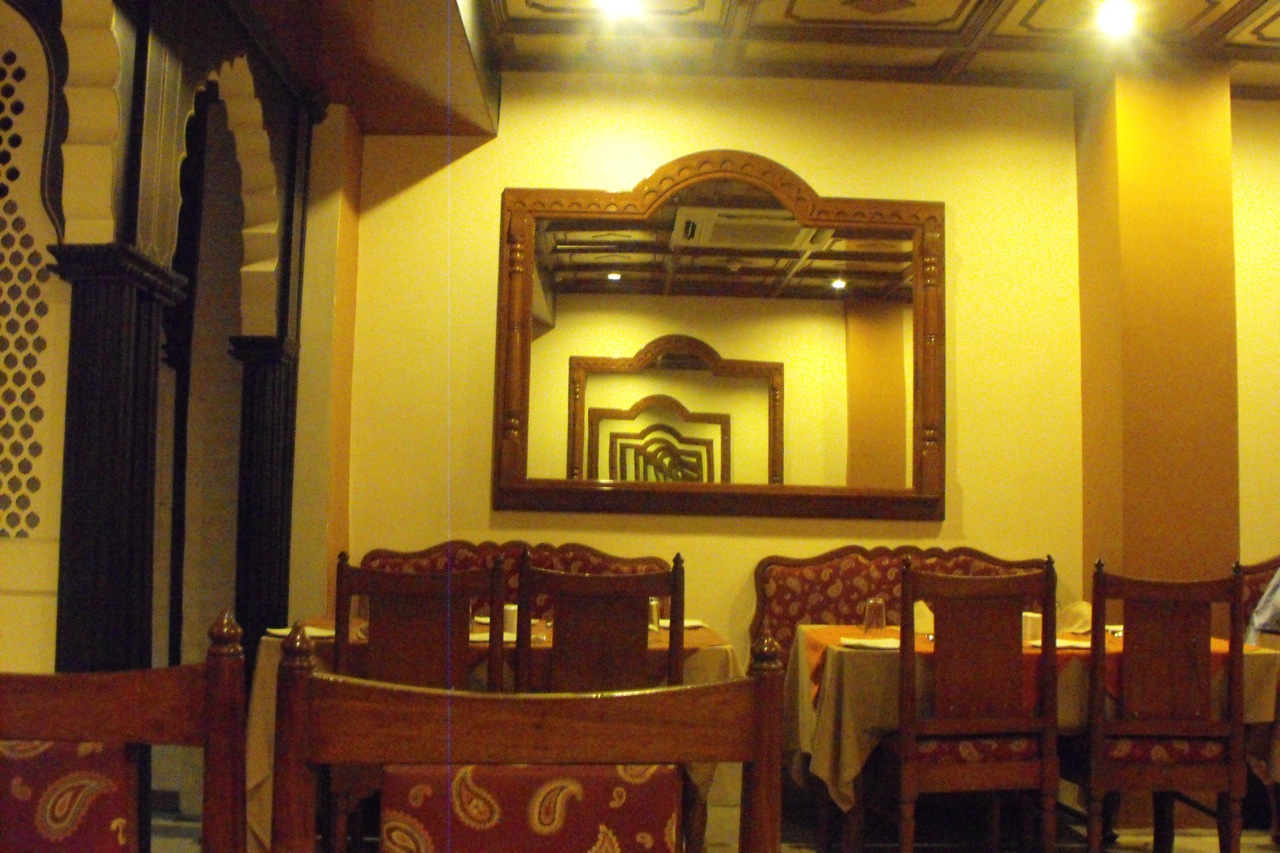





 subincontinentia